
Which Smart Air Quality Monitors Detect a Dust Storm?
Dust storms are PM10 events, but many Matter- and HomeKit-connected monitors don't report PM10 at all, so a hub-first pick can stay green through a haboob while an accuracy-first pick may never trigger your purifier. This status-labeled device × ecosystem matrix shows which monitors can actually detect a dust event and which integrate with your existing hub before you buy.
Last updated
A smart air quality monitor for dust storm use has one job before it has any smart-home job: it has to see the dust. In the Southwest, the failure case is not theoretical. A haboob can arrive as a PM10-heavy wall of dust, with reported walls reaching up to 8,000 feet and moving around 40 mph in the Davis Instruments overview of dust-storm monitoring risk.[1] If the monitor on the shelf only reports PM2.5, the tile in your home app can look calm while the coarse-particle event you bought it for is already outside.
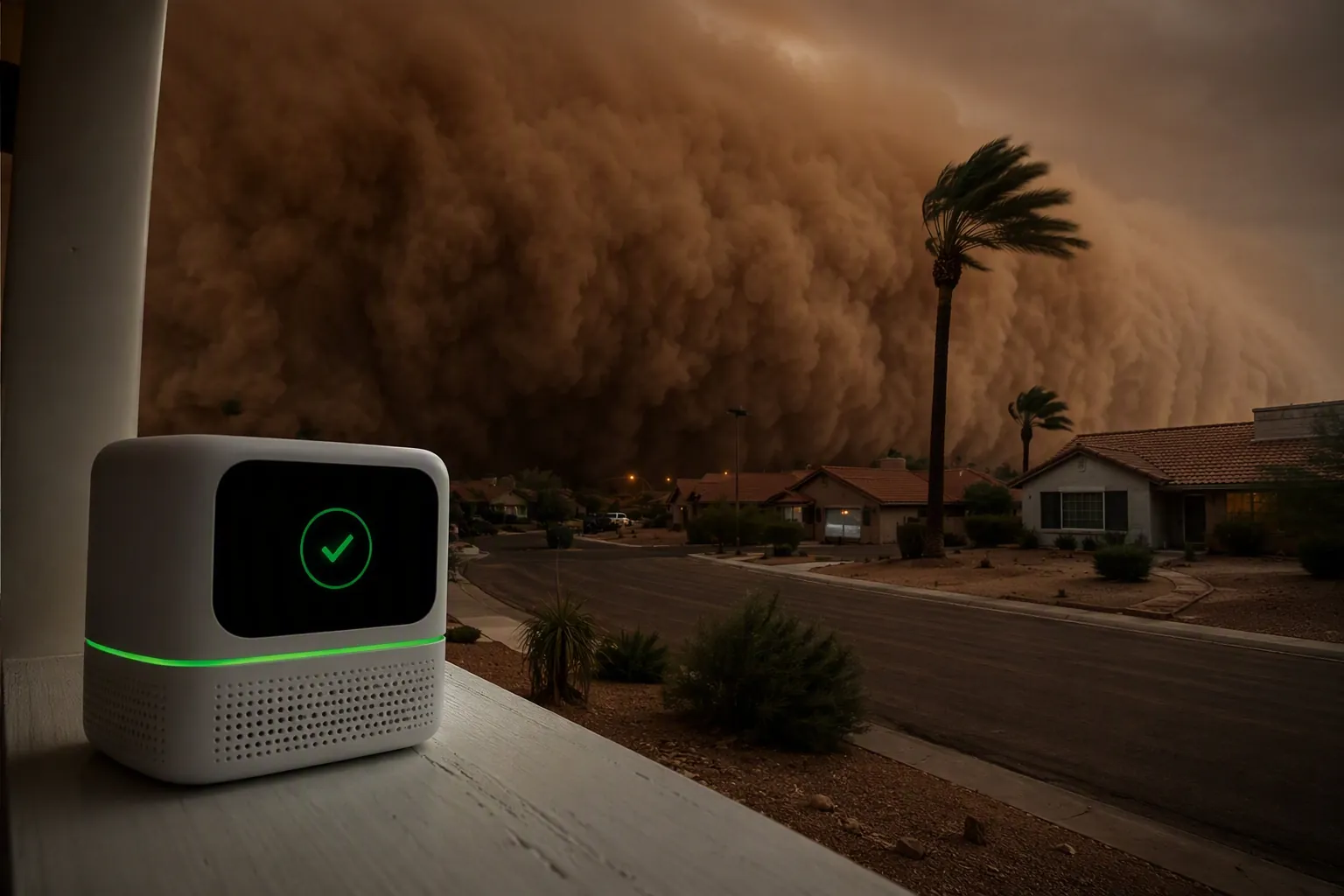
That is why “does it measure PM10?” and “does it work with my hub?” have to be checked separately. Matter 1.2 added an Air Quality Sensor device type that can cover PM1, PM2.5, PM10, CO2, nitrogen dioxide, VOCs, carbon monoxide, ozone, radon, formaldehyde, and AQI.[2] The PM10 Concentration Measurement cluster also exists in Matter as cluster 0x042D, introduced with Matter 1.2.[3] The standard can carry the signal. Many products and hub apps still do not.
For wildfire smoke, PM2.5-first guidance can be reasonable; that is the lane for the wildfire smoke monitor guide. Dust storms are a different purchase. A HomeKit or Matter badge is not enough if PM10 disappears before it reaches the automation screen.
Dust-storm monitor matrix: PM10 first, hub behavior second
Status labels below are intentionally conservative. “Verified” means the cited material directly supports the device behavior named in that row. “Reported” means a credible hands-on source saw the behavior, but NestGrid has not reproduced it across the named hub path. “Investigate” means the device may still be useful, but a buyer should not treat it as a confirmed PM10 automation answer without checking device, hub, protocol path, firmware or app version, and verification date.
| Device | Approx. lane | PM10 reporting | Hub / ecosystem path | Automation usefulness for dust storms | Status as of 2026-08-05 |
|---|---|---|---|---|---|
| Qingping Air Monitor Lite | $80–$100 HomeKit-native candidate | Reports PM10 in hands-on HomeKit accounts, along with PM2.5, CO2, temperature, and humidity.[4][5] | Apple Home / HomeKit; protocol and app/firmware version need purchase-time confirmation | Strongest HomeKit-native PM10 candidate in this set, but still needs dated verification on the exact Home hub and iOS/Home architecture | Reported: promising HomeKit PM10 path |
| Sonoff AirGuard 07P | About $40 low-cost Matter-over-Wi-Fi candidate | Matter Alpha reports PM2.5, PM10, humidity, and AQI exposed over Matter.[6] | Native Matter over Wi-Fi; Matter Alpha also reports Apple Home and Google Home automation limits around AQI-level logic rather than numeric PM values.[6] | Can be a good low-cost PM10 signal source if your platform exposes numeric PM10; not safe to assume Apple or Google automations will | Investigate: PM10-over-Matter reported, hub automation behavior not broadly reproduced |
| PurpleAir PA-II / PA-II-FLEX family | Accuracy-first outdoor / ambient lane | Reports particulate channels including PM10; no native Matter, HomeKit, or Thread path in the materials reviewed.[7][8] | Home Assistant via PurpleAir cloud-polling integration.[9] | Best fit when monitoring credibility matters more than clean hub-native control; automation depends on cloud/API path and Home Assistant design | Verified for HA integration path; PM10 hub-native automation not available |
| IKEA ALPSTUGA | Clean Matter / IKEA lane that misses dust PM10 | Reviewers report its Sensirion SEN63C module can measure PM1, PM4, and PM10, but IKEA surfaces only PM2.5 in-device and over Matter.[10][11] | Matter path reported in reviews; exact buyer result depends on hub and firmware | Good example of why sensor-module capability is not the same as dust-storm usability | Verified problem: PM10 not surfaced in cited reviews |
| IKEA VINDSTYRKA | Low-cost IKEA / DIRIGERA lane | Measures PM2.5, tVOC, temperature, and humidity; no PM10 and no CO2 in the cited HomeKitNews report.[12] | DIRIGERA firmware 2.256.003 added HomeKit support for the air quality sensor on 27 Mar 2023.[12] | Useful for PM2.5/VOC-style monitoring, not a PM10 dust-storm pick | Verified for no PM10 in cited report; Matter-over-DIRIGERA status needs separate dated verification |
| SwitchBot Meter Pro / Meter Pro CO2 path | Matter bridge lane that hides the relevant air readings | CO2 and particulate readings stay in the SwitchBot app in the cited HomeKit Weekly account; over Matter via Hub 2, only temperature and humidity reach HomeKit.[13] | SwitchBot Hub 2 to Matter to Apple Home | Not a dust-storm automation pick through HomeKit if PM data does not enter the hub path | Verified gotcha in cited hands-on account |
The fastest way to read the table is not by brand. Start with the pollutant column. If PM10 is absent, the device may still be a fine room monitor, but it is not the monitor that should decide whether a dust-storm automation runs. Then move to the hub path. Numeric PM10 inside a vendor app is different from numeric PM10 inside Apple Home, Google Home, Home Assistant, or a Matter controller. Finally, decide whether AQI bands are good enough for your use case. For a purifier or HVAC automation, “AQI changed from good to moderate” is a much blunter trigger than “PM10 crossed the threshold I care about.”
The clean hub picks are where buyers get trapped
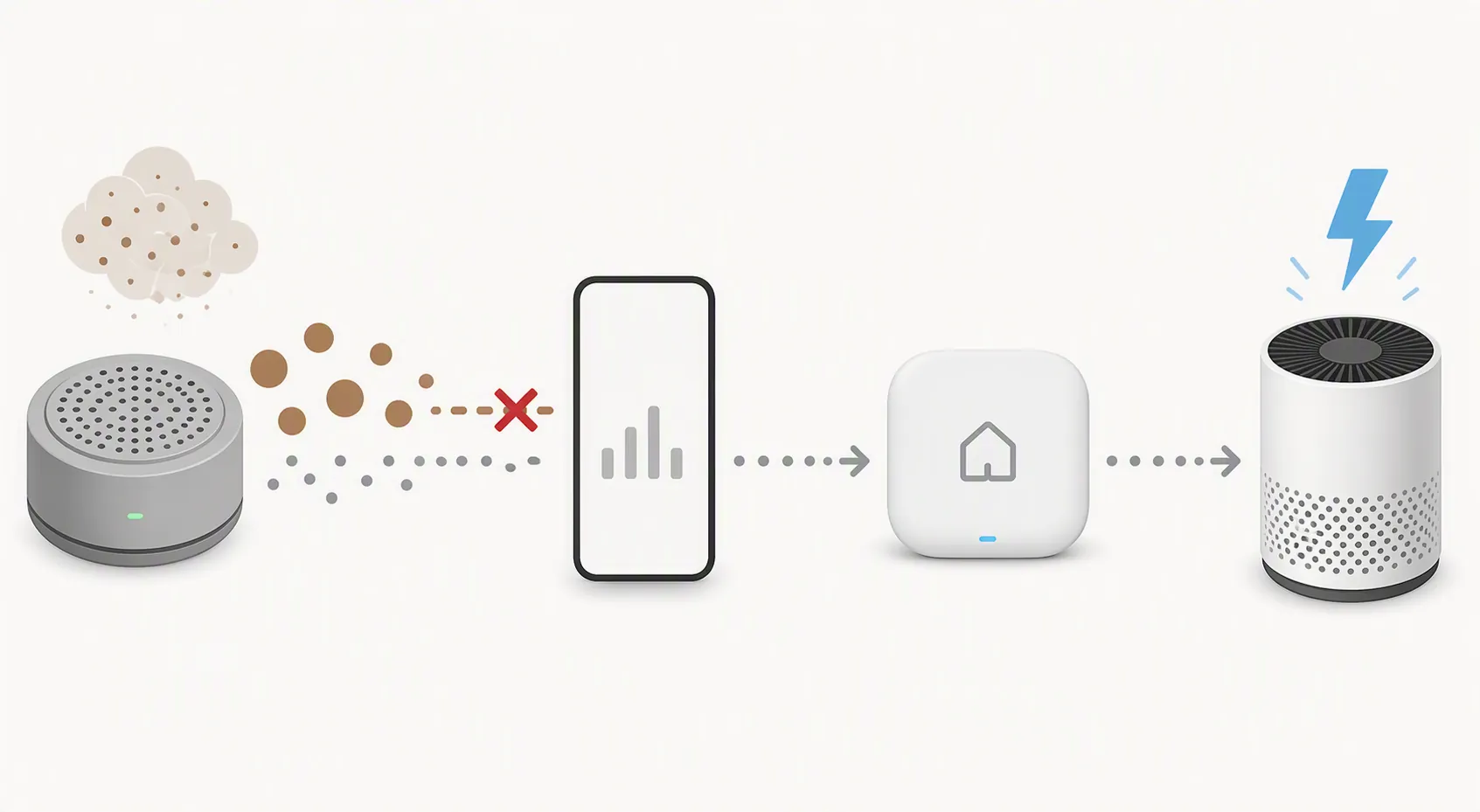
IKEA ALPSTUGA is the neatest illustration of the hidden-field problem. The interesting fact is not that a low-cost monitor has limitations. It is that the cited reviews say the hardware module inside it, Sensirion’s SEN63C, is capable of PM1, PM4, and PM10, while IKEA exposes only PM2.5 on the device and over Matter.[10][11] A buyer looking at module capability, Matter support, and an air-quality tile can end up believing the dust-storm problem is covered. The usable signal has already been narrowed before the hub ever gets a vote.
That distinction matters in four places: what the sensor module can detect, what the product firmware chooses to calculate or display, what the bridge or Matter endpoint exposes, and what the hub app allows as an automation condition. Any one of those layers can drop PM10. Once it is dropped, the purifier automation cannot recover it by being clever.
IKEA VINDSTYRKA is less subtle. HomeKitNews reported that DIRIGERA firmware 2.256.003 added HomeKit support for the air quality sensor on 27 Mar 2023, and described the device as measuring PM2.5, tVOC, temperature, and humidity, with no PM10 and no CO2.[12] That makes the buying judgment straightforward for dust: do not treat VINDSTYRKA as a PM10 monitor. It can still be useful in an IKEA home, but not for the dust-wall event this article is about.
SwitchBot shows the same pattern through a bridge instead of an IKEA hub. In the cited HomeKit Weekly hands-on account, SwitchBot Meter Pro reaches Apple Home through Hub 2 over Matter, but only temperature and humidity are exposed; CO2 and PM data remain in the SwitchBot app.[13] That is not a small omission if the planned automation is “when dust rises, start filtration.” It is the whole automation variable.
This is also why broad Matter optimism needs to stay in its lane. Matter 1.2 gave air-quality sensors a much better vocabulary, and that is good news.[2] The broader Matter buying context is worth following in the 2026 Matter-compatible devices buyer’s guide. But a vocabulary in the standard is not the same as a field exposed by a product, accepted by a hub, and offered in the automation editor.
The PM10-capable choices all trade away something
Qingping: the HomeKit-native PM10 candidate to inspect first
If the requirement is HomeKit-native PM10, Qingping Air Monitor Lite deserves the first serious look. The cited iMore guide lists it among HomeKit air quality sensors and describes support for PM2.5, PM10, CO2, temperature, and humidity, while an earlier hands-on account also discusses its HomeKit-visible air-quality readings.[4][5] In this set, that makes Qingping the closest thing to the clean answer Apple Home users want.
The caution is not a dismissal; it is a purchase discipline. The available material is indirect rather than a current raw-spec verification from Apple or Qingping’s blocked/JS-heavy product pages. Before buying, confirm the exact model, region, firmware, Home hub, iOS/Home architecture, and whether PM10 appears as a condition you can actually automate on. Seeing PM10 in an accessory details screen is better than not seeing it. Seeing it as a numeric automation trigger is the thing you are paying for.
Sonoff AirGuard 07P: promising Matter PM10, still not a universal hub answer
Sonoff AirGuard 07P is the intriguing low-cost row because the cited Matter Alpha review says it is a native Matter-over-Wi-Fi sensor at about $40 and reports PM2.5, PM10, humidity, and AQI to Matter.[6] That is exactly the sort of product the dust-storm market needs: inexpensive, hub-addressable, and not limited to PM2.5.
The same review is also the reason it cannot be treated as a solved purchase. Matter Alpha reports that some Matter platforms, notably Apple Home and Google Home, limit automations to AQI level rather than numeric PM values.[6] That means the device may expose PM10 at the Matter layer while the mainstream hub app still gives you a coarse AQI-style automation surface. For a buyer who only needs “bad air, turn purifier on,” that might be acceptable. For a buyer trying to separate dusty afternoons from cooking particles, humidifier mist, smoke, or normal PM2.5 events, it may not be.
Home Assistant users have a better chance of extracting numeric value from devices that mainstream hub apps flatten, but that is still a versioned setup, not magic. If your path is Matter into Home Assistant, check your Matter server and integration behavior against the Home Assistant Matter setup guide, especially if you are depending on Server 9.0-era behavior from June 2026. The question is not whether the device pairs. The question is whether PM10 becomes an entity you can threshold.
PurpleAir: the monitoring-first answer, not the hub-native answer
PurpleAir belongs in a different lane. Smart Air’s 2024 roundup points to the PurpleAir PA-II as a strong performer in PM2.5 monitor testing, and the South Coast AQMD PA-II-FLEX summary report gave the device a 95% score in field testing context.[7][8] That score should not be stretched into a PM10-accuracy claim: the AQMD result is PM2.5-oriented and R²-based, not proof that every PM10 reading is equally accurate. It is still useful credibility context for particulate monitoring compared with many decorative indoor gadgets.
The hub tradeoff is blunt. PurpleAir is not a native Matter, HomeKit, or Thread monitor in the reviewed materials. Home Assistant supports PurpleAir through a cloud-polling integration.[9] If you are placing an outdoor or ambient sensor to understand the dust event before it reaches your return-air path, PurpleAir can make sense. If the requirement is local, hub-native, low-latency purifier control with no cloud dependency, it is the wrong shape of product.
What to verify before a dust-storm automation depends on it
The compatibility check should be written down before purchase, not improvised after pairing. Use the same discipline as a CO2 or purifier automation matrix: device, hub or ecosystem, protocol path, firmware or app version, verification date, and status label. The format is similar to the CO2 monitor hub compatibility matrix, but dust adds one more trap because PM10 can vanish even when PM2.5 survives.
- Confirm the monitor reports PM10, not only AQI, PM2.5, VOC, temperature, or humidity.
- Confirm where PM10 appears: device screen, vendor app, Matter endpoint, HomeKit accessory details, Google Home device view, Home Assistant entity, or automation editor.
- Confirm whether the automation can use numeric PM10, an AQI band, or no air-quality value at all.
- Record the hub, bridge, firmware, app version, and date. A DIRIGERA, Hub 2, Matter controller, or Home Assistant update can change the result.
- Decide whether cloud polling is acceptable. PurpleAir through Home Assistant is a different reliability model from local Matter or HomeKit.
For purifier control, the next decision is what to do once the signal is trustworthy. The automation side is covered separately in the smart-home air purifier automation guide; the sensor decision here comes first because no automation can trigger on a pollutant the hub never receives.
The practical buying rule
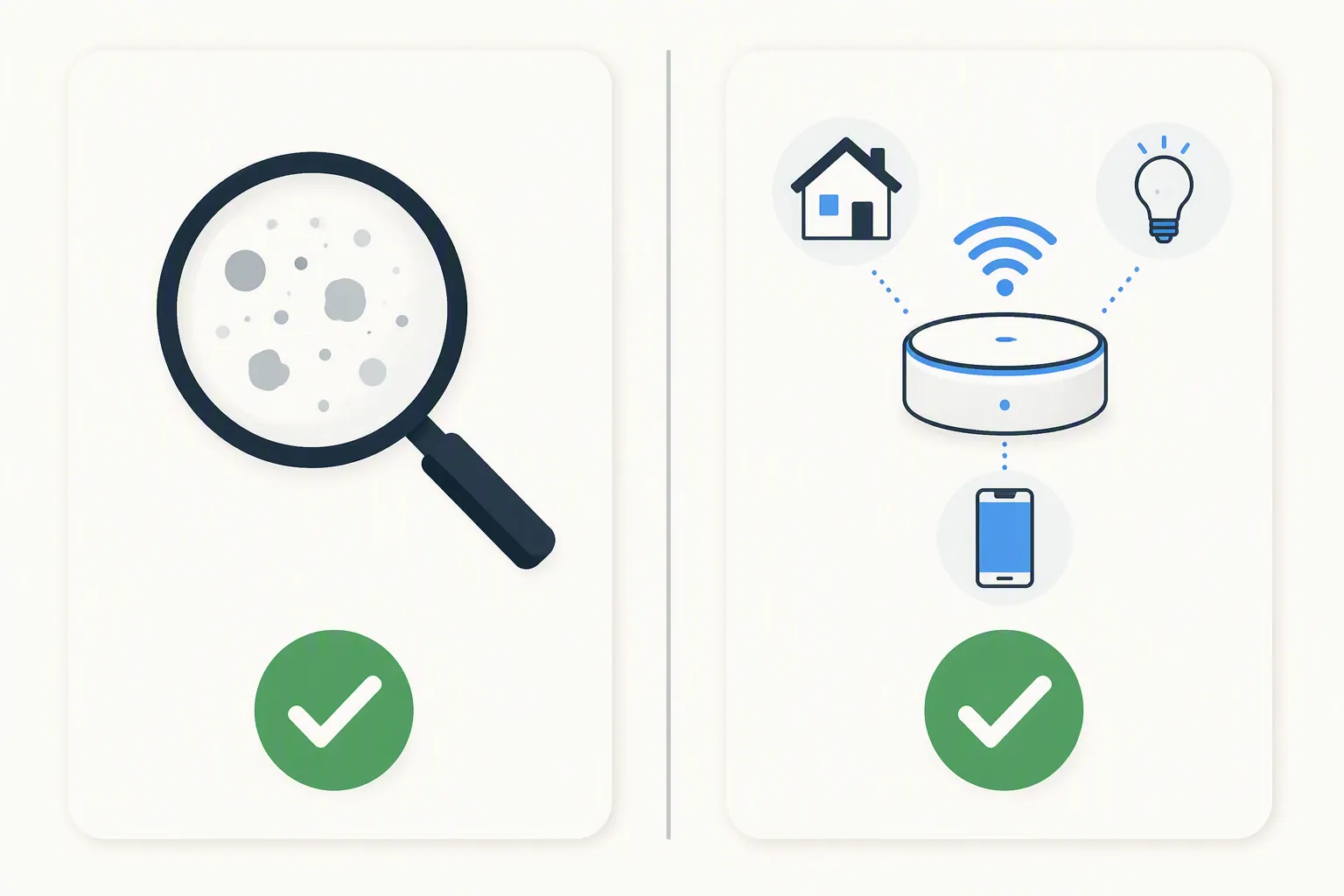
If you want HomeKit-native PM10, Qingping Air Monitor Lite is the device in this group that deserves the closest inspection, but verify the exact HomeKit automation behavior before treating it as confirmed. If you want low-cost Matter PM10, Sonoff AirGuard 07P is promising, but keep it status-labeled until PM10 behavior is reproduced on your actual Apple Home, Google Home, or Home Assistant path. If monitoring credibility matters more than hub-native control, PurpleAir belongs in the accuracy-first lane, with the Home Assistant cloud-polling tradeoff accepted up front. If you are buying IKEA, the problem is not that ALPSTUGA or VINDSTYRKA are useless monitors; it is that current PM10 exposure is not there in the cited paths.
Do not buy a dust-storm monitor on “air quality,” “Matter,” or “HomeKit” alone. Buy it only after PM10 measurement and hub integration have both been verified independently.
References
- Can AirLink help protect drivers from dangerous dust storms? — Davis Instruments.
- Matter 1.2 Arrives with Nine New Device Types — Connectivity Standards Alliance.
- PM10 Concentration Measurement — Matter Cluster Explained — Matter Alpha.
- Best HomeKit air quality sensors in 2026 — iMore.
- A New Dismal Gadget, an Air Quality Monitor — Retired Moocher Dave, 2022-09-14.
- Sonoff AirGuard 07P and 08P review — Matter Alpha.
- Best PM2.5 Air Quality Monitors in 2024 — Smart Air.
- PurpleAir PA-II-FLEX AQMD Summary Report — South Coast AQMD.
- PurpleAir — Home Assistant.
- IKEA Alpstuga Review — Breathe Safe Air, July 2026.
- IKEA ALPSTUGA air quality monitor review — Matter Alpha.
- Ikea Dirigera Update Adds HomeKit Support for Air Quality Sensor — HomeKitNews, 2023-03-27.
- HomeKit Weekly: SwitchBot Meter Pro CO2 Monitor — 9to5Mac, 2025-04-04.
Known issues with this device / protocol
Spec-version history
For active regressions on this protocol, see Update Watch.
No linked Update Watch entries yet.