Has S27 Ultra battery life been tested for smart home use?
Buying the S27 Ultra for smart-home battery life targets the wrong bottleneck: in SmartThings, a Galaxy phone is a Matter controller and commissioner, never the always-on hub. This compatibility check separates the contested battery leak reports from the only real battery test to date, so pre-order buyers know what the phone adds — and doesn't add — to their setup.
Last updated
No, S27 Ultra battery life has not been tested for smart-home use. As of Q3 2026, the phone is still unreleased, and every S27 Ultra battery figure in circulation is a leak rather than a reviewed spec. More importantly, the test many buyers are imagining would not answer the real SmartThings question anyway: in Samsung’s smart-home architecture, a Galaxy phone is the app you use to add, control, and check devices. It is not the always-on SmartThings hub or Thread border router that keeps Matter-over-Thread devices reachable when the phone is dead, upstairs, out of the house, or in someone else’s hand.
That distinction matters more than whether the rumored S27 Ultra battery ends up being 5,534 mAh rated, roughly 5,700 mAh advertised, or closer to 5,800 mAh. A bigger phone battery can make the S27 Ultra a better personal remote. It does not turn the phone into the fixed smart-home infrastructure your lights, locks, sensors, and automations rely on.
The phone is the controller, not the house
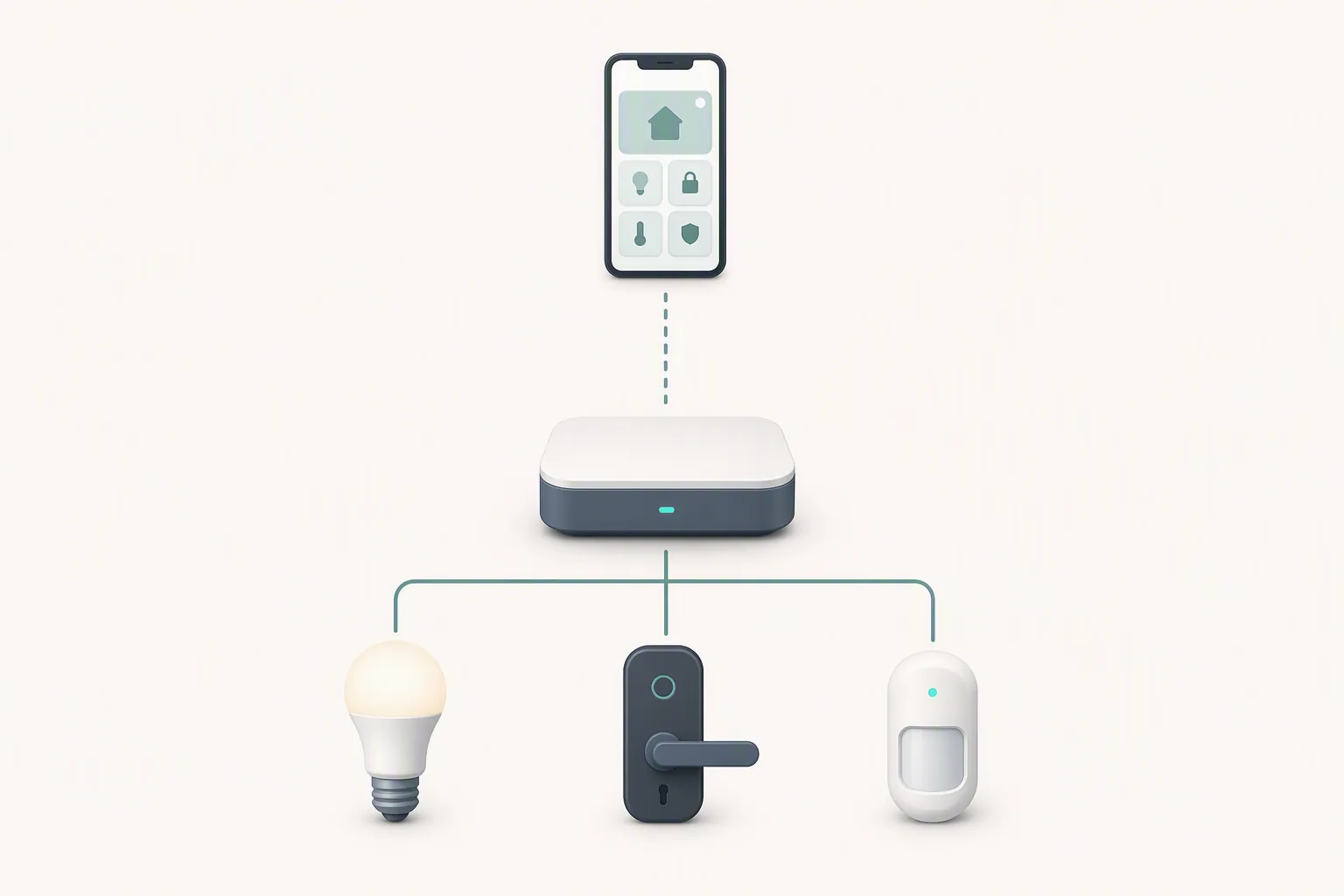
Samsung’s own Matter support language places the SmartThings app in the controller and commissioning role: it is how you connect Matter devices to SmartThings and manage them through the app. For Matter-over-Thread, the support material points the user toward a compatible hub or Thread border router, not toward a Galaxy phone pretending to be one in the background.[1]
Samsung’s public SmartThings materials tell the same story. The company lists SmartThings-compatible hub options across products such as Samsung TVs, Family Hub refrigerators, Smart Monitors, soundbars, projectors, SmartThings Station, and standalone hub hardware; Galaxy phones are useful SmartThings control surfaces, but they are not presented as built-in hubs in that list.[2][3] The S27 Ultra battery rumors also do not establish the phone as a Thread border router.
| Role | What it does | Where the Galaxy phone fits |
|---|---|---|
| Matter commissioner | Adds a Matter device to a smart-home ecosystem during setup | Yes, through the SmartThings app |
| Controller | Lets you view, trigger, and manage devices and scenes | Yes, through the SmartThings app |
| SmartThings hub | Provides always-on home infrastructure for supported devices and automations | No official S27 Ultra or Galaxy-phone hub role is listed |
| Thread border router | Bridges Thread devices to the wider home network | Not established by the S27 Ultra battery rumors |
This is the compatibility line a pre-order buyer should care about. If the S27 Ultra battery is excellent, the SmartThings app may stay available longer before you charge. You may get more time to check a dashboard, open a camera view, unlock a door from the phone, commission a Matter device, or use routines manually. But the household should not be designed around the phone staying awake. The hub-class device is the part expected to remain available when the phone is not.
This is not a Samsung-only quirk. Apple homes have the same architectural split between an iPhone as a controller and devices such as HomePod or Apple TV acting as home hubs and Thread border routers. NestGrid’s Apple Matter hub guide is useful for the same reason: it keeps the remote-control device separate from the always-on network device.
What the S27 Ultra battery rumors actually say
The S27 Ultra battery story is interesting, but it is still a rumor stack. Forbes, citing Galaxy Club on July 30, 2026, reported a 5,534 mAh rated battery and suggested that Samsung could market the pack around the 5,700–5,800 mAh range, with silicon-carbon chemistry implied in the discussion.[4] GSM Arena had reported similar leaked S27 Pro and S27 Ultra battery-capacity claims on July 27, 2026.[5]
A separate July 3, 2026 report from Gadgets360, based on @phonefuturist, framed the battery possibility differently: Samsung SDI may stay with lithium-ion while using a larger 5,600 mAh or 5,800 mAh cell.[6] That does not make the report right or wrong; it means the capacity and chemistry are unresolved. Treating the highest number as a finished Samsung specification would be premature.
| Status in Q3 2026 | Claim | What it can support |
|---|---|---|
| Unverified leak | 5,534 mAh rated / roughly 5,700–5,800 mAh advertised | Possible larger S27 Ultra battery, not tested smart-home endurance |
| Unverified leak | Silicon-carbon chemistry implied in some coverage | Possible chemistry change, not confirmed for S27 Ultra |
| Unverified leak | Lithium-ion may remain, with a larger 5,600/5,800 mAh cell | Competing chemistry possibility, not a settled spec |
| Official SmartThings architecture | Phone functions as app/controller/commissioner, not listed hub hardware | Reliable compatibility guidance for smart-home planning |
If the larger-capacity reports survive launch scrutiny, the practical smart-home benefit is still narrow. The phone may be less annoying as the household remote. It may have more margin on days when you are using SmartThings, maps, camera, messages, and media heavily. It may make Matter setup less stressful because you are not watching the battery icon during a device reset. Those are real conveniences. They are not evidence that the phone can replace a SmartThings Station, Aeotec hub, compatible Samsung TV, or another listed hub-class product.
The only tested battery evidence is from the S26 Ultra
For tested battery behavior, the nearest usable evidence is the Galaxy S26 Ultra, not the S27 Ultra. GSM Arena’s standardized battery test lists the S26 Ultra, with its 5,000 mAh battery, at 16 hours and 23 minutes of active use.[7] Android Authority’s first-hand heavy-use account reported ending a demanding day above 35% remaining.[8]
Those results are useful only as proxies. They tell us that Samsung’s current Ultra-class phone can already be a strong day-long handheld device under tested or reported heavy use. They do not tell us how the S27 Ultra performs, how its final battery chemistry behaves, whether Samsung changes power management, or what happens in a standardized smart-home-specific workload. There is no public S27 Ultra test that measures a day of SmartThings commissioning, camera checks, dashboard use, lock control, location routines, and normal phone tasks.
Even if such a test existed, it would measure the handheld experience, not the home’s uptime. A smart-home battery test on a phone can answer, “How long can I keep using this as a remote?” It cannot answer, “Will my Matter-over-Thread sensors stay online when the phone is gone?” That second question belongs to the hub and border-router layer.
The silicon-carbon warning should stay in its lane
The chemistry rumors deserve one extra caution. Forbes’ S27 Ultra coverage also points to Samsung’s Z Fold 8 battery-cycle disclosures, where Samsung’s own spec sheets list 1,200-cycle minimum endurance for the Fold 8 versus 2,000 cycles for the Fold 7, a 40% reduction tied in that coverage to the silicon-carbon move.[4] That is relevant because some S27 Ultra rumors lean on the same general chemistry story.
It is not, however, an S27 Ultra battery-life prediction. The Z Fold 8 is a different device class, with different packaging and design constraints. The only fair use of that information here is as a reminder that higher capacity and newer chemistry can involve trade-offs, and that cycle-life claims should be checked against official S27 Ultra specifications when Samsung publishes them.
What better phone battery life can change in a smart home
For SmartThings users, a longer-lasting S27 Ultra would still be welcome. The phone is often the most convenient interface in the house. It is the screen in your hand when someone rings the doorbell, when a sensor notification arrives, when a guest needs a temporary lock code, or when a Matter device has to be added after dinner instead of during a tidy weekend maintenance window.
- Opening SmartThings more often without rationing battery late in the day.
- Commissioning Matter devices without starting the process near empty.
- Checking cameras, locks, sensors, and scenes while away from home.
- Using the phone as a practical remote across a long workday, travel day, or weekend away.
There are also ordinary app-level annoyances that can make phone battery life feel more important than it architecturally is. Some users have reported SmartThings-related battery-drain problems in community discussions, including older workaround-style threads. That kind of report is worth noticing if you are troubleshooting your own phone, but it is not the same as a Samsung-confirmed platform-wide defect, and it should not be used as proof that a larger S27 Ultra battery is required to keep a SmartThings home functioning.
The cleaner pre-order test is simple: if your concern is “Will I enjoy using this phone as my daily smart-home remote?” battery capacity belongs in the conversation. If your concern is “Will my smart home keep working reliably?” look first at your hub, Thread border router, Wi-Fi, device compatibility, and automation design.
Pre-order judgment for smart-home buyers
Do not pre-order the Galaxy S27 Ultra because a leaked battery number makes it sound like a better smart-home hub. That is the wrong job for the phone. In SmartThings, the Galaxy phone remains the familiar, portable controller and commissioner; the always-on work belongs to supported hub hardware and border-router-capable devices.
If Samsung ships the rumored larger battery, the S27 Ultra may well be a better smart-home remote than earlier phones. That is a good reason to care about the battery. It is not a compatibility reason to redesign a SmartThings setup around the handset.
References
- SmartThings x Matter Integration — SmartThings Support
- Samsung SmartThings — Samsung US
- Where did smart home hubs go everywhere? — SmartThings Blog
- Samsung Galaxy S27 Release Date: Battery Specs, Silicon Carbon — Forbes, July 30, 2026
- Samsung Galaxy S27 Pro and S27 Ultra battery capacities leak — GSM Arena, July 27, 2026
- Samsung Galaxy S27 Ultra Battery Size Expected to Be Bigger Than iPhone 18 Pro Max: Leak — Gadgets360, July 3, 2026
- Battery test v2 — GSM Arena
- I was wrong about the Galaxy S26 Ultra battery — Android Authority
Known issues with this device / protocol
Spec-version history
For active regressions on this protocol, see Update Watch.
No linked Update Watch entries yet.