
Qualcomm's chip price hike hits smart home devices hardest
Qualcomm's double-digit chip price increase, effective September 2026, will raise costs for smart home devices that use its silicon — especially cameras, locks, and sensors. This article explains which product categories are most exposed and whether you should buy before the hike takes effect.
Last updated
The date that matters for a smart-home buyer is September 1, 2026. Qualcomm told customers on July 24 that it would raise chip prices by a double-digit percentage starting on that date, according to reporting on a customer letter reviewed by Bloomberg and covered by Reuters and The Verge.[1][2] That is enough to make a pre-September purchase worth considering, but not enough to make every Qualcomm-based gadget an emergency buy.
The exact increase is not public. “Double-digit” could mean the low teens or something much closer to 30%. Qualcomm has not issued a public release detailing the affected product lines, and the reporting does not explicitly say whether every IoT part used in smart-home products is covered at the same rate as mobile silicon. So the practical question is narrower than the headline: which smart-home devices are exposed enough that a chip hike could plausibly show up as a higher shelf price, weaker discounts, smaller bundles, or a quietly replaced model?
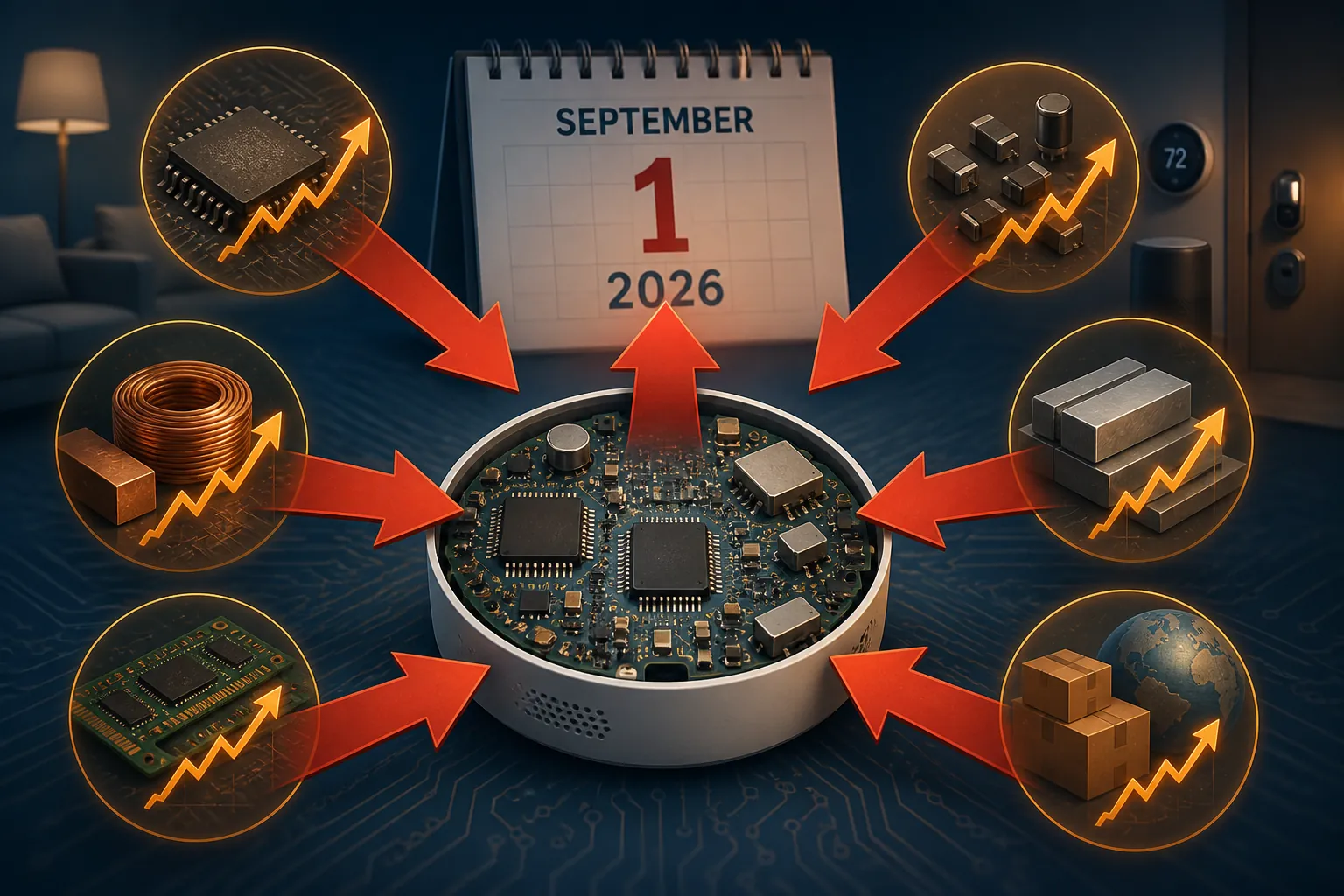
Where the Qualcomm increase actually lands
A smart-home device does not become expensive because one line item moves. It becomes hard to hold at a shelf price when several line items move at once and the original product was already designed around a tight bill of materials.
That is why Qualcomm’s chip price increase is most visible in smart-home products that combine wireless connectivity, memory, sensors, power management, and software features inside a low retail price. A $179 camera kit and a $69 sensor pack do not have the same room to absorb a component increase as a premium hub sitting in a larger ecosystem bundle.
| Device category | Likely Qualcomm exposure | Why the price pressure matters |
|---|---|---|
| Security cameras and video doorbells | Connectivity silicon, possible QCC730M/QCC74xM use, and Dragonwing AI/video platforms in higher-feature designs | High-volume products with memory, image processing, wireless, and cloud-feature expectations squeezed into tight consumer price bands |
| Battery sensors and smart locks | QCC730M-class low-power Wi-Fi connectivity for battery-operated devices | Small BOM changes matter because products compete on price, battery life, and multipack value |
| Matter hubs and border routers | QCC74xM tri-radio designs supporting Wi-Fi 6, Bluetooth 5.3, and 802.15.4 | Integration can reduce design complexity, but the $129-$299 hub segment has more pricing headroom |
| Thermostats and premium control panels | Possible connectivity exposure, depending on design | Less clear without model-level teardown or spec confirmation; software, display, and brand positioning may dominate pricing |
The Qualcomm parts worth watching are not generic smartphone chips. The QCC730M is positioned for dual-band Wi-Fi 4 in battery-powered IoT devices such as sensors and locks. The QCC74xM combines Wi-Fi 6, Bluetooth 5.3, and 802.15.4 for Matter-capable hubs and border-router designs, with CNX Software detailing the family in late 2024.[3] Qualcomm’s Dragonwing Q-8750 and Q-7790 platforms, announced for edge AI use cases, point toward more capable cameras and media hubs where video, AI, and connectivity sit closer together in the platform decision.[4]
Cameras and video doorbells have the least slack
Security cameras and video doorbells are the cleanest place to see why a chip increase can matter before it becomes a visible MSRP change. These devices sell on resolution, night vision, person detection, local or cloud recording, Wi-Fi reliability, enclosure size, and app features. The buyer sees a camera. The manufacturer sees a stacked cost problem.
Connectivity is only one slice. Video products also lean on memory, image-processing silicon, storage choices, microphones, speakers, power components, weatherproofing, and sometimes AI acceleration. TrendForce reported in May 2026 that LPDDR4X prices rose 70% to 75% quarter over quarter, while LPDDR5X rose 78% to 83%.[5] Those are not small background movements for a category that keeps being asked to add smarter detection and faster local processing without feeling expensive.

The pressure is sharper in budget cameras than in flagship models. A premium outdoor camera can hide some cost movement inside subscriptions, bundles, seasonal promotions, or a higher starting price. A cheaper indoor camera, a two-pack doorbell bundle, or a starter security kit has fewer places to move. If a company does not raise the sticker price, it can still pass along the pressure by reducing discount depth, ending multipack deals, cutting storage bundles, or pushing buyers toward a newer model with a less generous launch price.
That is the part worth watching before September 1. The first visible effect may not be a sign that says “price increased.” It may be a camera that used to sit at $79 during sales returning to $89 more often, a doorbell bundle losing a chime, or a Black Friday discount that looks thinner than last year’s. None of those outcomes is confirmed for a specific brand. They are the common retail shapes of a BOM problem.
Locks and sensors are small devices with small margins
Battery-powered locks and sensors are less glamorous than AI cameras, but they may be more exposed to a component increase precisely because they have less room to maneuver. A contact sensor, motion sensor, leak sensor, keypad lock, or retrofit deadbolt has to be cheap enough to buy in multiples and efficient enough that battery complaints do not bury the product.
The QCC730M is relevant here because it targets battery-operated IoT devices that need Wi-Fi connectivity without the power profile of a more demanding design.[3] If that class of silicon becomes more expensive, the manufacturer cannot simply substitute a random cheaper radio without revisiting range, sleep behavior, certification, firmware, and battery-life claims. In smart locks, that work also touches reliability expectations that are much less forgiving than in a plug-in speaker.
This is where the low-margin math matters. Counterpoint data shows low-end device BOMs already up 20% to 30% year to date, while smartphone average selling prices were forecast to rise 6.9%.[6] The smartphone comparison is useful mostly as a contrast: phone makers have larger volumes, higher ASPs, and more mature pricing ladders. A low-cost smart-home peripheral may be built around a much thinner per-unit cushion.
For a buyer, the implication is simple enough to be useful: if the product is a lock, sensor, keypad, or multipack accessory that you already know you need, waiting for post-September clarity may not buy much. The risk is not that every unit jumps overnight. The risk is that the next replenishment cycle, next bundle, or next minor hardware revision lands with less generous pricing.
Matter hubs and border routers are exposed, but not equally urgent
Matter hubs and border routers need a different reading. The QCC74xM matters because it puts Wi-Fi 6, Bluetooth 5.3, and 802.15.4 into a tri-radio design aimed at the messy reality of modern smart-home compatibility.[3] Edge AI Vision’s March 2026 connectivity analysis highlighted the challenge of making multiple radios coexist cleanly, and why single-die radio arbitration can matter for Matter devices that have to coordinate Wi-Fi, Bluetooth commissioning, and Thread-style 802.15.4 behavior.[7]
That integration can save engineering pain. It can reduce board complexity, simplify coexistence work, and make a hub easier to design around than a more fragmented radio approach. But integration does not make the part immune to price pressure, and it does not tell us how much of a Qualcomm increase a hub maker will pass through.
The hub category also has more pricing room than budget peripherals. A $129 to $299 hub, smart display, or control panel can absorb a few dollars differently than a sensor multipack or entry camera. It may be sold as an ecosystem anchor, discounted during major shopping windows, or bundled with speakers and services. That does not make the Qualcomm increase irrelevant; it makes the buying deadline less clean.
For Matter accessories, the urgency depends on what the device is. A small Thread sensor or bridge-class accessory with a tight BOM belongs closer to the lock-and-sensor bucket. A premium hub with a display, speaker array, and smart-home dashboard belongs closer to the wait-for-a-good-discount bucket. The presence of a QCC74xM-class radio is a useful clue, not a retail-price prediction.
The Qualcomm hike is only one layer of the BOM stack
The reason this story matters for smart-home buyers is not that Qualcomm raised prices in isolation. It is that the increase arrives while other component categories are already moving. Analog Devices raised prices by 15%, Texas Instruments increases reached up to 85%, and broader wafer pricing from TSMC and SMIC rose 3% to 10%.[8][9]
Analog and MCU parts do not get the same attention as the main wireless chip, but they are everywhere in smart-home hardware: power regulation, sensing, motor control, audio paths, battery management, and radio support circuitry. A smart lock needs motor control and power discipline. A camera needs power conversion and sensor support. A hub needs stable radios and always-on behavior. When those less visible pieces move at the same time as memory and connectivity silicon, the final device has fewer cheap fixes.
Coherent Market Insights noted in March 2026 that rising semiconductor, sensor, and network-chip prices were increasing final smart-device costs and pushing brands to rationalize portfolios.[10] Portfolio rationalization is a polite phrase with practical consequences: fewer slow-selling models, fewer lightly differentiated SKUs, fewer cheap bundles kept alive only to fill a price point.
That matters because a buyer may never see a clean before-and-after price chart. The affected product might simply stop being promoted. A second color may disappear. A three-pack may become a two-pack. A low-end model may be replaced by a slightly more expensive “new” version that looks similar from the outside.
How to check your own exposure before September 1
Most product pages will not say “Qualcomm inside” as clearly as a laptop sticker. Still, there are a few practical checks that are worth doing before treating the September 1 date as a buying deadline.
- Check the product’s certification pages, FCC filings, teardown notes, or developer documentation for Qualcomm, QCC730M, QCC74xM, Dragonwing, or related module names.
- Treat battery cameras, video doorbells, smart locks, contact sensors, leak sensors, and Matter bridges as higher-priority checks than premium displays or speakers.
- Look at the selling pattern, not only the list price: disappearing coupons, weaker bundles, and shorter promo windows can be early signs of cost pressure.
- Do not buy an incompatible device just to beat a component deadline; Matter, Thread, Wi-Fi coverage, app support, and ecosystem fit still decide whether the product will be useful.
- If the device is already discounted and you planned to buy it anyway, the pre-September hedge is stronger than waiting for an uncertain post-hike promotion.
The absence of a visible Qualcomm part number should not be overread. Many devices use modules, revised boards, or regional variants. A teardown for one model year may not cover a later revision. The check is meant to improve your odds, not produce certainty.
What not to assume yet
There are several lines this evidence does not cross. It does not prove that every smart-home device using Qualcomm silicon will become more expensive on September 1. It does not prove that the QCC series or Dragonwing parts are covered at the same percentage as other Qualcomm chips. It does not show direct responses from Ring, Arlo, Ecobee, Google, Amazon, or other OEMs. It also does not show that Matter adoption will slow because of this price increase alone.
The better reading is more restrained. Qualcomm’s reported increase adds pressure to categories that already had rising memory, analog, MCU, and wafer costs. That pressure is more likely to matter where products are cheap, battery-powered, high-volume, or bundled aggressively. It is less decisive where a manufacturer has premium pricing, subscription revenue, inventory already purchased at old component costs, or enough margin to absorb a supplier increase.
The practical buying rule
If the device you want is a budget security camera, video doorbell, battery smart lock, sensor pack, or Matter accessory likely to use Qualcomm connectivity silicon, buying before September 1, 2026 is a reasonable hedge for a price-sensitive shopper. The case is strongest when the product is already on sale, already compatible with your home, and already part of a plan you intended to build.
If the device is a higher-priced hub, premium control panel, or flagship camera, the Qualcomm increase should be only one input. Discounts, inventory timing, ecosystem fit, subscription terms, and model age may matter more than the supplier letter. A bad hub bought early is still a bad hub. A compatible lock or sensor pack bought before a likely cost reset is a different calculation.
References
- Qualcomm chip price increase report, Reuters, July 2026.
- Qualcomm is raising chip prices, The Verge, July 2026.
- Qualcomm QCC74xM tri-radio Wi-Fi 6, Bluetooth 5.3 and 802.15.4 IoT chips, CNX Software, November 2024.
- Qualcomm Dragonwing Q-8750 and Q-7790 edge AI platforms, Edge AI Vision, January 2026.
- May 2026 memory price data, TrendForce, May 2026.
- Low-end device BOM increase and smartphone ASP forecast, Counterpoint Research, 2026.
- Smart home connectivity and tri-radio design analysis, Edge AI Vision, March 2026.
- Analog and MCU component price increases, Analog Devices and Texas Instruments, 2026.
- Foundry wafer price increase context, TSMC and SMIC, 2026.
- Smart Home Devices Market report, Coherent Market Insights, March 2026.
Known issues with this device / protocol
Spec-version history
For active regressions on this protocol, see Update Watch.
No linked Update Watch entries yet.