
How Much Can PM Surya Ghar Rooftop Solar Save You?
How much does PM Surya Ghar actually pay, and what will a rooftop system really cost after the subsidy? This explainer works through the 2026 numbers — subsidy slabs and net out-of-pocket cost, realistic bill savings, and payback ranges by state — so you can decide whether to apply before the scheme closes on 31 March 2027.
Last updated
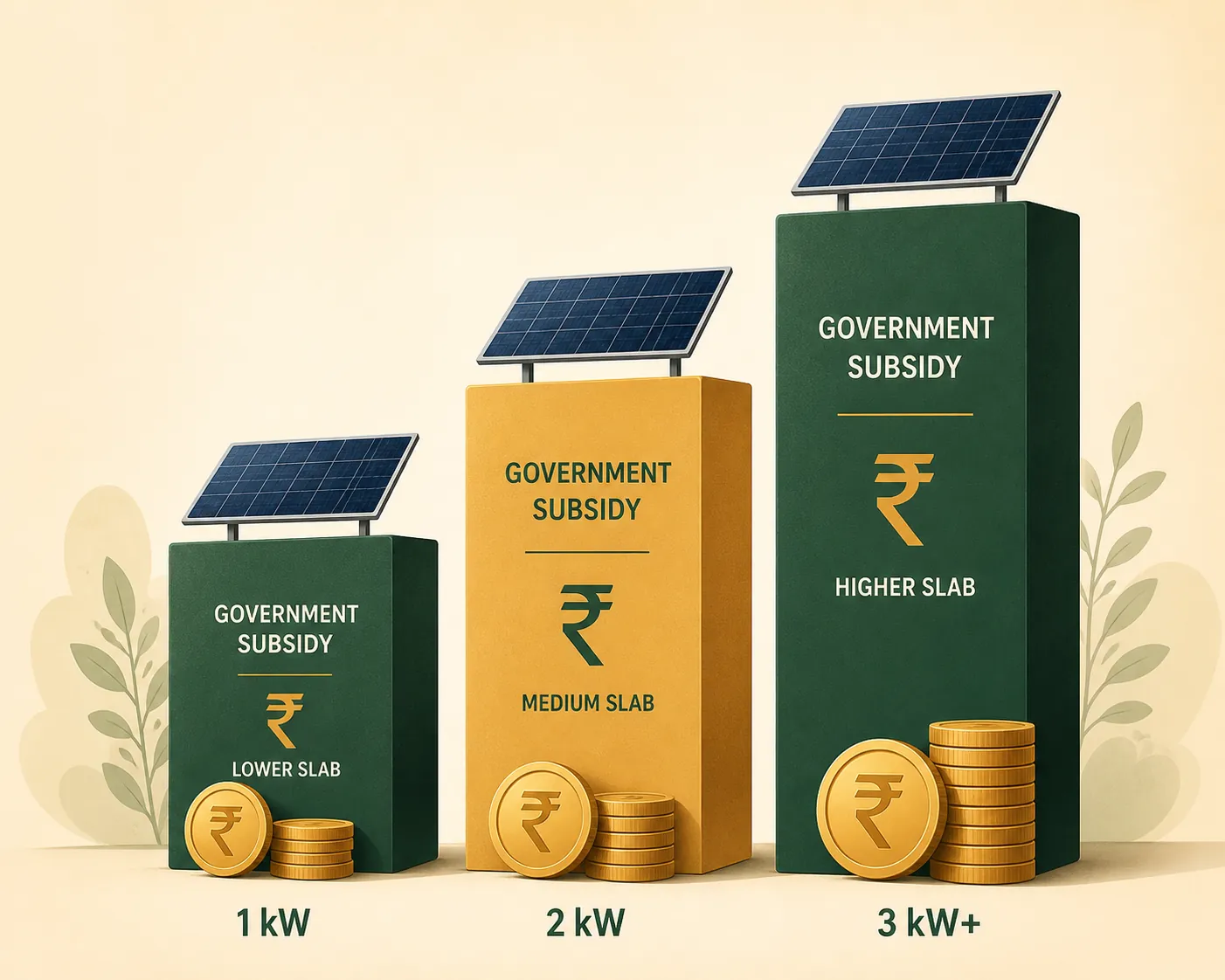
For a homeowner checking how much the PM Surya Ghar rooftop solar scheme can save at home in Q3 2026, the useful answer starts with three numbers: the central subsidy is ₹30,000 for 1 kW, ₹60,000 for 2 kW, and ₹78,000 for 3 kW and above; a typical 3 kW home system often lands near ₹1.0–₹1.32 lakh after that central subsidy; and 3 kW can produce roughly 300–360 units a month in decent conditions, enough to push a 300-unit bill close to zero under net metering, though not necessarily every fixed charge or state-specific fee.[1][2][3]
That is the calculator version of the scheme. If your monthly bill is already low, the subsidy may not rescue the payback. If your bill is high but your roof is shaded, the generation estimate is the weak link. If you live in a state with a meaningful top-up or generation-based incentive, the same 3 kW quote can pay back much faster than it would in a state with only the central subsidy. Treat 31 March 2027 as the working deadline to complete the subsidy path, but recheck the current portal or MNRE notice before paying an installer, because a missed deadline changes the entire cash-flow argument.
| System size | Central subsidy in 2026 | What this means for the bill calculation |
|---|---|---|
| 1 kW | ₹30,000 | Works only if consumption is modest and the roof is not being oversized just to chase a subsidy. |
| 2 kW | ₹60,000 | Often the middle path for homes that do not consistently use around 300 units a month. |
| 3 kW and above | ₹78,000 total central cap | The subsidy stops rising after 3 kW, so extra capacity must justify itself through additional bill savings. |
The 3 kW example is where the scheme becomes measurable
Most subsidy pitches lean hard on the phrase “300 units free.” The more useful version is this: the official scheme material links a 3 kW rooftop system with up to 300 units a month, while market sizing guides commonly use a rough 300–360 units/month range for a well-sited 3 kW system.[1][2] The homeowner’s saving is not the word “free”; it is the value of the units that your DISCOM would otherwise have billed you for, adjusted for net metering rules, fixed charges, minimum bills, and any export-credit treatment in your state.
| 3 kW line item | 2026 working number | How to read it |
|---|---|---|
| Gross installed cost before central subsidy | Roughly ₹1.78–₹2.10 lakh in common benchmark or market-estimate calculations | This varies by city, installer, inverter, mounting structure, panel type, and roof complexity. |
| Central subsidy | ₹78,000 | This is the national cap once the system reaches 3 kW; adding a fourth kW does not add more central subsidy. |
| Net out-of-pocket after central subsidy | Roughly ₹1.0–₹1.32 lakh | This is the number to divide by annual bill savings, not the brochure’s pre-subsidy quote. |
| Expected monthly generation | About 300–360 units/month in reasonable conditions | A shaded roof, poor orientation, downtime, or delayed net-metering can lower the realized saving. |
| Typical payback before state-specific adjustments | About 3–4 years in many cases | This assumes the household can actually use or credit most of the generated units at retail-bill value. |
| Payback with strong state support | Can fall under 2 years in favorable cases | This is state-dependent; it should not be treated as an all-India claim. |
Here is the arithmetic to do before speaking to an installer. Start with your annual electricity spend, then estimate how much of it a 3 kW system can offset. If your monthly use is around 300 units and your DISCOM’s net-metering arrangement gives fair credit for rooftop exports, a 3 kW system may reduce the energy portion of the bill sharply. If your bill includes large fixed charges, arrears, demand charges, or a minimum charge, the bill may not become zero even when generation matches usage.
A clean payback formula is enough:
Payback in years = Net out-of-pocket cost after subsidy ÷ Annual bill savingSo if the installed system costs about ₹1.0–₹1.32 lakh after subsidy, it needs to save roughly ₹25,000–₹44,000 a year to sit in the 3–4 year payback band. The exact monthly saving comes from your tariff slab and how your DISCOM credits solar generation, not from the nameplate capacity printed on the quotation.
Do not buy more kW than your bill can absorb
The central subsidy design tempts many households toward 3 kW because that is where the ₹78,000 cap is reached. That does not make 3 kW automatically right. A home that routinely uses much less than the system produces may export more power than the bill can economically use, depending on the state’s settlement rules. A home with air conditioners, pumps, an electric geyser, or daytime occupancy may absorb rooftop generation better than a home that is mostly empty during sunny hours.
| Your situation | Capacity to test first | Why |
|---|---|---|
| Bill is modest and consumption rarely approaches 300 units/month | 1–2 kW | A smaller system may give a cleaner payback than a subsidized but oversized 3 kW system. |
| Bill is driven by roughly 300 units/month of regular consumption | 3 kW | This is where the central cap, the official 300-unit framing, and practical bill reduction usually line up. |
| Bill is high even after 300 units/month are offset | 3 kW first, then test extra kW separately | Capacity above 3 kW gets no additional central subsidy, so the fourth and fifth kW must stand on unsubsidized savings. |
| Roof has shade, weak structure, or limited clear area | Smaller system or no system | The subsidy does not compensate for poor generation. |
Roof space is a quick reality check. Installer guidance commonly uses about 100 square feet per kW, which means a 3 kW system needs roughly 300 square feet of usable, largely shade-free space.[4] “Usable” matters. A water tank shadow, parapet shadow, dish antenna, lift-room shadow, or awkward roof access can reduce output or raise mounting costs.
If the house is planning major load changes, size for the future only when the future is real. A second air conditioner already ordered is different from a vague plan to buy an EV someday. Rooftop solar pays from actual units offset, not from imagined appliances.
Net metering decides whether generation becomes savings
A grid-connected rooftop system saves money because the solar units reduce imported grid units, and surplus units may be credited under net metering or a related state settlement mechanism. Net-metering guides describe the basic flow: solar generation first serves home consumption, excess power flows to the grid, and the bill is adjusted according to state DISCOM rules.[5] The important part for a homeowner is that the financial value of one solar unit is not identical in every state.
This is why two neighbors in different DISCOM areas can buy the same 3 kW system and get different paybacks. One may offset expensive slab-rate consumption. Another may export surplus at a lower credit value or lose some value at annual settlement. A third may face a delay between installation and net-meter commissioning, during which the panels are physically present but the savings are not fully flowing.
Before signing a quote, ask the installer to show the calculation in units, not only rupees: expected monthly generation, expected self-consumption, expected exports, tariff slab avoided, fixed charges remaining, and whether credits expire or roll over. If the answer is only “your bill will be zero,” the calculation is not finished.
State support can move payback from ordinary to very fast
The national calculation is only the first layer. State incentives can materially change the result. Installer-tracked 2026 subsidy guides flag Delhi’s generation-based incentive and Uttar Pradesh support as examples that can shorten payback, with favorable cases falling below two years.[3] That is a real reason to check your state, but it is also the place where national articles often become misleading. A Delhi-style or UP-style result should not be casually applied to Rajasthan, Maharashtra, Tamil Nadu, Karnataka, Gujarat, or any other state without checking the current state order and DISCOM procedure.
| Layer | What to verify | Why it changes savings |
|---|---|---|
| Central subsidy | Whether your system size and equipment qualify for PM Surya Ghar central financial assistance | This sets the national ₹30,000, ₹60,000, or ₹78,000 subsidy base. |
| State subsidy or incentive | Whether your state adds a capital subsidy, GBI, or other support | This can reduce upfront cost or add a recurring generation-linked benefit. |
| DISCOM net metering | Meter approval, credit value, settlement period, export limits, and billing treatment | This determines how many generated units become bill savings. |
| Tariff slab | The effective value of the units your solar system offsets | Offsetting high-slab units pays back faster than offsetting low-slab units. |
DCR panels versus the 2026 “Give It Up” choice
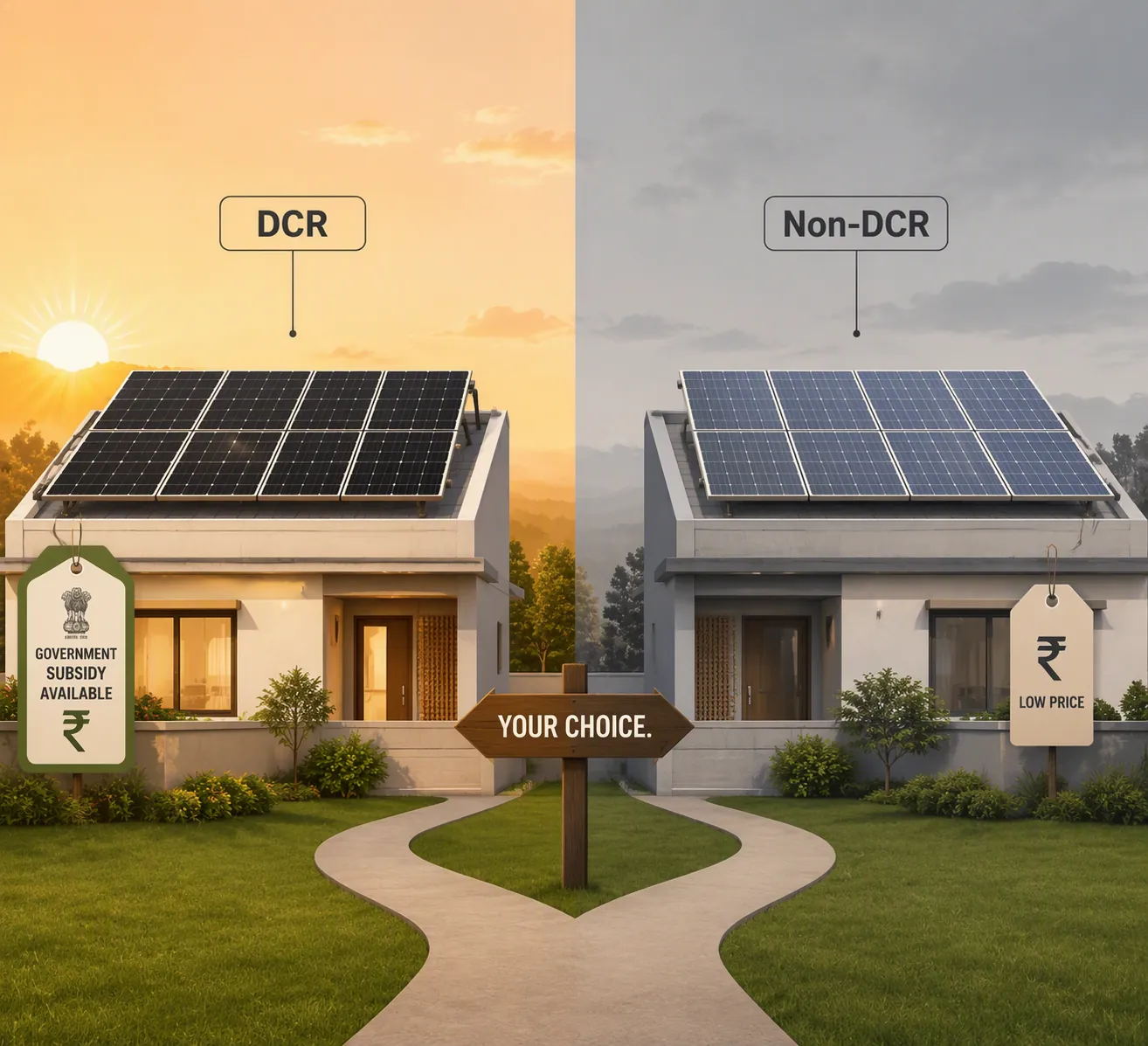
For subsidy-linked residential rooftop systems, the panel question is not only brand and wattage. It is also DCR versus non-DCR. DCR-compliant equipment keeps the central subsidy path open. Non-DCR panels, commonly associated with cheaper imported modules, may reduce the quote but can put the central subsidy out of reach unless a specific opt-out path applies.
In 2026, industry guidance reported a “Give It Up” option allowing consumers to voluntarily forgo the central subsidy and install cheaper non-DCR panels; the same point should be verified against the original MNRE order before any purchase decision, because the official portal and MNRE notice should govern eligibility. This option matters most where the unsubsidized non-DCR quote is low enough, or the household values faster procurement over the DBT route. It should not be assumed to beat the subsidy.
The arithmetic is simple but often hidden inside bundled quotations. IEEFA reported DCR module costs around ₹23–₹26/W, versus roughly half for non-DCR modules.[6] On a 3 kW system, that module-price gap can be meaningful, but the central subsidy is ₹78,000. So the homeowner should ask for two full system quotes: DCR with subsidy eligibility and non-DCR without central subsidy. Compare the final cash paid after DBT, not just the panel line item.
| Panel path | When it may fit | Main caution |
|---|---|---|
| DCR with central subsidy | Most eligible 1–3 kW homeowners who want the national subsidy and possible state-linked support | Higher module cost, documentation burden, portal and DBT timing. |
| Non-DCR under a voluntary opt-out path | Homes where the full unsubsidized quote is much cheaper or the owner wants to avoid subsidy-linked equipment constraints | No central subsidy; the claimed saving must beat the lost subsidy in actual rupees. |
| Capacity above 3 kW | Homes with consistently high consumption and enough roof space | Central subsidy remains capped at ₹78,000, so extra kW are judged on normal bill savings. |
Applying is not the same as getting a subsidized system
The scheme is large, but an application is only the start of the queue. The official process runs through registration, DISCOM approval, vendor selection, installation, inspection or commissioning, net-metering steps, redemption, and then central financial assistance transfer. A March 2025 PIB release described CFA processing after redemption as about 15 days.[7] Installer-side and market guides, however, report that real DBT timing can stretch longer, often discussed in a 30–90 day range, depending on documentation, DISCOM progress, and portal processing.[3]
That gap matters because the homeowner usually cares about cash outflow first. If the installer quote assumes the subsidy is already in your pocket, ask who finances the gap until DBT arrives. Some offers net the subsidy in the invoice; others require the homeowner to pay more upfront and wait. The risk is not that the scheme has no subsidy. The risk is signing a cash-flow plan that assumes the subsidy arrives before the household can comfortably carry the expense.
There is also a conversion problem. IEEFA reported that only about 22.7% of applications had converted to completed installations as of its December 2025 analysis, and it discussed consumer-experience timelines that could run 45–120 days through the process.[6] Those numbers may have improved during 2026, but they are enough to reject the lazy equation that “applied” means “installed and subsidized.”
- Keep the electricity bill name, consumer number, bank details, and ownership or occupancy documents consistent.
- Use an eligible vendor and equipment path if you want the central subsidy.
- Do not let the installer install first and solve DISCOM approval later unless you understand the subsidy risk.
- Ask when the net meter is expected, not only when panels will be mounted.
- Check whether the quote assumes DBT reimbursement to you or an upfront discount passed through by the vendor.
The national rollout is big; your decision is still local
PM Surya Ghar was designed at national scale, with a ₹75,021 crore outlay and a target of 1 crore households.[1] By 19 March 2026, Mint reported 26.19 lakh rooftop systems installed and ₹17,967 crore disbursed under the scheme.[8] Industry coverage in August 2026 reported the scheme crossing 50 lakh rooftop installations and 14.8 GW of commissioned capacity, a useful scale marker that should still be rechecked against the official portal before relying on it for a purchase timeline.[9]
Those rollout numbers are encouraging, but they do not answer whether your home should buy. Your answer comes from the smaller facts: your sanctioned load, your roof, your monthly units, your tariff slab, your state incentive, your DISCOM’s net-metering treatment, and whether the DCR quote after subsidy beats the non-DCR quote without subsidy.
When rooftop solar may not make sense
A subsidy does not turn a weak site into a strong investment. Solar-worthiness guides list several ordinary cases where a homeowner should slow down or avoid the purchase: low electricity consumption, heavy roof shade, an unsuitable or temporary roof, uncertain ownership, planned relocation, or a tariff/net-metering setup that gives poor value for exported units.[2] In these cases, a smaller system, load reduction, or no system may be the better financial choice.
The most common bad purchase is an oversized system sold against a low bill. If your monthly bill is around the lower end of the ₹1,500–₹8,000 range, do not start with the installer’s favorite package. Start with your units. If a 1 kW or 2 kW system captures most of the economic saving, the extra capacity may only make the brochure look better.
The second bad purchase is a rushed system before state clarity. If your state has a pending top-up, changing net-metering rules, or a new DCR/non-DCR interpretation, the difference can be large enough to wait for a written rule. Waiting is not the same as ignoring the 31 March 2027 deadline. It means not paying based on a WhatsApp screenshot of a subsidy that may not apply to your consumer category.
A practical decision threshold
Apply now if your bill regularly reflects enough units for a 2–3 kW system, your roof can hold the panels without serious shade, your state’s net-metering rules are workable, and the DCR-with-subsidy quote gives a net cost near the expected ₹1.0–₹1.32 lakh band for 3 kW. In that case, the central subsidy is large enough to justify entering the process early rather than waiting until the deadline compresses DISCOM and vendor queues.
Resize the system if the quote is built around 3 kW but your bill is not. The subsidy cap should not become a reason to buy generation you cannot use or credit well. Ask for 1 kW, 2 kW, and 3 kW versions of the same quote, each with expected monthly units and payback.
Compare DCR and non-DCR paths if your installer is pushing a cheaper imported-panel package. The lost ₹78,000 central subsidy is a real cost. The non-DCR system must beat it in final cash terms, not only in a lower per-watt panel quote.
Avoid the purchase if the roof is poor, the bill is too low, the ownership or meter situation is unclear, or the payback only works when the installer assumes zero delays, perfect generation, full export value, and instant DBT. PM Surya Ghar can be a strong household-energy investment, but only when the bill, roof, state rules, and panel choice all agree on the same arithmetic.
References
- PM-Surya Ghar: Muft Bijli Yojana, Press Information Bureau, December 2024
- Is Solar Worth It in India?, Heaven Green Energy
- PM Surya Ghar Subsidy Amount: How Much, Bridgeway Power, July 2026
- PM Surya Ghar Muft Bijli Yojana, Waaree
- Net Metering Solar India, Rayzon Solar
- Residential rooftop solar grows under PM Surya Ghar Yojana, but gaps persist, Institute for Energy Economics and Financial Analysis, December 2025
- PM-Surya Ghar: Muft Bijli Yojana, Press Information Bureau, March 2025
- PM Surya Ghar Muft Bijli Yojana: Eligibility, subsidy benefits, and how households can apply for the scheme, Mint, May 2026
- PM Surya Ghar Scheme Crosses 50 Lakh Rooftop Solar Installations, 14.8 GW Capacity Commissioned, Energetica India, August 2026
Known issues with this device / protocol
Spec-version history
For active regressions on this protocol, see Update Watch.
No linked Update Watch entries yet.