Is the OPPO Enco Clip2 a smart home voice remote?
A dated, hands-on review of the OPPO Enco Clip2 from the smart-home voice angle: does its tap-to-invoke flow make it a reliable hands-free remote for Google Assistant/Gemini home commands? It verifies what 'smart home control' actually means for earbuds with no smart-home radio, and which limits belong to the phone and assistant rather than the earbuds.
Last updated
As of August 25, 2026, the OPPO Enco Clip2 is best understood as a smart-home voice gateway, not a smart-home controller in its own right. Its configurable double- or triple-tap gesture can quickly invoke Gemini on a supported Android phone, while the open-ear microphone system gives that phone a hands-free way to hear a command.[1] The light, plug, lock, or Google Home routine is still controlled by the paired phone and its assistant account.
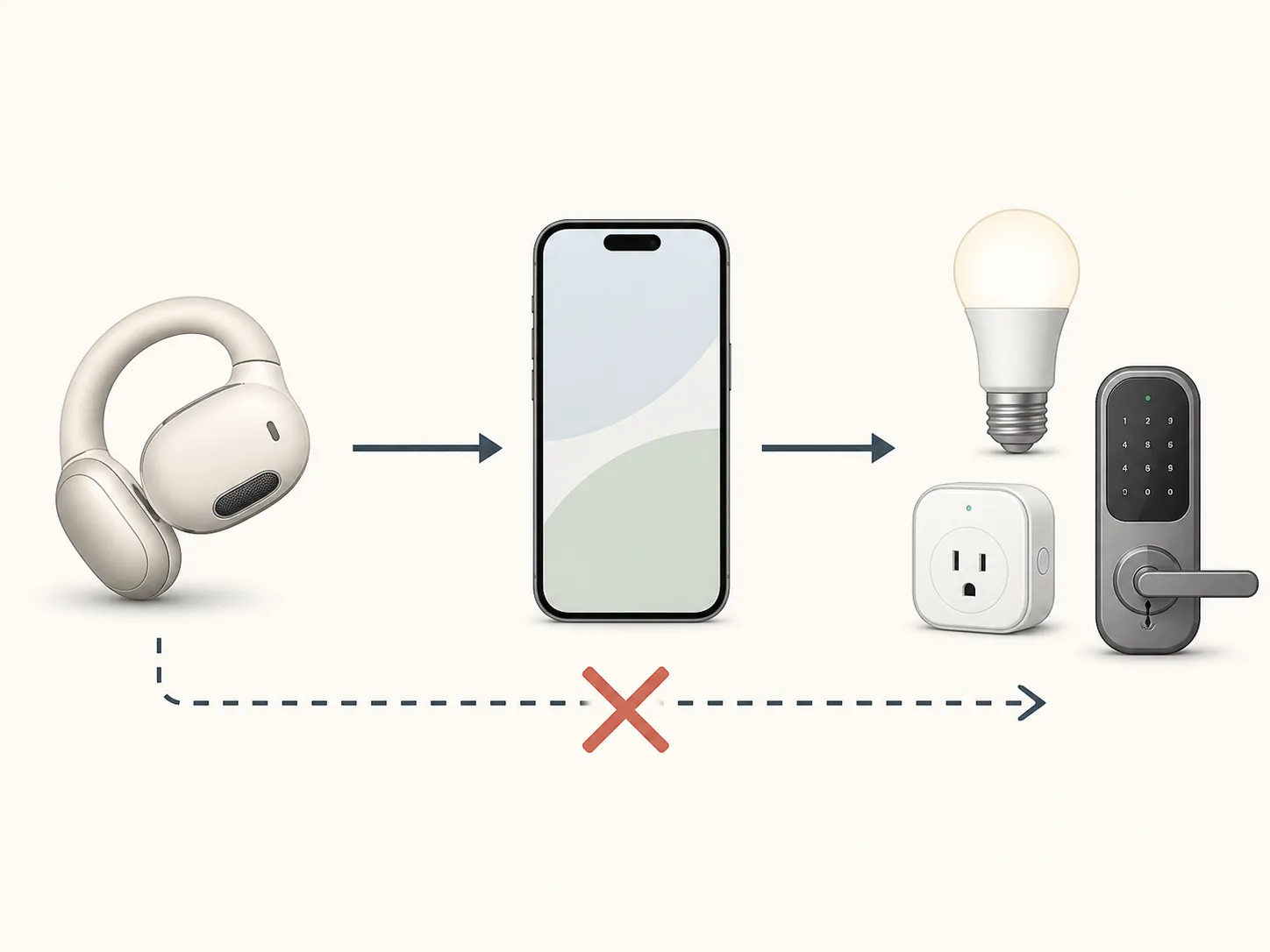
That distinction matters before buying. The Clip2 has no Wi-Fi, Matter, Zigbee, Thread, or other smart-home radio, and it does not connect directly to lights, plugs, locks, a Google Home network, or a hub.[2] It is a wearable microphone and an assistant shortcut. Whether it can turn off the hallway lights depends on the phone, ROM, region, assistant, account permissions, and the smart-home platform already in place.
| Path | Status as of August 25, 2026 | What that status means |
|---|---|---|
| Android global ROM + Gemini/Google Assistant | Confirmed gateway path; end-to-end command verification requires a phone-specific check | The Clip2 gesture and phone-side assistant route are documented, but the available evidence does not identify a reproduced Clip2-to-Google-Home test with phone model, ROM, app version, and command result. |
| China ROM + Breeno | Workaround | Chinese-market units use Breeno, while Google Assistant and Gemini availability is restricted on China ROMs. |
| iPhone + Siri | Investigating | HeyMelody support for Clip2 was added on April 24, 2026, but on-bud Siri invocation has not been independently reproduced in the supplied evidence. |
| Direct smart-home control from the earbuds | Not supported | The earbuds have no smart-home radio or direct connection to home devices. |
What the tap actually does
The useful part of the Clip2 is not that it knows anything about a light bulb. It is that it puts an assistant trigger on the side of your head. OPPO documents a double- or triple-tap gesture for quickly activating Gemini, with the gesture configurable through HeyMelody or the Bluetooth settings on supported ColorOS phones.[1]
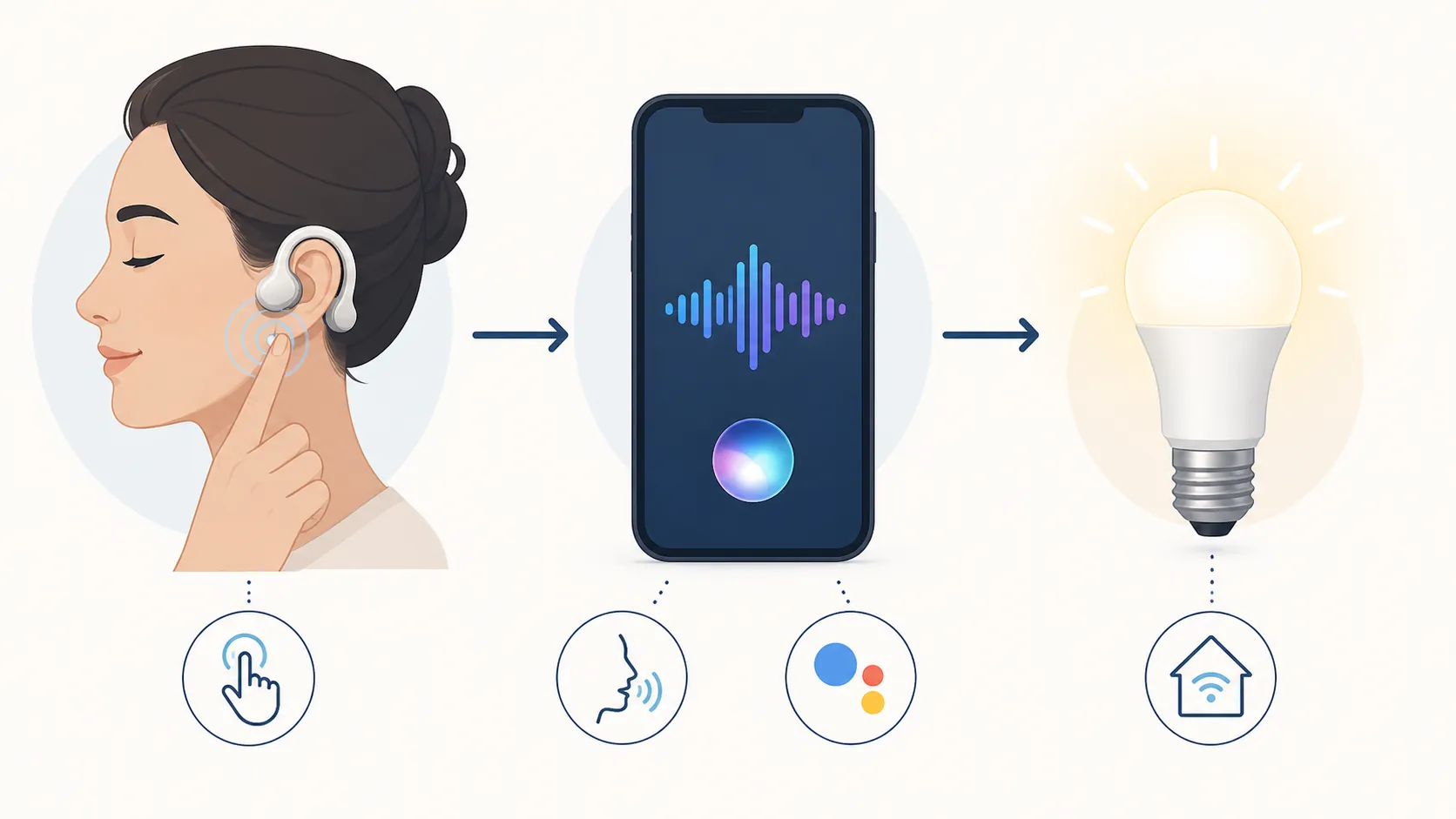
The complete route is straightforward:
- Pair the Clip2 with the phone that already has the relevant assistant and smart-home account.
- Open HeyMelody, or the relevant ColorOS Bluetooth-device controls, and confirm that the chosen tap gesture is assigned to the voice assistant.
- Tap the earbud to start the assistant conversation. A wake word is not required for the tap-activation flow described by the component supplier.
- Speak through the Clip2's open-ear microphone array.
- The paired phone sends the request to Gemini, Google Assistant, or another supported phone-side assistant.
- That assistant uses the permissions and integrations already configured on the phone to operate the smart-home device or routine.
Google's headphone documentation describes the platform-side model: compatible headphones can start an Assistant conversation through a gesture, after which the phone's Assistant handles the interaction.[4] Maxic's component note likewise describes tap-based assistant activation through an in-ear detection sensor without waiting for a wake word.[5] Those sources explain why the Clip2 can feel like a voice remote while walking between rooms. They do not prove that a particular light, lock, or routine will respond on every phone.
That last part belongs to the phone-side test. A command such as “turn off the hallway lights” is successful only if the assistant recognizes the speech, identifies the intended home and device, has permission to act, and supports that action in the user's region and account configuration. The Clip2 supplies the input channel; it does not replace any of those dependencies.
The microphone is the practical test
For this use case, the VPU bone-conduction system and AI NPU microphone processing matter more than the codec list. Independent reviews credit the Clip2's voice and call pickup, which is the relevant hardware evidence when the device is being used to capture a command rather than play music.[3]
The open-ear design is also useful around the house. You can hear a timer, running tap, child, or doorbell while the assistant path remains available, and you do not have to speak toward a speaker in another room. But open-ear awareness is not the same as noise isolation. Independent impressions report that voice pickup becomes less dependable in loud environments, where surrounding sound can drown out the speaker.[3] In a quiet kitchen or while carrying laundry, that is a sensible trade. Beside an extractor fan or a noisy street-facing window, it is a weaker one.
The available evidence does not include a reproducible, dated Clip2 command test with the required phone model, OS or ROM, HeyMelody or ColorOS version, assistant, region, and exact smart-home result. That means the hardware gateway path can be treated as confirmed, while a buyer's end-to-end Google Home result should remain a phone-specific verification item rather than a universal product claim.
Android, China ROMs, and iPhone limits
The cleanest target is an Android phone using a global ROM with Gemini or Google Assistant available in the user's region. Even there, the Clip2 does not create a new assistant capability. It exposes the capability that the phone already has, including its account, language, permissions, and Google Home setup.
A China-market unit or China ROM changes the calculation. For Chinese-market units, Breeno is the assistant path, while Google Assistant and Gemini are restricted on China ROMs. Buying the same earbud model does not therefore guarantee the same tap-to-command experience. Firmware and regional software are part of the product here, not background details.
iPhone support is less settled. The HeyMelody App Store history shows Clip2 support arriving in version 2.25.0 on April 24, 2026.[6] That is useful evidence that configuration support exists in the app, but it is not independent proof that a tap on the earbud reliably invokes Siri or completes a smart-home command. Vendor-adjacent references to Apple-adapted voice commands are not enough to move Siri beyond Investigating until the iOS path is reproduced with a named iPhone, iOS version, region, app version, and command.
What it does not replace
The Clip2 cannot replace a Google Home speaker, a hub, or a phone-side assistant service. It cannot join a Matter fabric, route Zigbee traffic, act as a Thread border router, or operate a device while the paired phone is absent. It also does not establish Alexa support in the available evidence. Calling it a smart-home controller without these qualifications would confuse a Bluetooth accessory with the system that actually executes the command.
Its role is narrower and more useful: it can make the phone's assistant available while your hands are occupied and while you are close enough for the phone to remain connected. That is meaningful for routines such as switching lights, setting a timer, or changing a home state, but only where the existing assistant already knows how to perform the action.
Buying context
The remaining specifications explain the accessory, not its smart-home intelligence. OPPO lists Bluetooth 6.1, LHDC 5.0, AAC and SBC support, IP55 protection, and battery claims of 9.5 hours for the earbuds and 40 hours with the case.[2] Independent reviews cited here measured roughly 10 hours, while pricing has appeared at CNY 899 or 849, S$259 or 229, A$299, and £149 depending on market and promotion.[3] These details may affect whether the Clip2 is a good everyday earbud, but they do not expand what its assistant can control.
Retail copy has also mentioned a 400-meter Bluetooth range, which conflicts with OPPO's own shorter Bluetooth specification.[2] Treat the longer figure as marketing until it is tested under stated conditions. A home voice remote needs a stable phone connection through ordinary rooms, not an impressive distance claim detached from walls, interference, and the phone's position.
Verdict
Buy the OPPO Enco Clip2 for smart-home control if you already have a compatible Android phone, a supported global ROM and region, Gemini or Google Assistant configured, and a reason to want a wearable microphone with a tap shortcut. In that environment, it is a plausible hands-free voice remote because it reduces the distance between you and the phone's assistant.
Do not buy it expecting a new smart-home hub, direct device control, guaranteed Siri support, or independence from the phone. The honest verdict is phone-dependent by design. Before purchase, verify the exact phone, ROM, region, assistant, HeyMelody or ColorOS path, and the commands you actually use. A future per-phone compatibility matrix would make that check faster; this review does not claim that matrix exists yet.
References
- OPPO Enco Clip2 Open Earbuds — OPPO
- OPPO Launches Enco Clip2 — OPPO Newsroom
- OPPO Enco Clip2 Review — HardwareZone; OPPO Enco Clip 2 Review — WhistleOut; OPPO Enco Clip 2 Review — Trusted Reviews
- Use Google Assistant with headphones — Google Assistant Help
- Tap-Based Assistant Activation Without a Wake Word — Maxic
- HeyMelody — Apple App Store
Known issues with this device / protocol
Spec-version history
For active regressions on this protocol, see Update Watch.
No linked Update Watch entries yet.