
Why On-Device AI Can't Replace Your Smart Home Hub
Discover why your smartphone's on-device AI still struggles with smart home control: the missing Zigbee, Z-Wave, and Thread radios force every command through the cloud, creating latency and offline failures that a dedicated hub avoids.
Last updated
The hard limit in using on-device AI as a smart home assistant is usually not the word “AI.” A phone can understand “turn off the downstairs lights” locally and still have no direct way to reach the lights. After the sentence is parsed, something has to carry the command across the home: Wi-Fi, Bluetooth, Zigbee, Z-Wave, Thread, or a bridge that speaks one of them. That is where the clean “your phone is the hub now” story starts to fray.
Most smartphones are excellent Wi-Fi and Bluetooth devices. Many smart homes, however, were not built only on Wi-Fi and Bluetooth. Zigbee switches, Z-Wave locks, Thread sensors, and older bridge-based systems still need hardware that can talk to those networks. A local language model on a phone may reduce a cloud trip for intent recognition, but it does not add a missing radio.
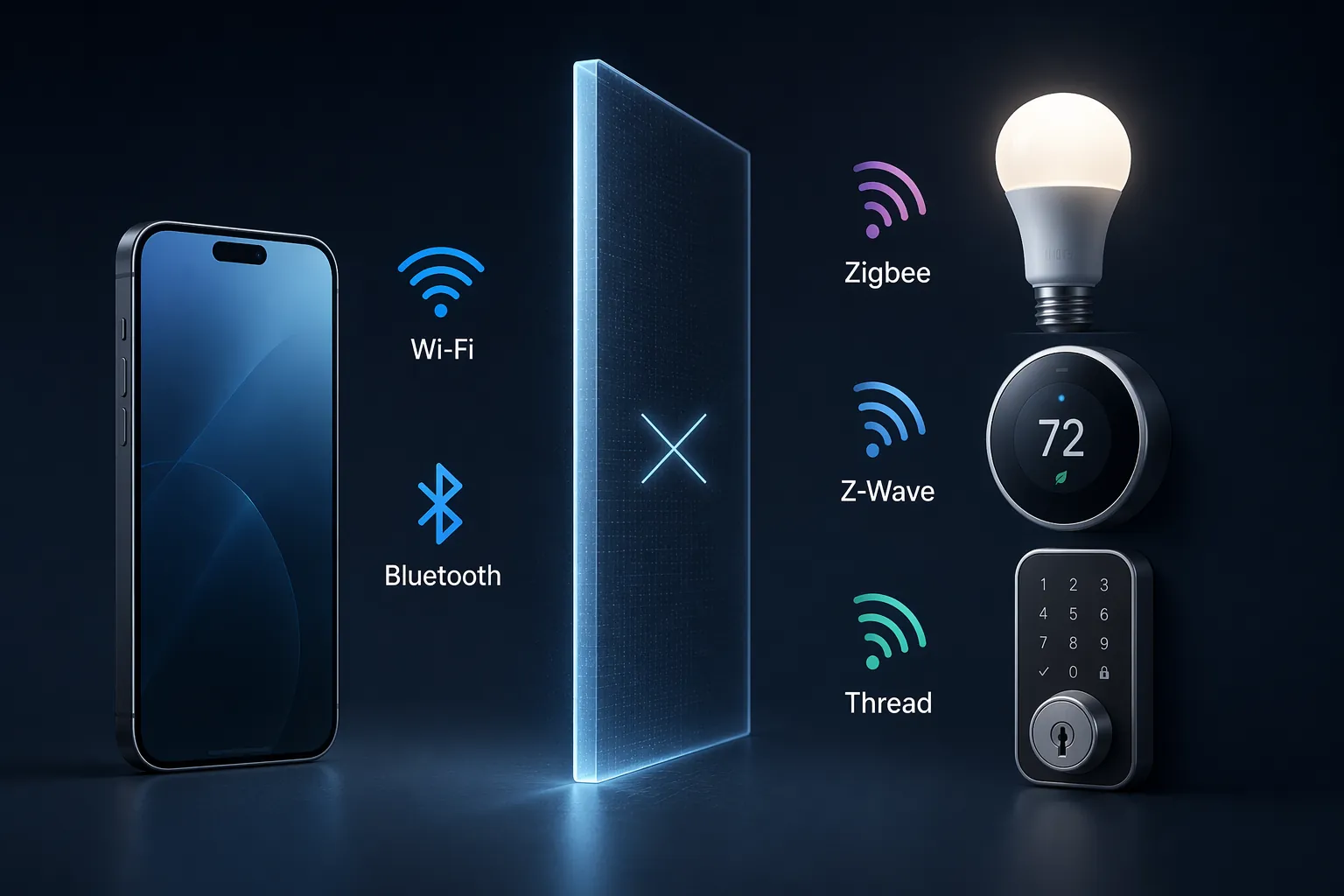
The Phone Understands the Command Before It Can Reach the Device
There are two different jobs hidden inside a smart home voice command. The first is interpretation: turning a sentence into an intent. The second is delivery: getting that intent to a real device over a network path the device can hear. On-device AI helps mostly with the first job. A hub exists mostly because of the second.
That distinction matters because the home is full of devices that were never designed to accept direct commands from a phone. Vesternet’s hub-versus-assistant comparison makes the radio split plain: phones and voice assistants rely on Wi-Fi and Bluetooth paths, while dedicated smart home hubs can include Zigbee and Z-Wave support for direct mesh control. The same comparison notes Z-Wave’s limit of up to 232 devices and Zigbee’s theoretical support for roughly 64,000 devices, while a typical home Wi-Fi router may hit client limits around 32 to 64 devices long before a dense smart home is finished expanding.[1]
| Device or control layer | What it commonly brings | What that means in practice |
|---|---|---|
| Smartphone | Wi-Fi and Bluetooth | Good interface for apps, voice, and AI interpretation; limited direct reach to Zigbee, Z-Wave, and most Thread devices |
| Dedicated hub or controller | Protocol radios or attached dongles | Can sit on the home network and translate commands into the radio used by the device |
| Thread border router | Thread-to-IP routing | Lets Thread devices participate in the IP smart home, but still must be present and working |
| Cloud service | Account-based routing between ecosystems | Useful for remote access and integrations, but dependent on internet and vendor availability |
A Wi-Fi bulb is the easy case. If the bulb’s app and service are working, the phone has a familiar route. A Zigbee wall switch or Z-Wave lock is different. The phone may show the control tile, and the assistant may understand the phrase, but the command still has to pass through a hub, bridge, or cloud-connected platform that can actually speak to the device.
Cloud Routing Is Where the Local-Control Promise Gets Spent
The frustrating part is that the user may not see this handoff. The phone hears the command. The assistant responds. The app interface looks local. But if the device sits behind a protocol the phone cannot speak, the command leaves the phone’s neat little local-processing story and goes looking for an intermediary.
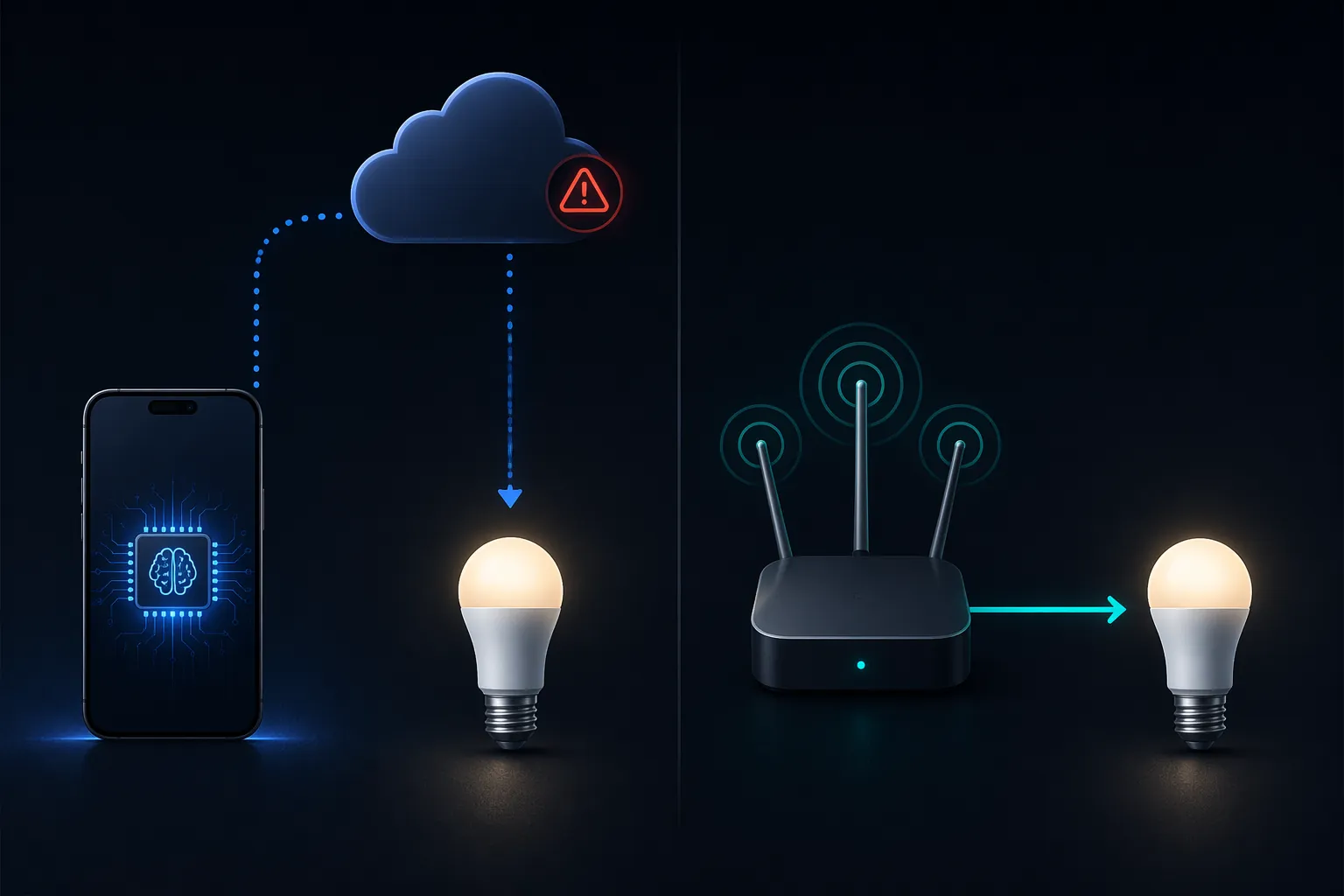
That intermediary might be a vendor cloud, a voice assistant cloud, a manufacturer bridge, or a hub on the local network. If it is cloud-based, the supposed local advantage disappears at the delivery layer. Vesternet describes voice assistants such as Alexa, Google Assistant, and Siri as routing device commands through cloud services; when the internet connection fails, a phone that lacks the device radio still has no direct route to the hardware it is trying to control.[1]
This is why “the AI runs on the phone” and “the home runs locally” are not the same claim. Local intent parsing can reduce one cloud dependency. It does not remove every cloud dependency downstream. If the actual switch is waiting on a Zigbee coordinator, a Z-Wave controller, a Thread border router, or a manufacturer service, the phone’s model is only the first participant in a longer chain.
Latency follows the same pattern. The delay in a smart home command is not only the time it takes to understand speech. It is also account routing, service availability, bridge translation, radio retries, and whether the target device is awake and reachable. On-device AI can make the first step feel faster while the rest of the path remains as indirect as before.
A Phone Is a Personal Device; a Hub Is Infrastructure
The radio gap is the main issue, but it is not the only one. A phone is designed around a person. It moves between rooms, leaves the house, conserves battery, sleeps radios, installs updates, reboots, and sometimes dies in a jacket pocket. That is sensible behavior for a personal computer. It is poor behavior for the one device that should be available every time a leak sensor, lock, light, or motion rule needs a route.
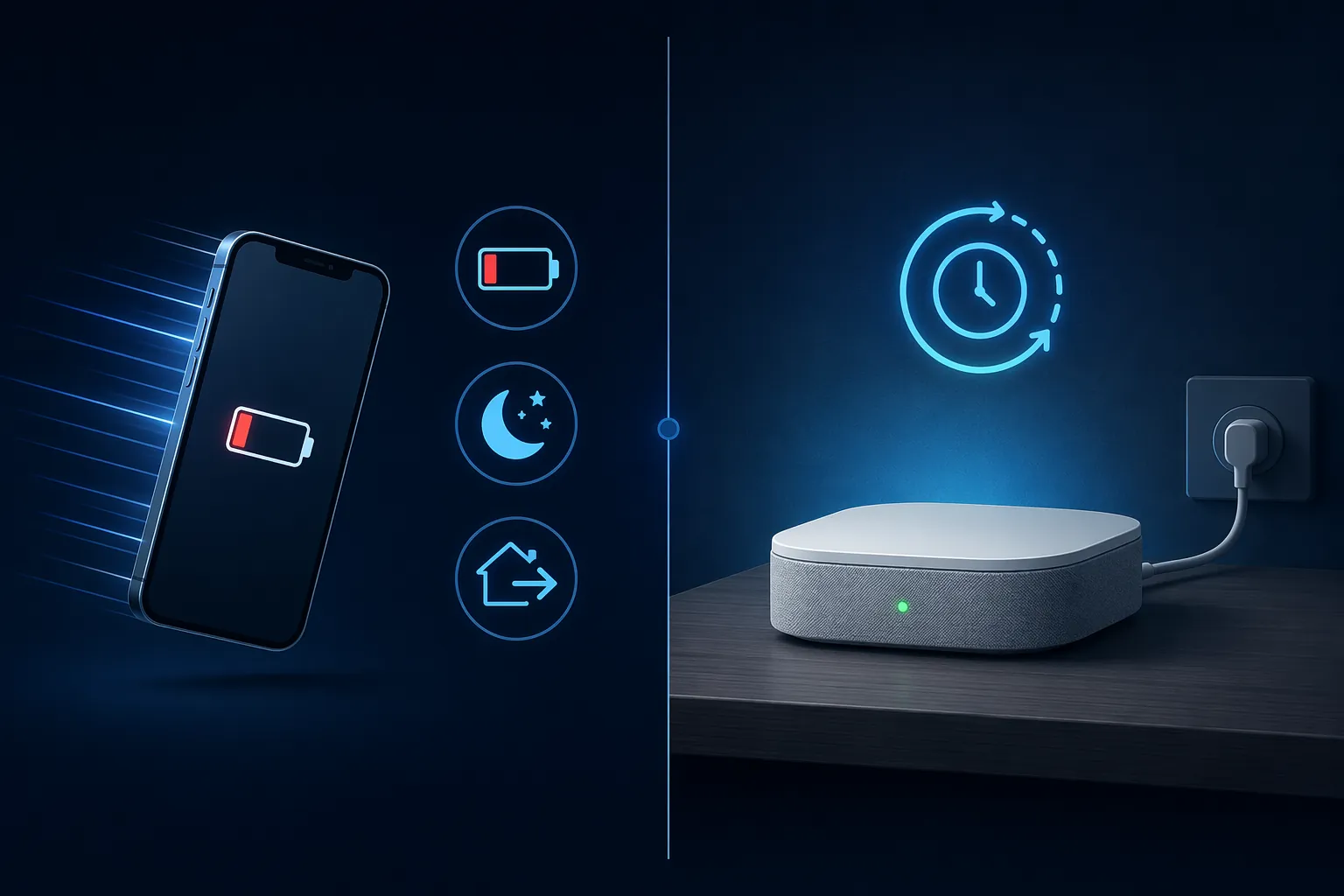
Dedicated smart home controllers are boring in exactly the way this job rewards. They sit in one place. They stay powered. They remain attached to the network. They can be backed up and restored. Vesternet frames this as a basic operational distinction between personal voice-assistant devices and smart home hubs designed for 24/7 control.[1]
That does not make a phone a bad controller. For many homes, the phone is the best interface in the system: it has the screen, the account, the voice assistant, the automation app, and now increasingly capable local AI. The mistake is treating that interface as if it were the control plane. A dashboard can be beautiful and still depend on another box to keep the lights, locks, and sensors reachable.
Matter Helps the Language Problem, Not Every Reachability Problem
Matter improves one important part of the smart home mess: the application language devices and ecosystems use to describe and control things. It does not magically install every needed radio into the phone, and it does not remove the need for Thread infrastructure when the device is a Matter-over-Thread product.
A Thread device needs a Thread network and a border router that can bridge that low-power mesh into the IP network used by phones, hubs, and apps. If the phone cannot provide that role reliably, another device has to. That might be a smart speaker, display, Apple TV-style box, dedicated hub, or other always-on border router. The phone can participate in commissioning and control, but the Thread path still has to exist after setup.
The current state of Android Matter-over-Thread setup shows why standards support is not the same as dependable local control. A Home Assistant Community thread documents commissioning failures tied to IPv6-enablement requirements, manual Thread credential resets, and VLAN incompatibilities that prevented users from adding Matter-over-Thread devices successfully.[2] That is not proof that every Android setup fails, and firmware and platform updates can change these outcomes. It is proof of a narrower but important point: a phone showing Matter support does not guarantee the network path is ready.
This is also where the Pixel 11 counterpoint belongs. A newer phone with a Thread radio narrows part of the gap. It can make phone-based control and setup more credible for Thread devices than older phones that lack that hardware entirely. But it still does not solve Zigbee. It still does not solve Z-Wave. It still does not turn a mobile, battery-managed personal device into an always-on household controller. A Thread-equipped phone is a better controller; it is not automatically a better hub.
Where the Smartphone Fits
The practical answer is not to throw away phone control. Use it for what it is good at. Let the phone handle voice capture, natural-language interpretation, app dashboards, remote access, notifications, and quick manual control. Let on-device AI make those interactions less brittle and less dependent on a server for every phrase.
Then keep the actual home-control infrastructure matched to the devices installed in the house. If the home depends on Zigbee sensors, use a Zigbee-capable hub or coordinator. If it depends on Z-Wave locks and switches, keep a Z-Wave controller in the system. If it depends on Thread, make sure there is a reliable border router on the network. If low latency or outage behavior matters, avoid a design where every command must leave the house before a nearby device can react.
A simple Wi-Fi-heavy apartment may feel fine with phone-first control, especially when devices are already tied to cloud apps and the owner values convenience over offline resilience. The line changes when the home contains mesh devices, security devices, automations that should run when nobody is home, or controls that should keep working during an internet outage. At that point, the missing radio is no longer an implementation detail. It is the reason the command has nowhere local to go.
On-device AI can make the assistant smarter. It can make the phone more useful. It cannot, by itself, make a Zigbee switch hear Wi-Fi, make a Z-Wave lock appear on Bluetooth, or make a Thread mesh work without border-router infrastructure. For a reliable smart home, the phone should be the interface and interpreter. The hub, bridge, dongle, or border router should remain the part that keeps the devices reachable.
References
- Smart Hubs Verses Voice Assistants, Vesternet.
- Unable to add devices to Home Assistant with Matter via Thread, Home Assistant Community.
Known issues with this device / protocol
Spec-version history
For active regressions on this protocol, see Update Watch.
No linked Update Watch entries yet.