
How Smart Weather Monitoring Works in Extreme Events
This article explains why consumer weather stations do not support Matter, Thread, Zigbee, or Z-Wave, and what that means for reliability during storms. It covers which stations maintain local-only operation when internet fails, and which require cloud connectivity to share data.
Last updated
The awkward answer is that most full weather stations do not behave like normal smart-home sensors. They usually will not appear in Matter, Thread, Zigbee, or Z-Wave device lists because their outdoor sensor link is built around Wi-Fi or proprietary sub-GHz radio, not the 2.4 GHz mesh standards used by many indoor sensors. Across the major consumer station families reviewed here—Ambient Weather, Tempest, Ecowitt, Davis, and AcuRite—the documented sensor-to-console or sensor-to-hub path sits outside Matter, Thread, Zigbee, and Z-Wave compatibility lists.[1]
There is one important counterexample, and it is also the trap in the question. Eve Weather supports Thread and Matter, but it measures temperature, humidity, and barometric pressure; it does not provide wind speed, wind direction, rainfall, or lightning detection.[2] That makes it a real Matter weather sensor, not a full extreme-event station. If the automation you care about is “close the shades when gusts pass a threshold,” “turn on flood lighting when rain starts,” or “warn when lightning is nearby,” Eve Weather is missing the measurements that would fire those rules.
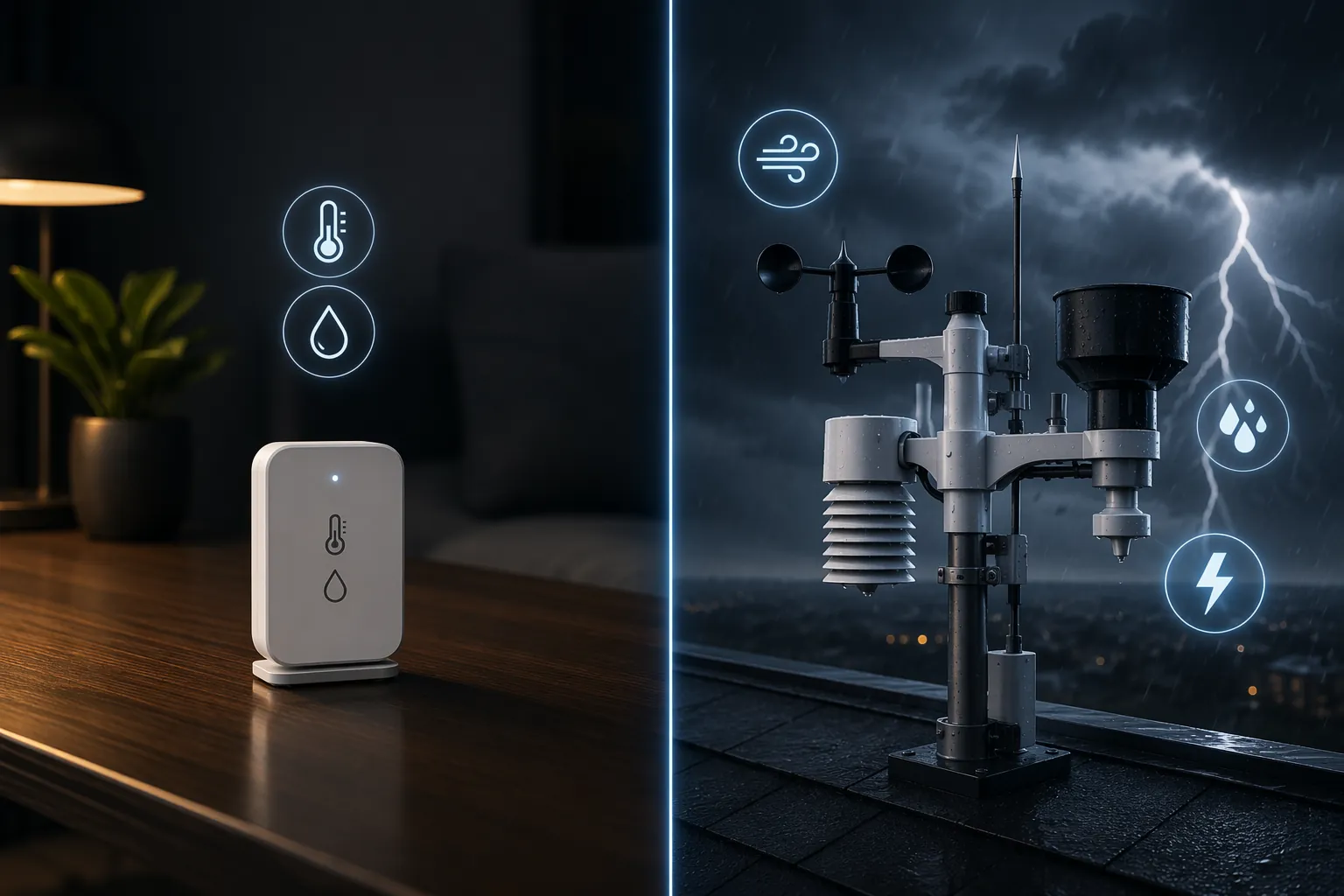
The Word “Connected” Hides Three Different Links
A weather station is not one connection. It is a chain. The outdoor sensor array has to reach a console, hub, or gateway. That device may need Wi-Fi or Ethernet to reach a cloud service. Then the cloud service, a local integration, or a bridge has to hand the data to Home Assistant, HomeKit, Alexa, Google Home, or another automation platform. When a storm takes out broadband, each link has a different failure mode.
This is why the protocol label matters less than the full path. A proprietary 915 MHz sensor radio can be a perfectly sensible outdoor engineering choice. It may travel farther than a short-range indoor mesh and can be tuned around battery life and weatherproof hardware. But that does not tell you whether your smart-home hub can still see the data when the WAN is down.
| Station family | Outdoor sensor path | Smart-home path that matters during a storm | What fails first when internet drops |
|---|---|---|---|
| Tempest / WeatherFlow | Proprietary sub-GHz mesh | Local UDP broadcast is available; many general integrations still use WeatherFlow cloud | Cloud-dependent features fail, but local UDP listeners can still receive broadcast data |
| Ecowitt | 915 MHz in North America | Home Assistant can receive local HTTP push | Cloud dashboards fail, but the local Home Assistant push path can continue on the LAN |
| Ambient Weather | 868/915 MHz sensor link on major stations | Alexa skill and common bridge routes are cloud-centered | Voice-assistant and cloud API routes are exposed to WAN failure |
| Davis Vantage Vue / Vantage Pro2 | 868–916 MHz station radio depending on model and region | Requires WeatherLink Live for Wi-Fi participation in the setup described | Without the gateway, there is no smart-home network path to fail because the station remains local-display only |
| AcuRite Atlas | Proprietary station-to-display or station-to-hub path | Requires Access hub for smart-home connectivity in the setup described | Cloud or hub route becomes the dependency once Access is added |
| Eve Weather | Thread / Matter | Native Matter-style smart-home sensor behavior | Useful for basic weather readings, but not for wind, rain, or lightning automations |
Tempest: The Local UDP Path Is the Part to Care About
Tempest is one of the few consumer stations where the local path is not an afterthought. The station supports local UDP broadcast messages, and a documented Crestron integration uses those messages for rain detection without depending on an internet connection.[3] That does not mean every Tempest feature in every smart-home platform is automatically local. It means the station exposes a local signal path that an automation system can listen to while the cloud is unreachable.
That distinction is the difference between a dashboard and a trigger. A cloud dashboard can be excellent on an ordinary Tuesday. During the one hour when the cable modem is dark and the wind is climbing, the local UDP listener is the part that can still feed an automation controller on the same LAN, assuming the station, router, and controller still have power.
Tempest also occupies an odd place in Apple homes. It is described as the only station in this group with native Apple HomeKit support, but that support is via the WeatherFlow API.[1] For everyday Home app visibility, that may be enough. For storm survivability, API-based HomeKit visibility is not the same thing as a local UDP automation path.
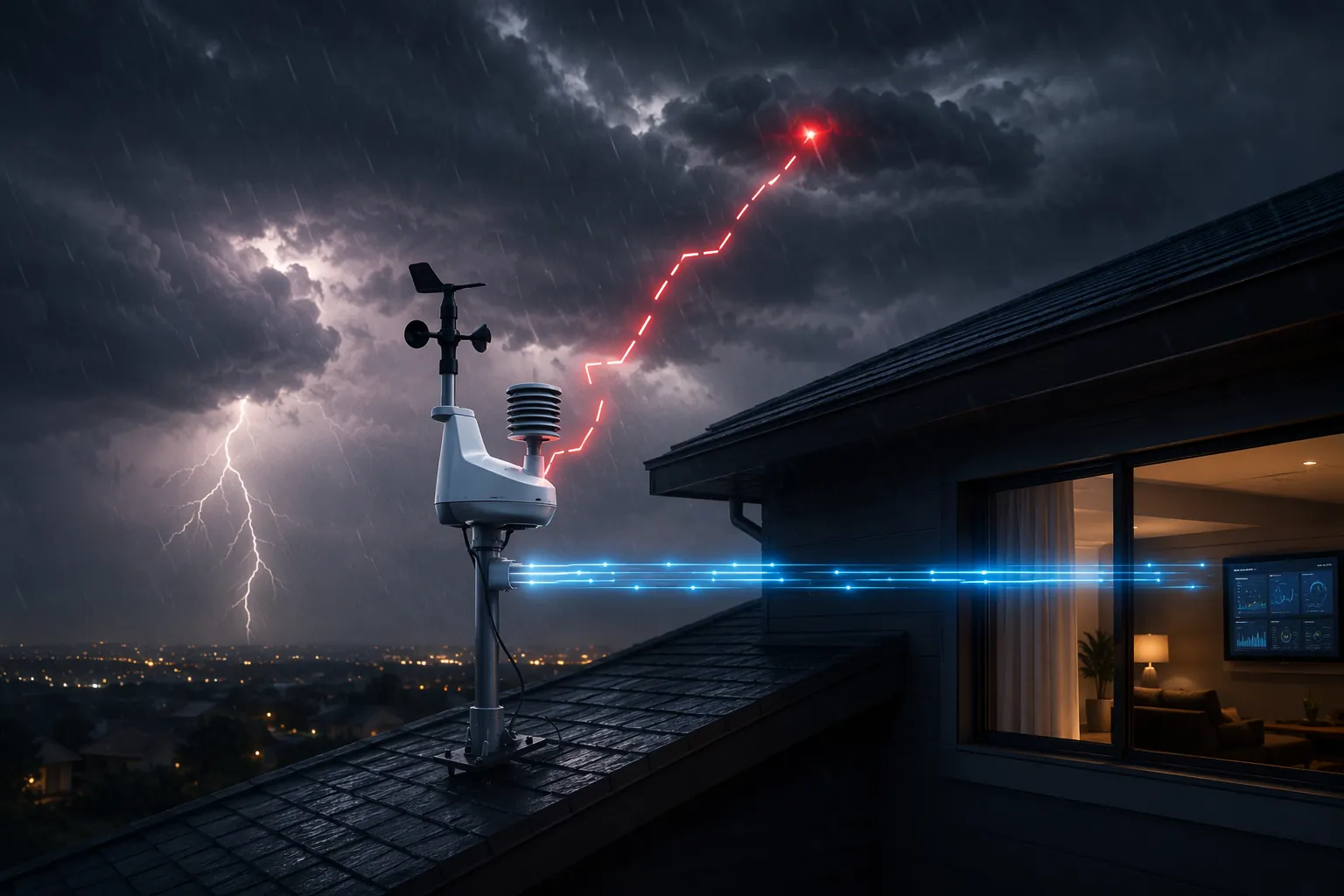
Ecowitt: Local Push, With One Plain Constraint
Ecowitt’s Home Assistant integration is the other meaningful local-survivability case. Home Assistant classifies it as Local Push: the Ecowitt device sends data to Home Assistant over the local network instead of requiring Home Assistant to poll a cloud account. The official integration page also documents that the integration requires HTTP rather than HTTPS.[4]
That HTTP requirement is not a reason to pretend the integration is cloud-bound. It is a local-network security and configuration constraint. On a trusted LAN, with the weather gateway and Home Assistant host on backup power, the practical benefit is clear: rain, wind, and sensor updates can keep moving even when outside internet service is gone.
The integration is not obscure inside Home Assistant, either. The official page reported Ecowitt in 2.7% of active Home Assistant installations as of mid-2026.[4] That figure measures adoption inside Home Assistant, not measurement accuracy and not storm success rate. Still, it says this is a real integration path people are using, not a one-off forum experiment.
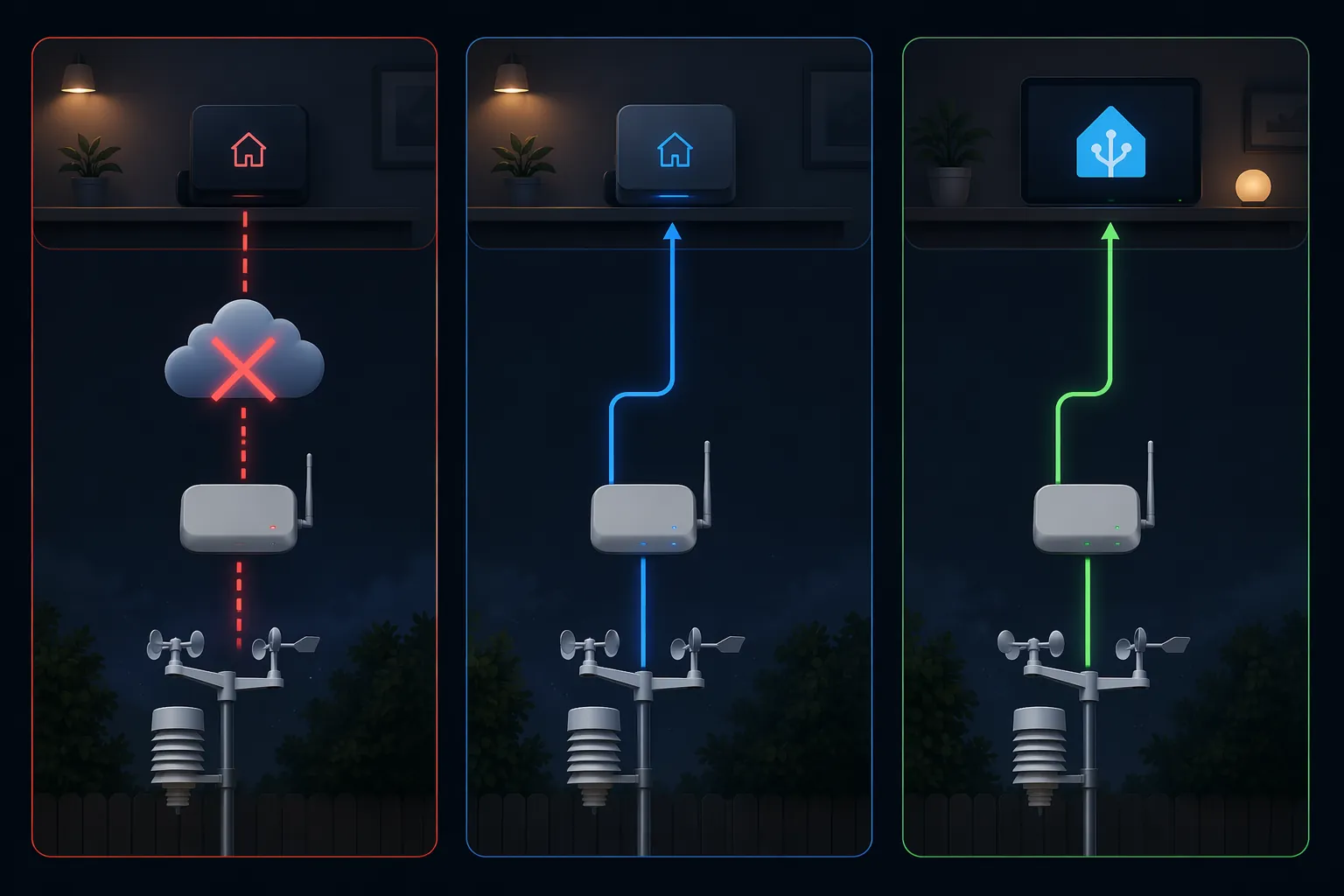
Ambient Weather, Davis, and AcuRite Depend More on the Middle Box
Ambient Weather stations are often attractive because they already feel internet-connected: app dashboards, account-based sharing, and voice-assistant routes are familiar. The WS-5000 has native Alexa integration through a skill, but no native HomeKit or Google Home support; HomeKit usually means a Homebridge route.[1] Those routes can be useful, but they do not turn the station into a Matter, Thread, Zigbee, or Z-Wave device, and they do not remove the cloud dependency from the core smart-home path.
Davis and AcuRite add another purchase-planning wrinkle: the gateway can be the difference between a good standalone station and a station that participates in automations at all. In the reviewed setup guidance, Davis Vantage Vue requires a separate $170 WeatherLink Live gateway to connect to Wi-Fi; without it, the station remains local-display only. AcuRite Atlas requires a separate $60 Access hub for smart-home connectivity.[1]
Those gateway costs are not just accessory trivia. They define the network architecture. If the outdoor array only talks to a console, your smart home cannot act on the data. If a separate gateway sends the data through a cloud service, your smart home may see the station beautifully until broadband fails. The expensive mistake is assuming the radio link from the roof and the integration link to the automation hub are the same thing.
Accuracy Still Has to Be Judged Separately
Local survivability does not prove a station measures well. Wirecutter’s one-month comparison against a National Weather Service site found Tempest had the best temperature deviation in its roundup at 0.65°F, while also posting the worst humidity deviation at 7.53%. Ambient Weather’s WS-2000 was reported as the most consistent overall, with 0.87°F temperature deviation and 4.81% humidity deviation.[5]
Those figures are useful guardrails, not a complete storm-performance verdict. A station can have a local data path and still need careful siting. A rain gauge can be blocked by roof splash. Wind readings can be dulled by trees or roofline turbulence. Cold-weather precipitation adds another layer: tipping buckets can freeze, and nontraditional rain sensors may detect impact or vibration without necessarily giving the liquid-equivalent number a hydrologist would want. None of that is fixed by a Matter logo.
What Actually Happens When the Internet Fails
The useful test is simple: unplug the WAN, not the weather station. If your automation still receives wind, rain, or lightning-adjacent data across the LAN, you have a survivable local path. If the app stops updating and the smart-home entity goes stale, the integration was cloud-mediated, even if the sensor array on the roof is still talking happily to its own console.
- Tempest can support local storm triggers when your automation platform listens to its local UDP broadcasts; cloud API features are a separate dependency.
- Ecowitt can support local Home Assistant triggers through local HTTP push; the HTTP-only requirement needs to fit your LAN security model.
- Ambient Weather voice-assistant and bridge paths are convenient, but the common smart-home routes do not remove cloud exposure.
- Davis and AcuRite buyers need to budget for the gateway before discussing smart-home behavior, because the base station may otherwise remain a display appliance.
- Eve Weather belongs in a Matter conversation, but not in a wind, rain, and lightning automation conversation.
Power is the companion problem. A local UDP or local push path still needs the station gateway, router, and automation host alive. The protocol choice gives you a possible route around the cloud; it does not give you a UPS, a better antenna location, or a second alert source.
Where This Leaves Matter, Thread, Zigbee, and Z-Wave
The practical reason full weather stations sit outside the usual smart-home meshes is that they are outdoor measurement systems first. They need long-enough outdoor range, battery-conscious radios, weather-sealed sensor arrays, and sometimes a console or gateway that can aggregate several measurements before anything reaches the home network. Matter, Thread, Zigbee, and Z-Wave are excellent in the right places, but a roof-mounted station measuring wind, rainfall, and lightning is not built like a door sensor or indoor temperature puck.
That does not make the absence permanent. It is a landscape finding from current product materials and compatibility behavior, not a law of physics. The safe conclusion is narrower: if you are shopping among the major consumer station families in 2026, do not expect full weather-station support through Matter, Thread, Zigbee, or Z-Wave. Expect a proprietary outdoor radio, Wi-Fi or Ethernet backhaul, and then either a cloud API, local UDP, local HTTP push, or a gateway-specific bridge.
For model-level storm shopping, the companion hurricane weather-station compatibility guide is the better place to compare station families. If the standards stack itself is the confusing part, the Matter, Zigbee, and Thread comparison explains the mesh layer that most full weather stations bypass.
If the goal is local storm-trigger automations, start with Tempest local UDP or Ecowitt local push and then design the rest of the chain around backup power and LAN continuity. If the goal is a clean app history, voice queries, or casual dashboard viewing, cloud integrations may be acceptable. If the goal is Matter specifically, buy Eve Weather with the right expectation: it is a basic weather sensor for temperature, humidity, and pressure, not an extreme-event station. For backup alerting beyond your own sensors, add a separate severe-weather notification path through hub-based weather alerts or fold station data into a broader extreme-weather mode.
References
- Best Smart Weather Stations 2026, SmartHomeExplorer
- Matter, Eve Home
- Integrating Natural Disaster Detection Sensors Into a Smart Home, Residential Tech Today
- Ecowitt, Home Assistant
- The Best Home Weather Stations, Wirecutter
Known issues with this device / protocol
Spec-version history
For active regressions on this protocol, see Update Watch.
No linked Update Watch entries yet.