
How the Foldable iPhone Changes HomeKit in 2026
Before buying the 2026 foldable iPhone, HomeKit power users need to know which features carry over, which get better, and which disappear — from Thread border router upgrades to the loss of MagSafe HomeKey and Face ID. This compatibility check provides a status-labeled breakdown so you can decide if the trade-offs are worth it for your smart home setup.
Last updated
If the rumored 2026 foldable iPhone becomes your daily phone, your Apple Home setup does not simply move over unchanged. The likely upside is real: Thread support through Apple’s N1 chip, a larger Home app workspace, iOS 27 camera and energy features, and a more capable Siri. The uncomfortable part is just as practical: the current evidence points to no MagSafe, no Face ID, and no Action Button, which means some HomeKey, authentication, presence, and scene-launching habits may break in ways an iOS update cannot repair.
This is a pre-purchase compatibility check as of July 24, 2026. Apple has not announced the foldable iPhone, so the hardware side is still built from rumors, dummy models, leaked CAD, and analyst reporting. Treat the table as a risk map, not a lab certification.
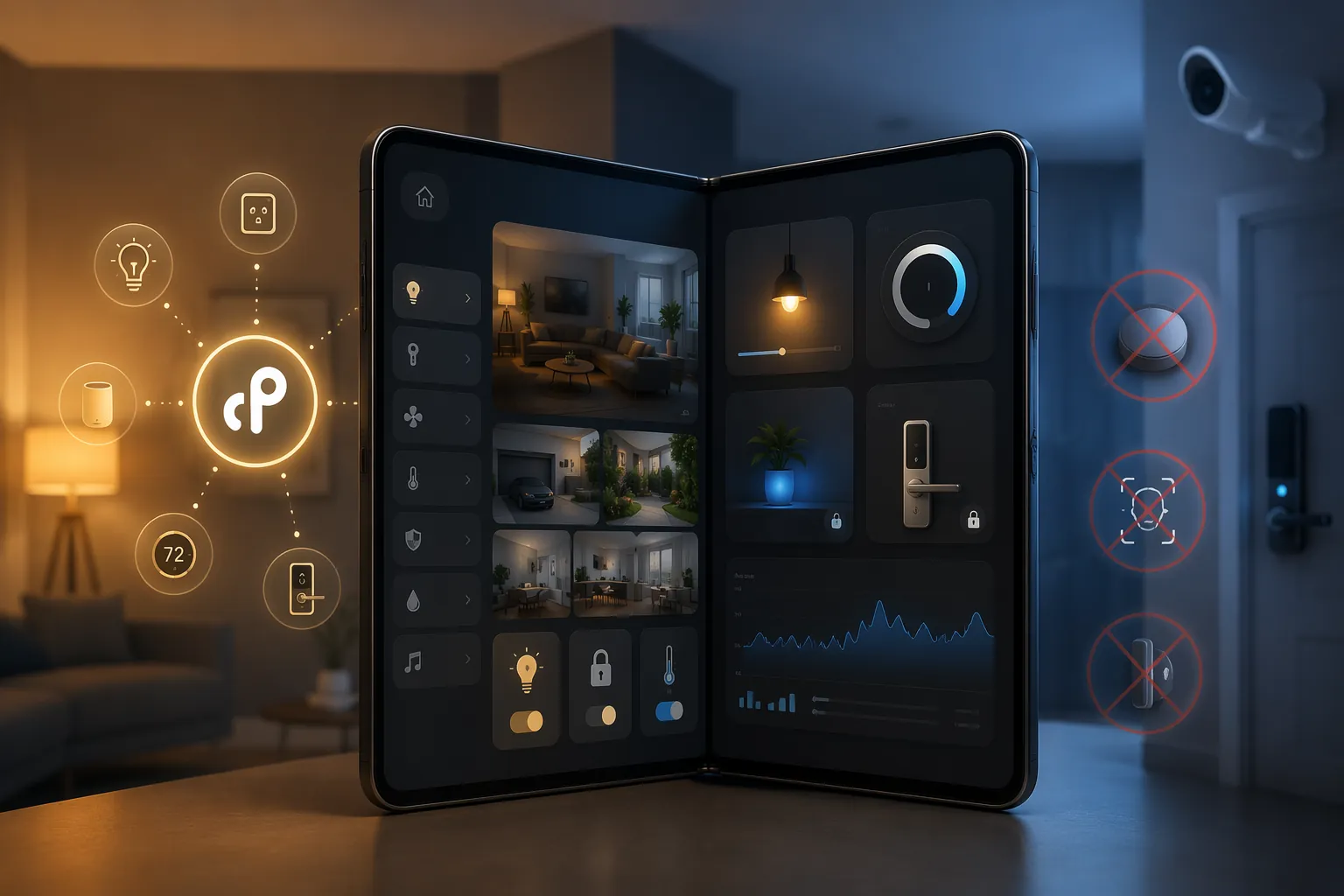
Compatibility Verdict for Apple Home Users
| HomeKit area | Status as of July 24, 2026 | What changes in daily use | Evidence type |
|---|---|---|---|
| Thread border router / Matter-over-Thread control | Expected | The Fold is expected to join the iPhone 17-and-later group that can act as a Thread border router for Matter/Thread accessories. That helps with direct accessory routing, but it does not turn the phone into a full HomePod or Apple TV replacement for every Apple Home job. | MacRumors says the Fold is expected to use Apple’s N1 chip, and Apple’s iPhone 17-series already introduced N1 with Thread support.[1][2] |
| iOS 27 Home app features | Beta / Unconfirmed | 4K HomeKit Secure Video, Apple Intelligence video summaries, grouped multi-camera events, energy monitoring, and Thread 1.4 support could make the Fold much better for camera-heavy and energy-aware homes. Final shipping behavior may still change. | MacRumors describes these as iOS 27 Home app beta-era features, with 4K HKSV requiring iCloud+.[3] |
| LLM-powered Siri for Home control | Expected | Voice control should become more forgiving for multi-part Home requests, especially when changing rooms, scenes, or device states. It should still be judged as a control layer, not proof that every automation will become smarter. | MacRumors’ 2026 Apple guide points to LLM-powered Siri arriving with the 2026 software and device cycle.[2] |
| 7.8-inch unfolded Home app layout | Expected | The larger canvas should help when watching cameras and adjusting accessories at the same time. A persistent sidebar, split views, and adaptive layouts matter more here than the novelty of the hinge. | Bloomberg reporting summarized by MacRumors points to a 7.8-inch inner display, while 9to5Mac reports new app features including side-by-side multitasking and iOS framework references for fold state and angle.[1][4] |
| MagSafe and HomeKey Express Mode tap-to-unlock | At Risk / Likely Missing | If MagSafe is absent, the neat phone-to-lock HomeKey gesture many users rely on may disappear. That is a front-door problem, not a spec-sheet inconvenience. | MacRumors reports dummy models from Sonny Dickson and Vadim Yuryev without MagSafe magnet indentations, while the article also leaves room for final hardware changes.[5] |
| Face ID for Home app authentication and presence-linked routines | Missing / Replaced | Secure Home app actions would move to Touch ID on the side button if Face ID is gone. Households using Face ID behavior as part of their phone-unlock, presence, or secure-control rhythm should expect a changed flow. | MacRumors reports that Face ID is expected to be replaced by a Touch ID side button because the TrueDepth array does not fit the rumored thin design.[5] |
| Action Button scenes | Missing | Any Home scene assigned to the Action Button, such as Good Night or Away, loses its physical launcher. Shortcuts, Control Center, widgets, and Siri can replace the function, but not the same blind, muscle-memory press. | MacRumors’ dummy-model analysis says the Action Button is missing from the foldable iPhone models shown.[5] |
| Phone camera as a Home-adjacent capture device | Minor Caveat | The rumored dual-camera setup and lack of telephoto matter little to most HomeKit setups, because HKSV depends on home cameras, not the phone camera. It only matters if you use the phone itself for setup, inspection, or documentation around accessories. | MacRumors’ iPhone Fold roundup describes a dual-camera arrangement without telephoto.[1] |
| eSIM-only travel use | Minor Caveat | This does not change HomeKit directly, but it can affect people who manage homes across countries and depend on local SIM flexibility while troubleshooting locks, cameras, or routers remotely. | MacRumors’ iPhone Fold roundup lists eSIM-only as an expected design choice.[1] |
The short version: the Fold looks promising if your Apple Home life is mostly screens, cameras, Matter accessories, and voice control. It looks risky if your home routines depend on magnets, biometrics, and a physical button you can press without looking.
The Upgrades Are Mostly About Control Surfaces
The N1 chip is the cleanest smart-home upgrade in the rumor stack. If the Fold ships with N1 as expected, it should be able to act as a Thread border router for Matter/Thread accessories, matching the capability Apple introduced with the iPhone 17-series and later devices.[1][2] That places it in the same practical family covered in NestGrid’s iPhone smart home hub compatibility guide, where the important distinction is direct control and routing support, not replacing every job of a dedicated HomePod or Apple TV.
That distinction matters. A Thread-capable iPhone can improve how Matter/Thread accessories are reached when the phone is present and participating, but it is not the same thing as saying the Fold becomes the permanent, always-home coordinator for a household. If you already own HomePods, Apple TVs, and Thread accessories, the Fold is more likely to be a stronger controller in the mesh than a reason to redesign the mesh.
The unfolded screen is the other obvious gain, and this is where the form factor finally earns smart-home relevance. Bloomberg reporting summarized by MacRumors points to a 7.8-inch inner display, and 9to5Mac reports side-by-side multitasking plus iOS framework references to fold state and angle APIs.[1][4] For Apple Home, the useful version of that is not “big phone.” It is opening a camera feed, keeping a room list visible, and still having space to change a thermostat, unlock a door, or dim a light without bouncing between panels.
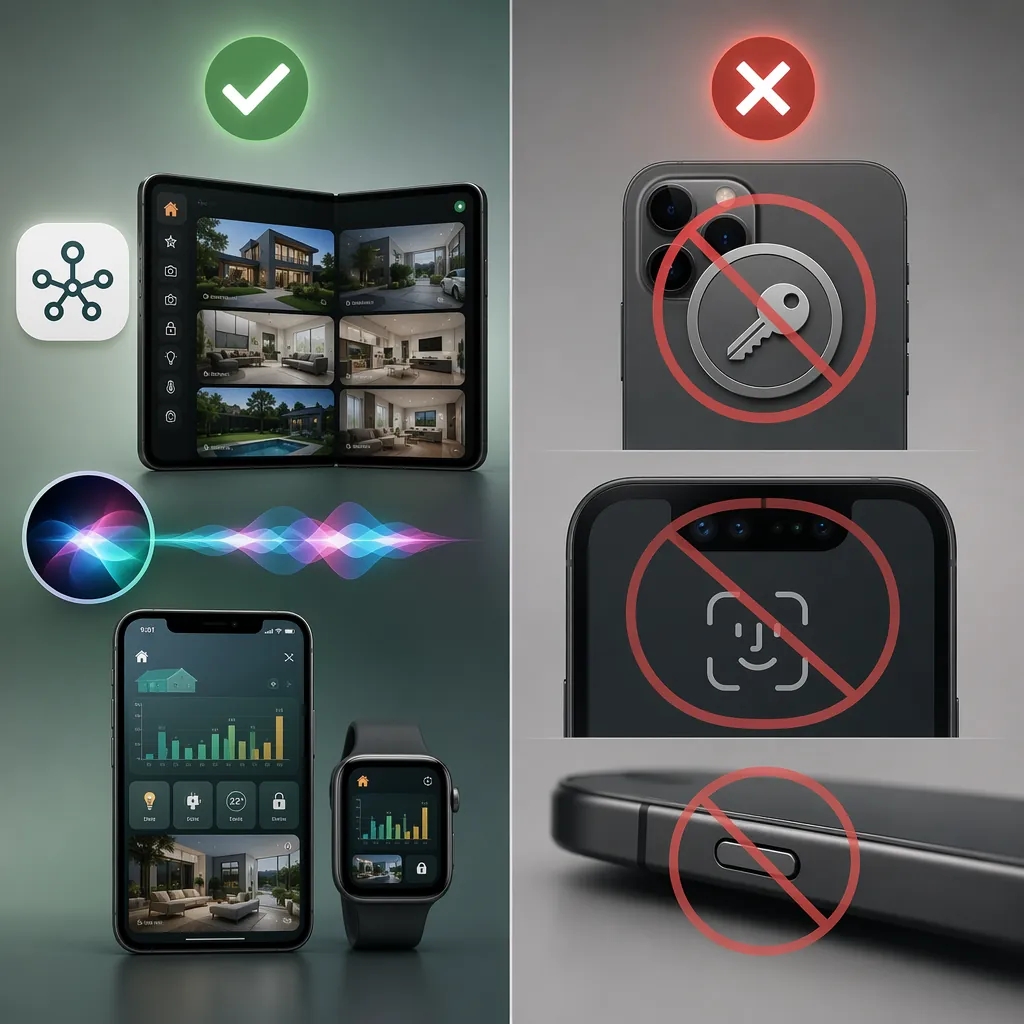
Camera-heavy homes would feel this first. iOS 27’s reported Home app work includes 4K HomeKit Secure Video with iCloud+, Apple Intelligence-generated video summaries, grouped multi-camera event tracking, energy usage monitoring, and Thread 1.4 support.[3] On a standard phone, those features compete for a narrow column. On an unfolded display, they can become a dashboard: multiple cameras on one side, accessory controls on the other, and fewer trips back to a room list just to check whether the garage light is still on.
The LLM Siri piece belongs in the same bucket. A smarter Siri could make Home control less brittle when someone says a room name imperfectly or asks for several related changes in one request.[2] That is valuable, especially at night or when hands are full. It should not be treated as a replacement for dependable buttons, locks, and automations. Voice is a convenient layer; the household still needs the underlying control path to work when people are tired, hurried, or standing outside the door.
For broader Matter context, the Fold appears closer to Apple’s recent Pro iPhones than to a new category. NestGrid’s iPhone 18 Pro versus Galaxy S27 Ultra comparison explains why Apple’s on-device Matter and Thread direction matters, while the iPhone 18 Pro HomeKit upgrade check is the useful warning: once a device is already in the iPhone 17-and-later Thread capability bucket, the next model does not automatically transform Apple Home.
The Losses Are Hardware Habits, Not Cosmetic Omissions
The MagSafe question is the one I would not wave away. MacRumors reports that dummy models from Sonny Dickson and Vadim Yuryev lack MagSafe magnet indentations, and frames this as one of the possible missing features on Apple’s ultra-thin foldable design.[5] That is still inference from dummy hardware, not Apple confirmation. Some final-unit surprises remain possible. But if MagSafe is truly gone, the impact lands at the door.
HomeKey Express Mode is valuable because it reduces the lock interaction to a repeatable gesture. Walk up, tap, enter. When it works, nobody in the household thinks of it as a feature anymore; it becomes the door. Losing that path does not make a smart lock useless, but it changes who has to open the Home app, who has to authenticate, who waits in bad weather, and who starts carrying a backup key again.
Face ID is the next serious break. MacRumors reports that Apple is expected to replace Face ID with Touch ID in the side button because the TrueDepth array cannot fit inside the rumored 4.5mm-thick design.[5] Touch ID can still be secure. The issue is not whether fingerprints are acceptable in the abstract; it is whether your Home app approvals, secure accessory actions, and presence-linked habits currently assume a glance-based unlock flow.
A side-button Touch ID check changes the small mechanics. A person carrying groceries may be able to glance at an existing iPhone while opening Home or approving a secure action. On the Fold, that same person may need a deliberate thumb placement on a different edge of a larger device. That is not catastrophic. It is exactly the sort of repeated friction that decides whether a smart-home workflow survives after the first week.
The missing Action Button is easier to underestimate because there are so many software alternatives. MacRumors says the Action Button is absent from dummy model images.[5] A Shortcut can move into Control Center. A scene can sit on the Lock Screen. Siri can run it. None of those is the same as pressing one physical button for Good Night while walking down a hallway.
- If your Action Button runs an Away scene, plan a replacement before switching phones.
- If your Action Button turns off downstairs lights before bed, test whether a Lock Screen control is fast enough.
- If another household member uses your phone’s button habit occasionally, assume they will not discover the replacement on their own.
- If the scene is safety-adjacent, such as locking doors or shutting off devices, keep a second path through Home, Siri, or a physical accessory button.
The camera and SIM caveats are real but smaller for HomeKit. A dual-camera phone without telephoto does not change what your HKSV cameras record, and eSIM-only mainly matters to travelers managing homes across carriers or countries.[1] Those details deserve a note, not a veto.
What Is Still Rumor-Dependent
There are two kinds of uncertainty here. The first is ordinary pre-launch uncertainty: Apple has not announced the foldable iPhone, and current expectations are stitched together from reporting, dummy models, leaked CAD, and analyst notes. The second is compatibility uncertainty: even if the phone ships broadly as rumored, iOS 27 Home features are still beta-era software and may change before release.[3]
| Claim | Confidence | Why it matters |
|---|---|---|
| The Fold includes N1 with Thread | Medium-high | This is expected from current reporting and Apple’s recent hardware direction, but it is not independently confirmed for a shipping Fold. |
| MagSafe is absent | Medium | Dummy models lack magnet indentations, but dummy models are not final retail devices. |
| Face ID is gone | Medium-high | Multiple reports point to Touch ID because of thinness constraints, and this would be difficult to change late without redesigning hardware. |
| Action Button is gone | Medium | Current dummy models omit it, but button layouts can be misread before launch. |
| iOS 27 Home features ship as described | Medium | The features are reported from beta software; Apple can delay, rename, limit, or region-gate features before release. |
Pricing and timing make the caution more than academic. The Fold is rumored for a September 2026 launch window, though some analysts have suggested December 2026 or early 2027, and estimates put pricing in the $2,000 to $2,500 range.[2] At that level, “probably fine” is not enough if the phone is also your house key, camera viewer, scene launcher, and troubleshooting screen.
Buy, Wait, or Skip for Your HomeKit Setup
Buy only if the Fold’s smart-home value is mostly visual and control-oriented: you want a larger Home app, better camera monitoring, Thread/Matter support through the expected N1 chip, iOS 27 Home features, and a more capable Siri. In that household, the Fold could become the best Apple Home remote Apple has made, provided the final hardware confirms the expected connectivity.
Wait if you use HomeKey but could survive without the tap-to-unlock habit. MagSafe is the feature most worth verifying after Apple’s announcement, because the current evidence is suggestive rather than final. Do not order on day one if your front door workflow depends on a behavior that may not exist on the device.
Skip, or keep a second iPhone active, if your household depends on MagSafe HomeKey Express Mode, Face ID-based secure flows, or Action Button scenes. Those are hardware affordances. Shortcuts and widgets can cover some of the function, but they do not restore the same gesture, the same biometric flow, or the same physical button.
The verdict is a cautious maybe. The Fold should improve Apple Home control for users who live in the Home app, watch multiple cameras, and care about Thread/Matter routing. It is a poor fit for power users whose smart home is built around MagSafe unlocking, Face ID convenience, and one-press scene control.
References
- iPhone Fold — MacRumors
- What to Expect From Apple in 2026 — MacRumors
- iOS 27 Home — MacRumors
- iPhone Fold expected to include new app features, including side-by-side multitasking — 9to5Mac
- iPhone Ultra Could Be Missing These 5 Features — MacRumors
Known issues with this device / protocol
Spec-version history
For active regressions on this protocol, see Update Watch.
No linked Update Watch entries yet.