
How to find Flock cameras near you and what to do
Street-mounted Flock cameras can read your license plate with no resident opt-out, but you can still find where they are and respond in checkable ways. You can locate ALPRs near you with DeFlock and local transparency portals, then weigh the options that actually exist — agency ALPR policies, Safe Lists, audit-log and public-records requests — along with the realistic limits of each.
Last updated
Start with the hard limit: if a Flock camera or another street-mounted automated license plate reader is watching a public road, there is no resident-level setting that makes it ignore your plate. That is true even if the camera sits beside your subdivision entrance, on the school route, or across from the corner where you turn toward home.
That does not mean you are stuck guessing. Questions about Flock cameras, home security, and privacy get clearer once you stop treating the pole as a mystery object and work backward: where is the camera, who operates it, what policy controls the data, and which response path actually fits that operator?

Find the camera first, then prove who runs it
The fastest starting point is DeFlock, a crowd-sourced map built on OpenStreetMap that marks likely automated license plate reader locations. DeFlock has shown roughly 118,000 to 119,000 mapped ALPR locations, depending on the snapshot being reported, while Fox News attributed about 83% of mapped units in its analysis to Flock cameras.[1][2]
Keep those numbers in their lanes. DeFlock’s mapped-location count is not the same thing as Flock’s own vendor claim. Flock has said it has about 100,000 cameras across more than 6,000 communities in 49 states, which uses the company’s own count and coverage language rather than a volunteer map methodology.[3]
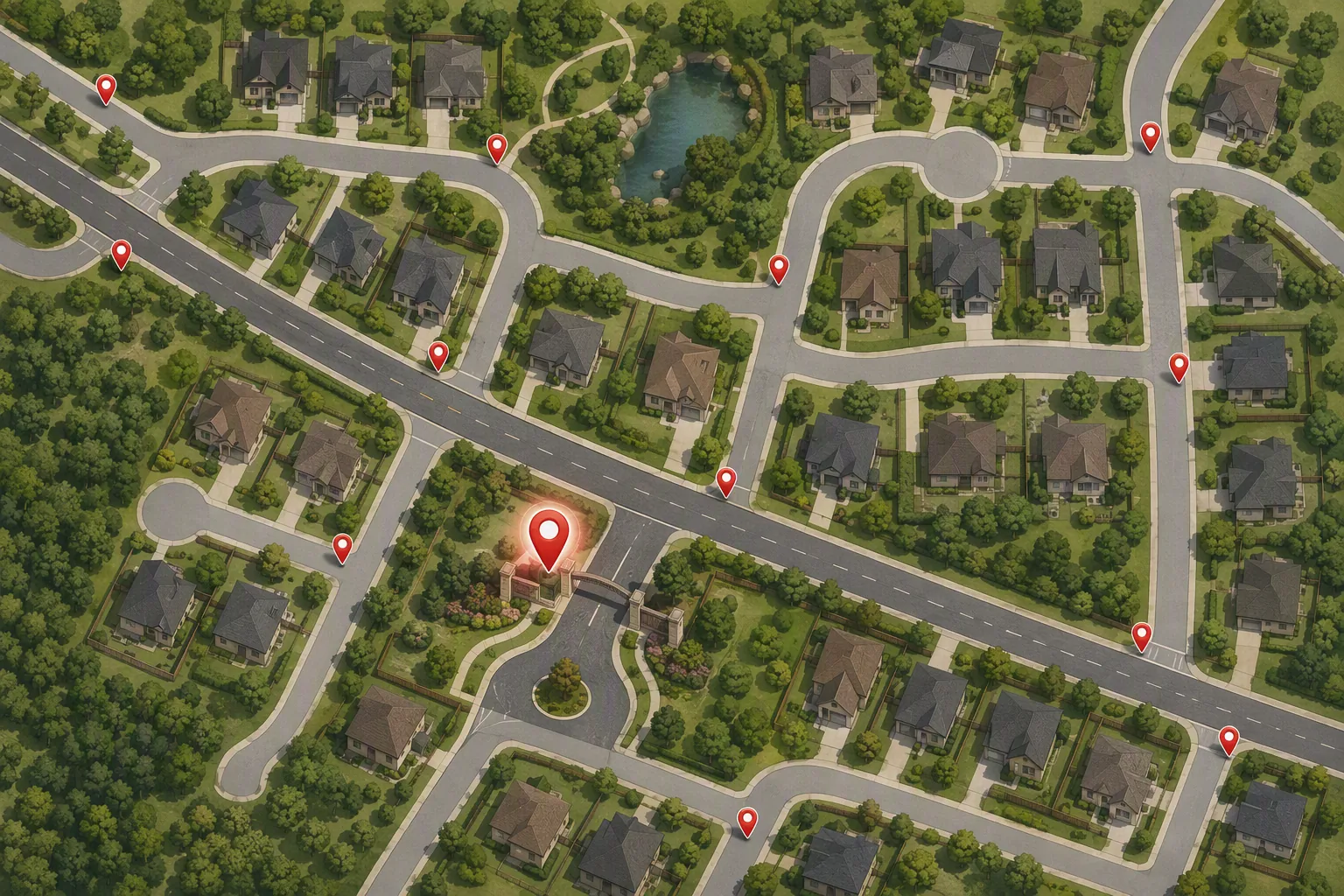
Use DeFlock the way you would use a neighborhood tip: useful enough to send you to the right corner, not strong enough to end the inquiry. Volunteer maps can have gaps. A camera pin can be misplaced. A solar-powered roadside device can be mistaken for a Flock unit when it is another brand, a traffic camera, or something else entirely.
- Search your address, subdivision entrance, school route, or commute corridor on DeFlock.
- Write down the nearest mapped camera locations, the date you checked, and whether each pin is labeled Flock or a different ALPR.
- Look for a local Flock Transparency Portal or city ALPR page for the police department, sheriff, HOA, business district, or other likely operator.
- Read the actual local policy: retention period, sharing partners, search rules, audit language, and complaint route.
- Choose the response that matches the operator. Safe List registration, an audit-log request, a public-records request, and a city council comment are different tools.
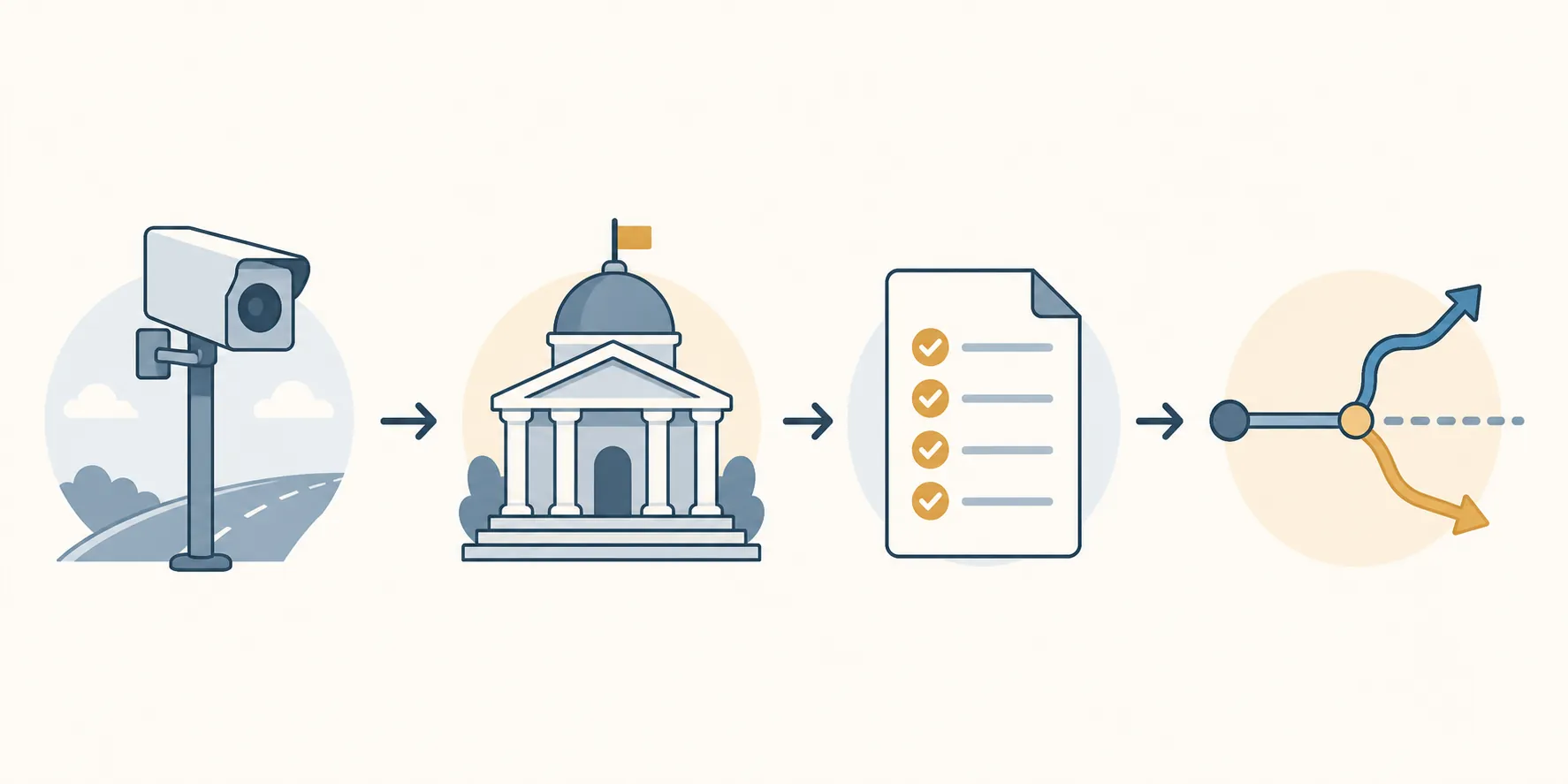
Where the transparency portal helps
Flock says more than 1,500 agencies have published a Flock Transparency Portal that can show items such as policy, retention, sharing partners, and search activity. Treat that as a vendor claim, not an independent census of every participating agency, but it is still worth checking before you start filing requests.[4]
Search the web for your city or county name plus “Flock transparency portal,” “ALPR policy,” “LPR policy,” and “license plate reader.” If the portal exists, do not stop at the map. Open the policy document and look for who may search, whether outside agencies can access data, what alerts are allowed, whether searches require a case number or purpose, and how long images are retained.
Retention needs a date stamp in 2026. Flock announced on Aug. 13, 2026, a seven-day recommendation and Evidence Mode, while older materials and locally approved policies may still refer to longer default periods or existing customer settings. The practical question is not “what does Flock usually do?” It is “what does my local policy say today, and has the local body approved a different period?”[4] For the broader explanation of what Flock records and who can search it, use NestGrid’s resident privacy explainer rather than trying to reconstruct the whole platform from one city page.
The operator changes your options
A camera beside a neighborhood road can feel like one thing to the driver, but the response path depends on who controls it. A police department camera, an HOA camera, and a business-district camera can all feed ALPR data into search systems, but they do not give residents the same lever.
| Likely operator | What to check | Most realistic route |
|---|---|---|
| Police department or sheriff | Agency transparency portal, ALPR policy, city contract, retention language, sharing partners, audit rules | Public-records request, audit-log or complaint route, council or county board agenda monitoring |
| HOA or gated/neighborhood association | Board minutes, resident notices, Flock agreement, Safe List or Authorized Access List rules, data-sharing terms | Safe List registration if offered, board records request, HOA meeting vote or policy amendment |
| Business district, shopping center, school, or private property owner | Owner or district documents, police partnership language, signage, local procurement records if public money is involved | Ask the operator for policy and sharing terms; use public-records law only where a public agency holds or controls the records |
| Unknown | DeFlock pin, nearby public-agency portals, city council agendas, permit or contract references | Document location first, then ask the city or county which entity owns or accesses the camera |
What you can do, and where each route stops
Safe Lists help only inside the system that honors them
If an HOA or neighborhood program offers a Safe List, sometimes called an Authorized Access List, it may let residents register a plate so the system treats it as a resident vehicle or excludes it from some neighborhood searches. Flock’s own FAQ describes the Safe List as a way for residents to self-register plates for that neighborhood context; it is not a universal opt-out from capture across the broader Flock network.[5]
That distinction matters. A Safe List might reduce nuisance alerts at your own gate or keep your plate from being searched in a particular community tool, depending on how the operator configured it. It does not make a city-owned camera three blocks away ignore you. It does not bind another HOA, sheriff’s office, mall, or business district. If this is your situation, the mechanics and privacy-request limits are covered in NestGrid’s Flock license plate reader opt-out guide, and the HOA contract side is covered separately in the HOA Flock camera guide.
Audit-log requests are for suspected improper searches
If your concern is ordinary roadside capture, an audit log may not solve it. If your concern is that a specific officer, employee, or outside agency searched your plate without a valid reason, auditability becomes the point.
The reason to care is not theoretical. Reporting summarized through the Institute for Justice and reflected in public tracking of Flock controversies identified 28 officer stalking-misuse cases since 2024.[6] That number should not be stretched into a claim about how often misuse happens in every agency. It does justify asking whether your local policy requires a search reason, case number, supervisory review, and preserved audit trail.
For law-enforcement cameras, check the agency policy before you complain. Some policies tell you where to send a misuse report. Others route complaints through internal affairs, the city manager, the sheriff’s office, or a civilian review body. If the agency publishes a transparency portal, compare the policy’s audit language against the portal’s search-activity description. NestGrid’s audit-controls explainer and Aug. 13 retention update coverage are the better place to dig into platform controls themselves.
Public-records requests can work, but only under local law
Public-records law is not uniform. Some agencies will release policies, contracts, and aggregate search records while withholding images, hotlist details, or investigatory material. Still, do not assume private storage ends the question. In Washington, a court ruled that Flock LPR images held for a city could qualify as public records under state transparency law even though the images were stored by a private company.[7]
A request works better when it asks for named record categories instead of accusing the whole system of being illegal. Keep it narrow, date-limited, and tied to the operator you have identified.
Public-records request template:

I request records related to automated license plate reader / ALPR / LPR cameras operated by or accessible to [agency name].

Please provide:
1. The current ALPR/LPR policy and any prior policy in effect during [date range].
2. The current contract, statement of work, renewal, or data-sharing agreement with Flock Safety or any ALPR vendor.
3. The retention period approved for ALPR images and metadata.
4. The list of agencies or entities with which ALPR data is shared, if maintained.
5. Audit-log records showing searches of plate [your plate] during [date range], including search date, searching user or agency, stated purpose, and case number, subject to lawful redactions.
6. Records describing complaint procedures for alleged misuse of ALPR data.

If any portion is withheld, please cite the specific exemption and release all reasonably segregable non-exempt portions.
Do not put someone else’s plate in a request unless you have a lawful reason and understand the local privacy rules. If the agency denies audit details, the denial itself may still tell you which exemption it is relying on and whether there is an appeal process.
Council agendas are the route for future deployments
If your real goal is to change where cameras go next, shorten retention, limit sharing, or require stronger audits, the most useful document may be a boring agenda packet. Search city council, county commission, school board, and police budget agendas for “Flock,” “ALPR,” “LPR,” “license plate reader,” “real-time crime center,” and “public safety camera.”
Contracts and renewals are where practical limits often appear: number of cameras, locations, data-sharing language, retention commitments, renewal dates, and whether the agency must publish a portal or annual report. If the vote already happened, calendar the renewal. A comment after installation can still matter, but a comment before renewal usually has more leverage.
A one-evening local check
For a resident trying to turn one blurry pole-camera sighting into something checkable, the finished product should be modest and specific. You want a dated note, not a theory.
- Camera locations: DeFlock pins near your home, commute, school route, or subdivision entrance, with the date checked and any uncertainty noted.
- Operator: police, sheriff, HOA, business district, private property owner, or still unknown.
- Policy link: local ALPR policy, transparency portal, HOA notice, or contract page.
- Retention note: the local approved period as written today, especially if it differs from newer vendor recommendations.
- Sharing note: which agencies or partners can access the data, if the policy or portal discloses it.
- Best route: Safe List registration, audit-log request, public-records request, council monitoring, HOA board action, or misuse complaint.
That answer may be unsatisfying because it does not make the license plate reader stop seeing your car. It does something narrower but useful: it replaces the guesswork with named cameras, named operators, written policies, and a response path whose limits are visible before you spend weeks chasing it.
References
- DeFlock — DeFlock — https://deflock.org/
- 119,000 Flock license plate cameras track drivers nationwide: map — Fox News — https://www.foxnews.com/us/119000-flock-license-plate-cameras-track-drivers-nationwide-map
- Flock camera map: How many are in your neighborhood? — The Hill — https://thehill.com/homenews/5456054-flock-camera-map-how-many-are-in-your-neighborhood/
- Flock Updates Privacy, Accountability, Security, and Transparency Safeguards — Flock Safety — Aug. 13, 2026 — https://www.flocksafety.com/blog/flock-updates-privacy-accountability-security-and-transparency-safeguards
- Flock Safety FAQ — Flock Safety — https://www.flocksafety.com/faq
- Flock Safety — Wikipedia — https://en.wikipedia.org/wiki/Flock_Safety
- Flock camera footage deemed public record in Washington state — Fox News / CyberGuy — https://www.foxnews.com/tech/flock-camera-footage-deemed-public-record-washington-state
Known issues with this device / protocol
Spec-version history
For active regressions on this protocol, see Update Watch.
No linked Update Watch entries yet.