What Etched's $10.3B Valuation Means for Smart Home Bills
Etched's $10.3 billion valuation may seem disconnected from your monthly Nest Aware or Ring bill, but the inference ASIC boom it represents is compressing cloud AI costs by an order of magnitude. This article traces the economic chain from data-center chips to subscription pricing, explaining which smart home costs could eventually drop and why camera AI remains expensive.
Last updated
The useful way to read Etched’s $10.3 billion valuation is not to imagine one of its chips inside a Nest camera, Ring doorbell, or Echo speaker. It will not be there. The useful way is to start with the bill: Ring’s top annual plan has moved from $100 to $200, Nest Aware from $120 to $200, and Arlo from $117 to $216, even as AI infrastructure companies keep promising that inference is getting much cheaper.[1]
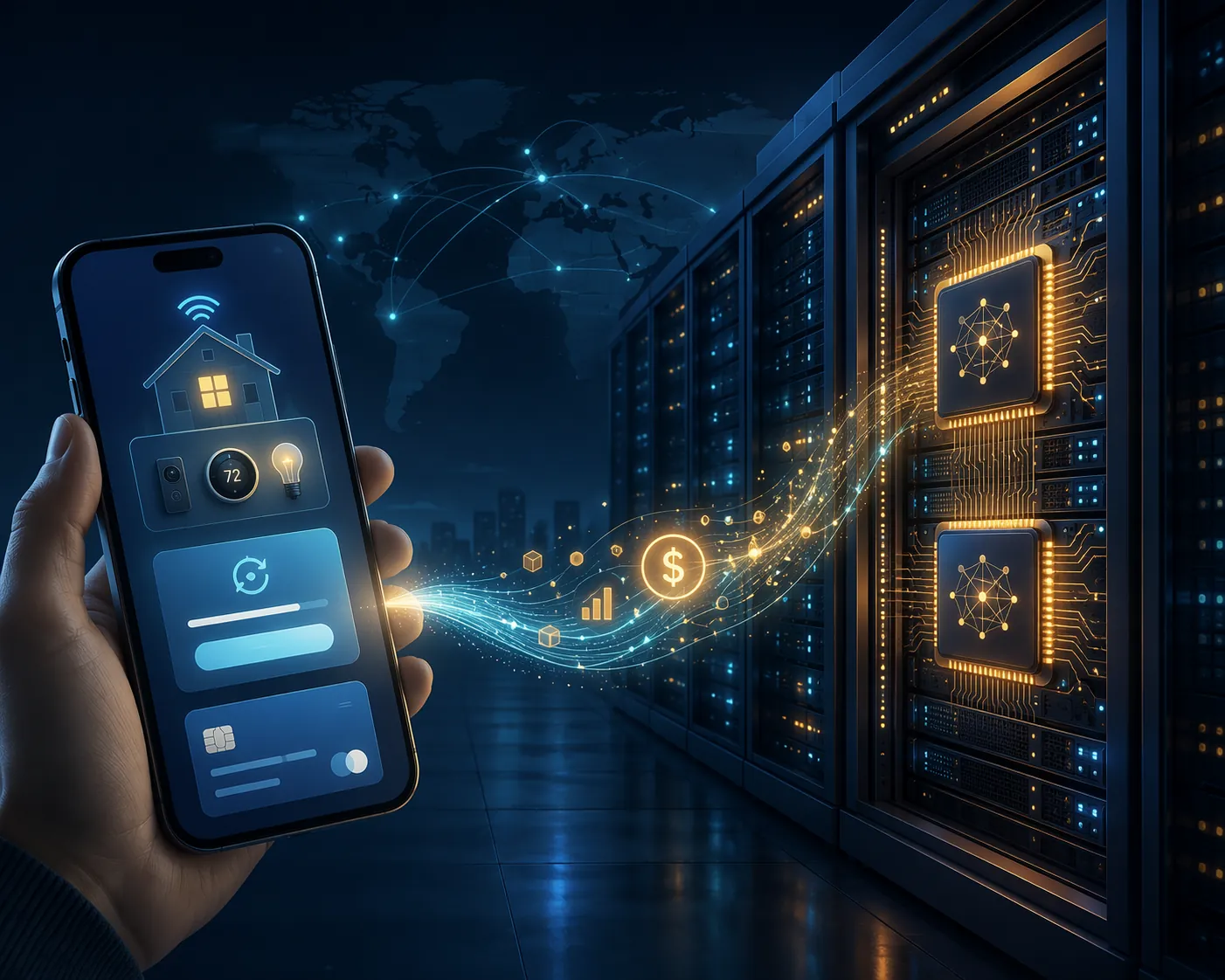
That contradiction is the point. Smart-home owners are being asked to pay more for cloud plans at the same moment the data-center side of AI is trying to crush the cost of answering each request. Etched matters because it sits on that hidden side of the stack: the part where a spoken command, a generated answer, or a natural-language automation request becomes paid compute.
Etched closed a $300 million Series C on July 23, 2026, at a $10.3 billion valuation, up from $5 billion seven months earlier. The company says it has $1 billion in booked orders and that its first racks are shipping in summer 2026.[2] That is not a consumer launch. It is a data-center supply signal, and for smart-home subscribers the question is narrower: which parts of a subscription bill are exposed to falling inference costs, and which parts are not?
The bill includes more than AI, but AI is becoming a larger line item
A smart-home subscription is a bundle. The visible features may be familiar — video history, package alerts, person detection, richer automations, emergency response, or an assistant that can do more than set a timer — but the price also carries storage, bandwidth, support, product margin, app development, feature packaging, and whatever strategic pricing a platform believes the market will tolerate.
That is why cheaper AI does not automatically mean a cheaper Nest Aware, Ring, or Arlo plan. The Smart Home Subscription Costs Tracker 2026 is the better starting point than any chip-company pitch deck: subscription prices have been rising through mid-2026, not falling.[1] A lower compute bill can reduce pressure inside the platform, but it does not force the platform to pass savings through.
Still, the compute bill is real. Cloud-based AI assistants do not answer for free. Every time a user asks an assistant to summarize notifications, interpret a command, draft a routine, or respond conversationally, the platform sends text-like units through a model. Those units are commonly priced as tokens. The cheaper it becomes to process tokens, the cheaper it becomes to serve assistant-style AI at scale.
Where Etched fits in the smart-home cost chain
Etched’s Sohu is a transformer-inference ASIC. In plain smart-home terms, it is designed for the data-center work behind text and voice AI models, not for the small device on your wall or counter. The chain looks like this: a person asks a voice assistant for something, the request is converted into model input, the model generates output token by token, and the platform pays for the infrastructure that makes that response fast enough to feel normal.
| Smart-home action | What the cloud pays for | Likely exposure to cheaper transformer inference |
|---|---|---|
| Asking a voice assistant to explain or control something | Speech handling, model routing, generated response tokens, service logic | Higher |
| Using a chat-style home assistant to build a routine | Language-model inference and app-side orchestration | Higher |
| Reviewing recorded doorbell video | Video storage, streaming, indexing, and camera AI | Lower |
| Searching video for a person, package, pet, or vehicle | Vision models, video processing, storage, and retrieval | Lower |
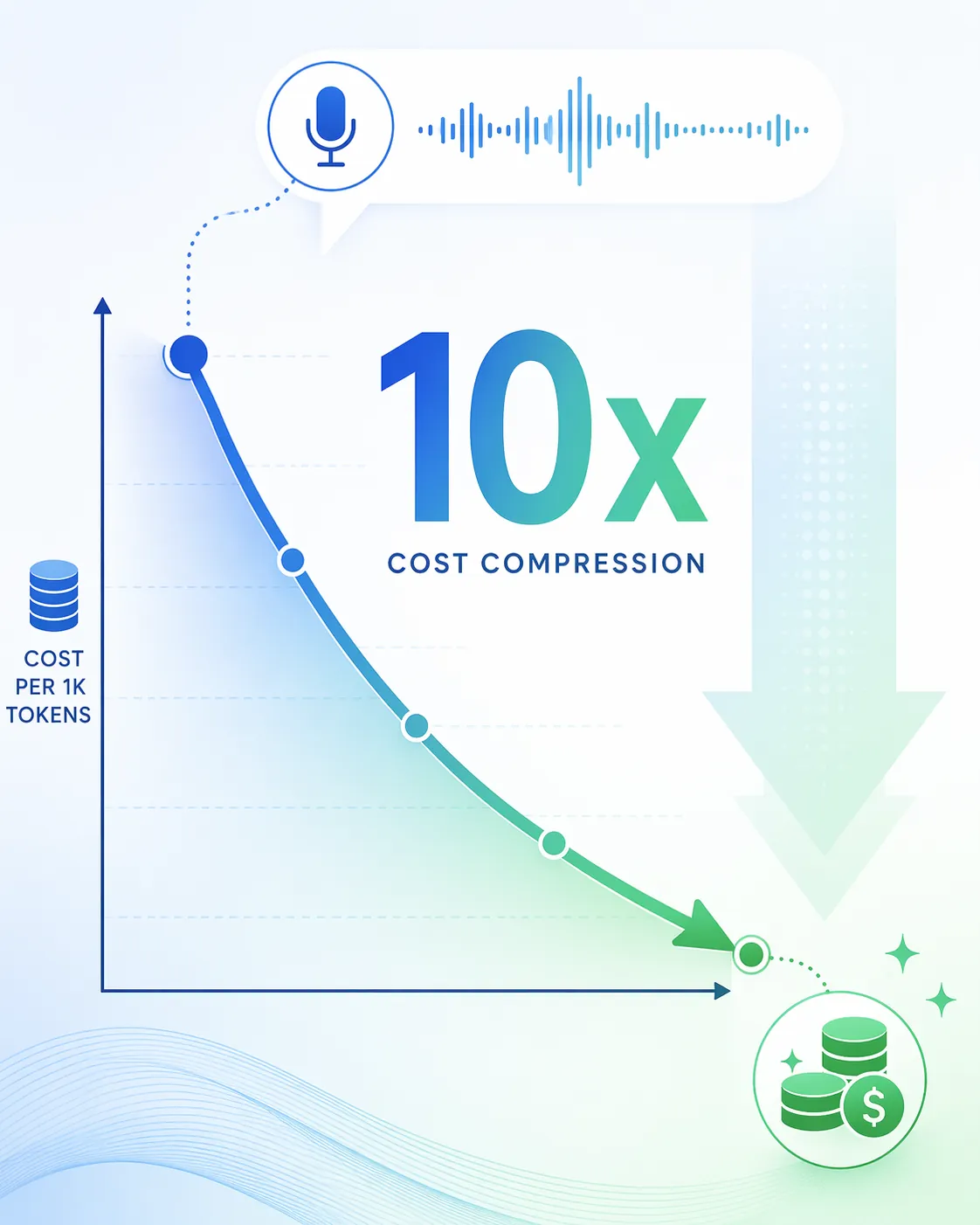
The magnitude of the cost shift is why the Etched valuation has smart-home relevance at all. Inference pricing for comparable AI capability fell from roughly $0.06 per 1,000 tokens in early 2025 to about $0.006 per 1,000 tokens by mid-2026, a decline of around 10x.[3] That does not map cleanly to a household bill, because a plan is not priced per token. But it changes the economics of a feature that millions of households might use many times a day.
Voice assistants are the cleanest example. If an assistant only turns on a light, the expensive part is not the command itself. But Alexa+, Google Home Premium, and similar services are being pushed toward richer answers, contextual control, and generative help. The more the assistant behaves like a cloud AI service rather than a command parser, the more its economics look like inference economics. For platform context, that is why the Amazon Alexa Platform Overview 2026 and the Google Home and Nest Device Ecosystem profile are really platform-economics stories now, not just compatibility guides.
Amazon already shows the pressure
Amazon’s Alexa+ costs make the infrastructure problem unusually concrete. Internal documents reported in July 2026 projected Alexa+ AWS costs reaching $1.7 billion in 2026, nearly triple the prior year. The same reporting said Amazon was trying to route simpler queries to cheaper in-house models and squeeze “more than quadruple the number of customer transactions each unit of computing capacity could support.”[4]
That is the bridge between a chip startup and a kitchen speaker. A platform with a growing assistant bill has three broad options: charge more, reduce usage or features, or make each query cheaper to serve. Routing easier requests to cheaper models is one version of the third option. Specialized inference chips are another tool in the same cost-control project, provided the workload matches the chip.
This is also where Etched’s valuation is more than venture-capital theater. A market does not need every Sohu claim to be independently proven before the direction matters. Custom AI silicon is being pulled into production because general-purpose GPUs are expensive, scarce, and not always the most efficient way to serve repetitive inference workloads. TrendForce data cited by Tom’s Hardware showed custom ASIC shipments growing 44.6% year over year versus 16.1% for merchant GPUs.[5]
Etched is a sharper version of that trend because Sohu is narrow by design. The company’s published materials claim very high throughput, including 500,000 tokens per second on Llama 70B and one server replacing 160 H100s, but those are company-published figures and had no independent third-party benchmarks as of July 2026.[6] For a smart-home bill, the exact replacement ratio matters less than the direction: platforms are hunting for cheaper ways to serve large volumes of assistant inference.
Voice AI gets cheaper before camera AI
The important boundary is that Sohu is not a camera-AI chip. It is not designed to run vision encoders, mixture-of-experts architectures such as DeepSeek V4 or Qwen3-235B-A22B, or diffusion models.[6] That matters because many of the smart-home features people actually pay for are camera-heavy: video history, event detection, package recognition, search across recordings, and increasingly multimodal assistants that can reason over what a camera sees.
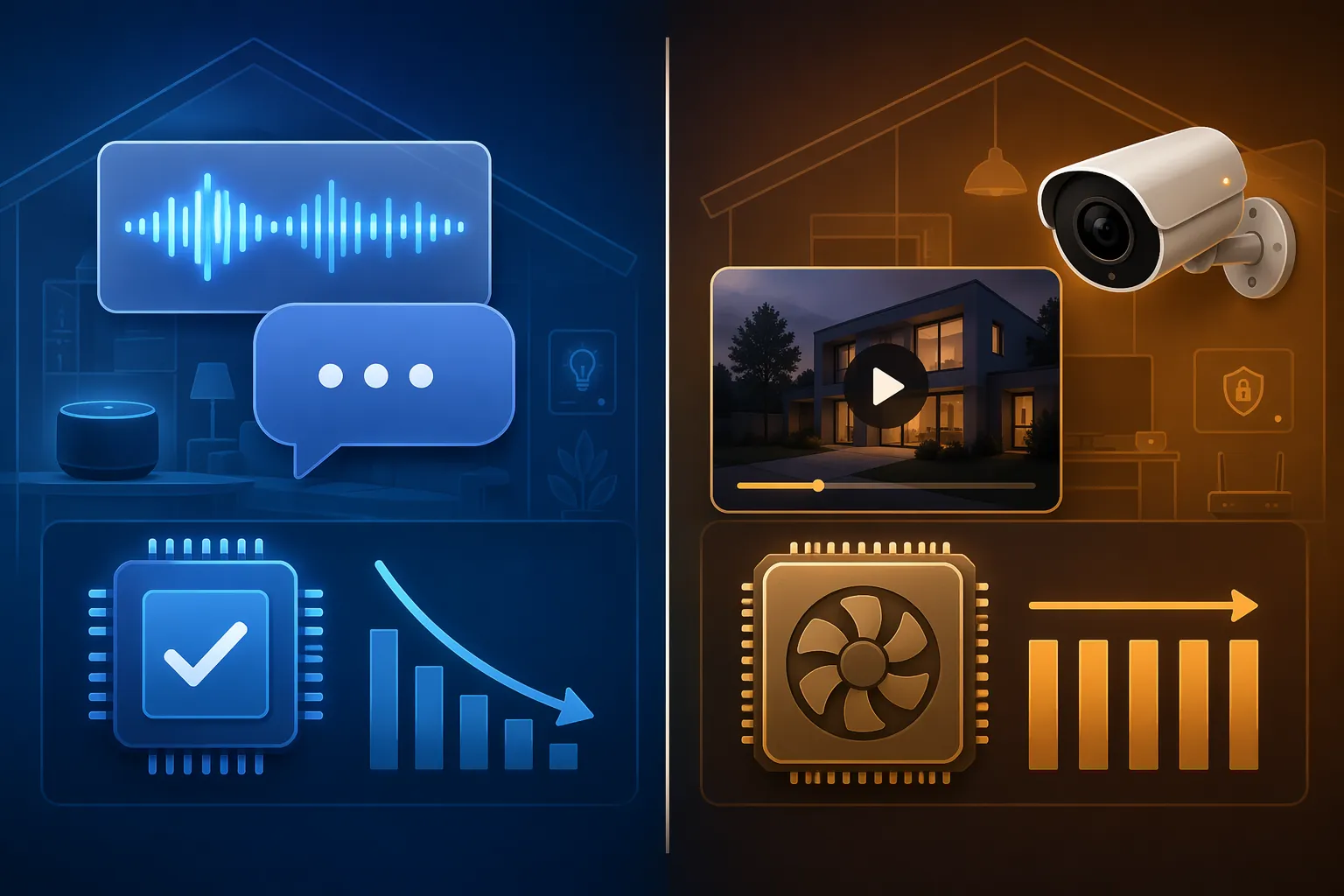
A doorbell plan is not mostly a chatbot plan. It carries continuous or event-based video handling, cloud storage windows, upload bandwidth, playback infrastructure, notification systems, and support costs. Some camera AI can run locally on the device, but cloud video features remain tied to storage and GPU-capable serving hardware when the workload requires vision processing or richer multimodal interpretation.
That split leads to a practical expectation: assistant features should feel the benefit of inference cost compression earlier than camera-heavy plans. A voice request that becomes text, flows through a transformer model, and returns a generated answer is close to Sohu’s intended lane. A video search request that asks a platform to inspect recordings, identify objects, compare scenes, and return moments from storage is a different cost structure.
This does not make camera subscriptions immune to chip progress. GPU prices, memory supply, model efficiency, local device processing, and storage economics all move. The adjacent 2026 memory chip shortage analysis is a reminder that hardware economics reach consumer devices through more than one path. But Etched specifically is strongest evidence for cheaper transformer inference, not cheaper video storage or vision AI.
Why cheaper serving may not show up as a cheaper plan
The uncomfortable part is that cost declines usually arrive inside a company’s margin model before they arrive on a customer’s invoice. If Amazon, Google, Ring, or Arlo can serve an AI assistant feature more cheaply, they can lower prices, hold prices steady while adding features, reserve the best features for premium tiers, or use the savings to protect margin after earlier cost increases.
For subscribers, the most plausible near-term effect is not an obvious price cut. It is more likely to appear as less upward pressure on voice-assistant AI plans, more generous assistant usage limits, faster answers, or more AI features included at the same tier. That still matters. A $20 monthly assistant plan has to justify itself every month; if the underlying inference cost keeps falling, the platform has more room to improve the product without raising the price again.
Camera-heavy plans are different. A Nest Aware or Ring plan could include more assistant features over time, but the customer is still paying for video retention, event processing, app infrastructure, and support. A cheaper language-model answer does not erase the cost of storing and interpreting hours of doorbell footage. That is why the broader AI-startups-in-smart-home framing needs a workload-by-workload filter. “AI” is not one bill.
What Etched’s valuation means for smart-home devices
Etched’s $10.3 billion valuation means investors and data-center buyers are betting that transformer inference is important enough, expensive enough, and repetitive enough to deserve specialized hardware. For smart-home devices, the impact is indirect: the chip stays in the cloud, but the cloud bill shapes which AI features platforms can afford to offer and how hard they push subscription pricing.
The cleanest consumer benefit, if the trend holds, is cheaper-to-serve voice and chat-style home intelligence. Alexa+ and Google Home Premium are closer to that lane than a camera archive is. Over time, lower per-token costs should reduce the pressure to make every richer assistant interaction feel like a premium metered resource.
It does not prove that Ring, Nest Aware, or Arlo prices will fall. It does not prove that Etched’s own performance claims will survive independent benchmarking. And it does not make camera AI cheap by itself. The useful conclusion is narrower: Etched’s impact on smart-home devices is real for cloud assistant economics, strongest for voice-based workloads, and much weaker for video-heavy subscriptions until the rest of the camera stack gets cheaper too.
References
- Smart home subscriptions are getting more expensive, The Verge, May 2026
- AI chip startup Etched raises $300M at $10.3B valuation, TechCrunch, July 23, 2026
- AI inference pricing analysis, Sesame Disk, 2026
- Amazon races to rein in Alexa+ AWS costs, Business Insider, July 2026
- Custom ASIC shipments grow faster than merchant GPUs, Tom’s Hardware, 2026
- Sohu technical materials, Etched, 2026
Known issues with this device / protocol
Spec-version history
For active regressions on this protocol, see Update Watch.
No linked Update Watch entries yet.