
Is Arm Stock Undervalued Through Its Smart Home Chip Business?
Arm's smart home chip royalties—embedded in billions of IoT devices—create a steady, high-margin revenue stream that most analyst models overlook. This article examines whether Arm stock is undervalued specifically through the lens of its smart home and IoT chip market position, separate from the AI data center narrative.
Last updated
Pair a Matter bulb, wake up a Thread sensor, replace the battery in a smart lock, or move a Wi-Fi bridge to stop it dropping offline, and the visible product is only the last layer of the system. Under the plastic is a radio, a microcontroller or application processor, a security stack, memory, firmware, and usually an Arm-based core that was licensed long before the device reached a shelf. Somewhere upstream, that shipment was a royalty event.
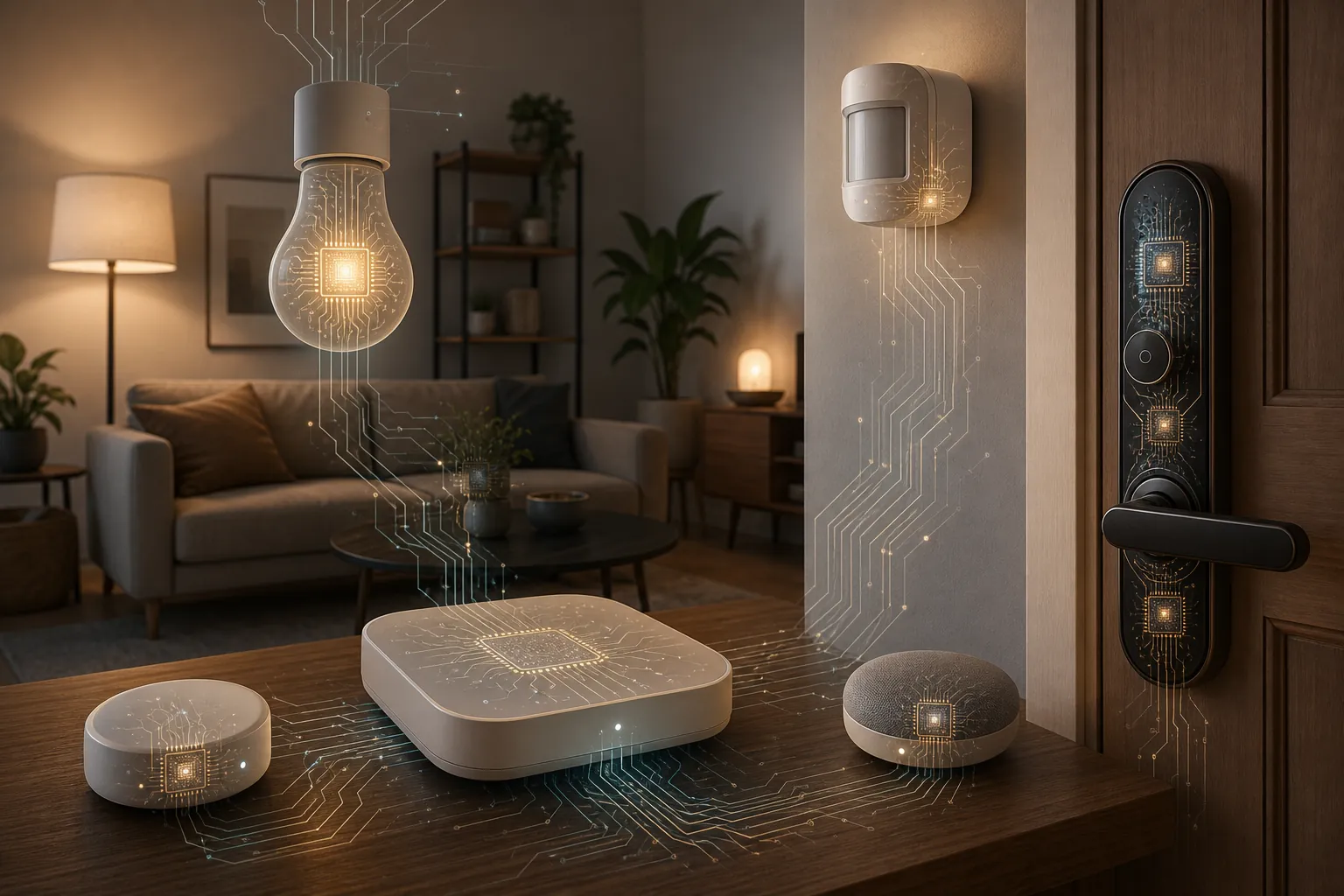
That is the cleanest way to approach the question of whether Arm stock is undervalued through the smart home chip market. Arm does not need to sell the bulb, lock, hub, camera, or thermostat. Its business model is closer to the compatibility layer beneath them: license the architecture, collect royalties as partners ship chips, then benefit again when those chips move to newer cores or more complete compute subsystems.
Arm says more than 350 billion Arm-based chips have shipped to date, and its royalty revenue grew 20.5% year over year to $2.613 billion in FY2025. The same SoftBank annual report shows Arm’s gross margin profile above 97.5%, which matters because royalty dollars do not behave like hardware revenue with factories and inventory attached.[1]
The problem for investors is that the smart-home part of that stream is not reported as its own neat line item. Arm reports broader end markets, and IoT is much wider than door sensors and light switches. So the smart-home thesis has to be built from mechanism and adjacent market data, not from a disclosed “smart home royalty” number. That makes the undervaluation case interesting, but also easy to overstate.
The Valuation Gap Is Not a Footnote
Arm looked expensive or cheap in July 2026 depending less on the stock chart than on which cash-flow story was being told. A Simply Wall St user-generated narrative published through Yahoo Finance put fair value near $430 and described Arm as about 40% undervalued around a roughly $260 share price. The same page’s DCF model put fair value at $89.52, implying the opposite conclusion: about 70% overvalued.[2]
TIKR’s mid-case scenario was more aggressive, pointing to $576 by 2030, while another TIKR snapshot showed a more immediate debate around whether a $251 valuation could keep the rally going. TIKR also reported 20 Buy or Outperform ratings, 10 Hold ratings, and 2 Sell ratings in April 2026, with the mean target around $170, below where the stock later traded.[3][4]
| Valuation View | Implied Message | Why It Matters For The Smart Home Thesis |
|---|---|---|
| Simply Wall St user narrative: about $430 | Arm appears undervalued near roughly $260 | This view can accommodate a durable royalty tail if future device growth and royalty-per-chip expansion are given credit. |
| Simply Wall St DCF: $89.52 | Arm appears overvalued | This view is far less forgiving if long-tail IoT royalties are treated as too small or too distant. |
| TIKR mid-case: $576 by 2030 | Large upside if growth and margins persist | The model depends on Arm converting broad compute demand into higher revenue over time, not merely shipping more low-end cores. |
| Analyst mean target around $170 | Street targets sit below the late-July trading area | The market may already be paying for AI optionality while still not isolating smart home as a separate royalty engine. |
This is why a simple “Arm is undervalued” claim does not hold up on its own. The models disagree too sharply. The useful question is narrower: whether the market is undervaluing a royalty base that keeps expanding through smart-home and IoT devices even when the attention is on AI accelerators, smartphones, and data center CPUs.
Why A Cheap Sensor Can Still Matter To Arm
A smart-home endpoint is often too cheap to look important in a stock model. A contact sensor, temperature puck, motion detector, or basic bulb may use a modest microcontroller. The retail product can be low-margin, seasonal, and brutally price-sensitive. But Arm’s exposure is not to the device’s shelf price. It is to the chip shipment and the licensed IP inside that chip.
That distinction changes the scale of the argument. Grand View Research estimates the smart home market at $162.8 billion in 2025 and forecasts it could reach $887.4 billion by 2033, at a CAGR above 20.5%.[5] That market-size number is not Arm revenue, and it should not be treated as if every dollar flows through Arm. It does, however, describe the device environment in which more bulbs, locks, speakers, bridges, panels, appliances, and sensors need chips.
The broader chip backdrop points in the same direction. Mordor Intelligence projects the IoT chip market from $0.77 trillion in 2026 to $1.51 trillion by 2031, a 14.45% CAGR.[6] DataIntelo estimates the ARM-based processor market at $68.9 billion in 2025, growing to $227.6 billion by 2034 at a 14.2% CAGR, with consumer electronics representing 45.8% of that market.[7]
Those are different market definitions, so they should not be stacked as if they describe one clean funnel. Smart home is a subset of consumer electronics and IoT; IoT includes factories, vehicles, utilities, logistics, and medical devices; ARM-based processors include far more than thermostats and hubs. Still, the overlap is where the stock debate lives: if device shipments keep rising and Arm captures royalties on a large portion of the processors inside them, the smart-home layer becomes part of a recurring royalty base rather than a lifestyle category.

The best version of the undervaluation case is not that every smart-home gadget is lucrative. Many are not. It is that a very large number of modest devices can create a royalty stream that is steadier than investors expect, especially when the same architecture shows up across endpoints, bridges, voice assistants, routers, displays, appliances, and home energy gear.
Matter Makes The Chip More Important, Not Less
Matter was supposed to make the smart home feel simpler to buyers. For device makers, it often makes the silicon decision more demanding. A Matter device may need Thread for low-power mesh networking, Wi-Fi for higher bandwidth or controller communication, Bluetooth Low Energy for commissioning, secure storage, over-the-air updates, and enough processing headroom to keep all of that reliable after launch.
Synaptics, writing through the Edge AI and Vision Alliance, describes the modern smart-home connectivity problem as a multi-radio environment in which Thread, Wi-Fi, and BLE increasingly have to coexist in small devices.[8] That is not just a protocol footnote. It changes what an OEM may choose to buy: a more integrated SoC, a more capable core, better security blocks, or a vendor platform that reduces certification and firmware risk.
This is where Arm’s royalty story can improve without relying only on more unit shipments. Arm CEO Rene Haas wrote that the transition to Armv9 is important because it commands “significantly higher royalty rates,” and he said CSS adoption continued to exceed expectations in fiscal Q3 2026.[1] CSS, or Compute Subsystems, is Arm’s way of giving chip designers more of the platform pre-integrated, which can shorten development work and make adoption stickier.
A basic non-connected appliance controller and a Matter-over-Thread device with secure commissioning do not place the same demands on silicon. The latter is more likely to reward a vendor for choosing a mature IP ecosystem, especially when the product still has to pass certification, receive updates, and interoperate with Apple, Google, Amazon, Samsung, and other controllers after it leaves the factory.
Silicon Labs notes that Arm was an initial member of the Thread Group, which is relevant less as a badge and more as a reminder that smart-home standards are not detached from processor ecosystems.[9] Compatibility work happens above the chip, but it is constrained by what the chip can securely and reliably support.
Why The Market Can Miss This Layer
Public-market attention has a habit of following the largest visible machine. In 2026, that meant AI infrastructure, data center CPUs, and anything that could be attached to artificial general intelligence spending. CNBC reported in March 2026 that Arm shares jumped 16% on expectations of an AGI CPU revenue windfall tied to SoftBank’s Stargate-related ambitions.[10]
Then the stock reminded everyone that smartphones still matter. Reuters reported that Arm posted record Q4 FY2026 revenue of $1.49 billion, but shares fell after concerns around smartphone market weakness and AI chip supply overshadowed the upbeat forecast. Haas described the smartphone memory supply picture as “slightly negative” on the May 7 call, and the stock was around $225 after that earnings drop, after trading near $151 in early April and about $197 in late April.[11]
By late July, the stock was around $260 in the Simply Wall St/Yahoo Finance valuation discussion.[2] That recovery makes the smart-home undervaluation question harder, not easier. A stock that has already moved sharply can still have an underappreciated royalty base, but the burden of proof rises. Investors are no longer asking whether Arm is ignored. They are asking which part of Arm’s future is already embedded in the price.
The smart-home and IoT layer is easy to under-model because it is diffuse. No single product launch looks like the event. No thermostat shipment changes the quarter. A smart speaker, a bridge, a lock, and a sensor may involve different chip vendors and different Arm cores. The royalty stream is visible in aggregate, but the household-level mechanism disappears inside broader categories.
The Bear Case Starts At The Low End
The weakest part of the smart-home royalty thesis is the cheapest endpoint. A simple sensor that needs very little compute is exactly where an OEM may be tempted by RISC-V or another low-cost alternative. In a category where a few cents can matter across large production runs, Arm’s installed base and tooling advantage do not automatically guarantee permanent share.
This risk is not evenly distributed. A low-power contact sensor, a basic switch module, and a multi-radio Matter hub are not the same design problem. The more a device needs secure commissioning, multiple radios, over-the-air updates, local intelligence, or long-term interoperability support, the more valuable a mature ecosystem becomes. The more it behaves like a disposable low-end controller, the more exposed the royalty stream is to substitution.
There is also a modeling risk. Smart-home market forecasts vary widely because firms define the category differently. Grand View’s $887.4 billion 2033 forecast is an upper-bound style market view, not a direct map to Arm royalties.[5] A valuation model that treats the entire smart-home market as if it cleanly converts into Arm revenue is doing the same thing weak smart-home marketing does with protocols: smoothing over the hard parts.
The cleaner test is more modest. Do smart-home and IoT shipments grow? Does Arm keep meaningful architecture share inside those chips? Do Matter, Thread, Wi-Fi, BLE, security, and edge-AI requirements push enough devices toward higher-value cores or CSS-like platform adoption? And does royalty-per-chip improve enough to matter against the much larger AI and smartphone assumptions already sitting inside the stock?

What Has To Be True For Arm To Be Undervalued
The bullish smart-home version of Arm does not require every connected device to become expensive. It requires volume to keep expanding, architecture share to hold, and the mix to move gradually toward more capable silicon. Under that version, a Matter lock, Thread sensor, Wi-Fi bridge, and home hub are not just consumer electronics; they are repeated evidence that the installed base keeps producing royalty events.
- Unit growth matters because Arm collects royalties when licensed chips ship, not when a device becomes fashionable at retail.
- Mix matters because Armv9 and CSS adoption can raise royalty economics beyond a simple count of low-end microcontrollers.
- Protocol complexity matters because Matter-era devices need more from their silicon than many older single-radio smart-home products.
- Disclosure matters because Arm does not break out smart-home royalties, so the thesis remains inferred rather than directly reported.
- Competition matters because RISC-V can pressure the low end where endpoint device makers are most cost-sensitive.
That is enough to support a valuation floor argument. Arm’s royalty revenue is already large, growing, and high-margin; the IoT and ARM-based processor markets are forecast to expand; and smart-home devices are becoming more silicon-dependent as interoperability and security requirements rise.[1][6][7][8] But a floor is not the same as unlimited upside.
If the stock’s future is judged mostly on AI CPU optionality, data center wins, and smartphone cycles, then smart home may remain too small and too blended to move the valuation debate. If long-tail IoT royalties are modeled as durable and gradually richer per chip, the gap between the $430-style fair value narrative and the $89.52 DCF becomes less mysterious: the two views are not arguing about the same business mix.[2]
So the disciplined answer is conditional. Arm can look undervalued if the smart-home and IoT royalty tail is treated as a durable, growing, high-margin base that sits underneath the louder AI story. It can look fairly valued or overvalued if that stream is treated as too diffuse, too vulnerable at the low end, or too small beside smartphone and data center assumptions. Saying “Arm is undervalued” is really saying whether the chip inside the smart home is a rounding error, or a long-tail royalty machine hiding in plain sight.
References
- SoftBank Group Annual Report 2026 — Message from Arm CEO
- Yahoo Finance / Simply Wall St — Arm Holdings Could Be 40% Undervalued
- TIKR — Why Arm Holdings Stock Has a Case for 190% Upside
- TIKR — Arm Stock Is Up 32% in 2026. Can a $251 Valuation Keep the Rally Going?
- Grand View Research — Smart Home Market Size 2026-2033
- Mordor Intelligence — IoT Chip Market Size & Growth 2031
- DataIntelo — ARM Based Processor Market Research Report 2034
- Edge AI and Vision Alliance / Synaptics — Smart Home Connectivity, March 2026
- Silicon Labs — Unify Smart Home Device Development with Matter
- CNBC — Arm stock jumps 16% on AGI CPU revenue windfall, March 25, 2026
- Reuters — Arm shares slide on smartphone market weakness, May 7, 2026
Known issues with this device / protocol
Spec-version history
For active regressions on this protocol, see Update Watch.
No linked Update Watch entries yet.