What Alibaba's Qwen AI Means for Smart-Home Voice Assistants
A dated, protocol-level breakdown of where Alibaba's Qwen fits in the smart home: the Tmall Genie/XGenie Voice appliance ecosystem versus running open-weight Qwen locally through Home Assistant. It gives you a status-labeled verdict on whether either path can join a Matter-, Zigbee-, Z-Wave-, or Thread-based home.
Last updated
As of August 4, 2026, the phrase “Alibaba Qwen AI model smart home voice assistant” hides two very different products. One is Alibaba’s own Tmall Genie/XGenie appliance ecosystem, powered by Tongyi/Qwen-era AI. The other is an open-weight Qwen model running locally as the conversation layer for Home Assistant. For a US home already built around Matter, Zigbee, Z-Wave, or Thread, those two paths do not land in the same place.
| Path | What it is | Status for a US standards-based home | Protocol fit | Practical outcome |
|---|---|---|---|---|
| Path A: Tmall Genie / XGenie appliance ecosystem | Alibaba smart speakers, whole-home hardware, and the AliGenie platform. Tongyi/Qwen integration was announced in April 2023, followed by an XGenie rebrand in September 2023 [1][2]. Alibaba-linked whole-home claims expanded in 2025, including 40M+ households, 11B+ monthly wake-ups, 1,800+ brands, and 530M+ connected devices [3]. | Investigating / no documented US fit found. Older sources describe Tmall Genie as China-only and Mandarin-only, and Alibaba Cloud Community staff said in 2020 that outside China it had limited features and recognized only Chinese; those regional and language details are older and may have changed [6][7]. | No documented Matter controller role found in the reviewed material. The ecosystem appears to be its own appliance and cloud/partner platform rather than a documented participant in a US Matter/Zigbee/Z-Wave/Thread fabric. | Do not buy it expecting it to commission Matter devices, bridge Zigbee or Z-Wave gear, or replace a US hub unless Alibaba or a distributor documents those roles for your region. |
| Path B: Open-weight Qwen through Home Assistant | A Qwen model used as the language/conversation layer while Home Assistant remains the smart-home controller. Qwen2.5-Omni-7B was released on March 26, 2025 under Apache 2.0, and Qwen3 followed on April 28, 2025; the model family kept moving through 2025 and 2026 [8][9]. | Workaround / practically usable. This does not require Alibaba’s appliance ecosystem or a Tmall Genie device. | Protocol-agnostic at the model layer. Home Assistant owns the Matter, Zigbee, Z-Wave, Thread, and other integrations; Qwen only interprets or helps generate the command. Home Assistant documented local LLM conversation-agent work via Ollama in September 2025 [10]. | The realistic route for a US user who wants Qwen in an existing standards-based home. Build around Home Assistant first; treat Qwen as replaceable intelligence on top. |

The naming problem is the compatibility problem
Search results make this harder than it should be because several names sit on top of one another. Tmall Genie is the consumer smart-speaker and home-appliance brand. 天猫精灵 is the Chinese name usually behind that translation. AliGenie is the broader platform and assistant layer attached to Alibaba’s smart-home ecosystem. Tongyi Qianwen and Qwen are the model family and AI-brand layer. XGenie appears in 2023 reporting as the renamed or transformed home-automation brand after large-language-model integration [2].
Those distinctions matter because “Qwen is in a smart speaker” does not tell you whether that speaker is a Matter controller, a Thread border router, a Zigbee bridge, a Z-Wave controller, or just a voice endpoint for Alibaba’s own device graph. The headline says AI assistant. The installation question is much duller: what owns the device fabric, and where does the command terminate?
Alibaba’s public story started looking like a modern LLM voice-assistant story in April 2023, when the company said its ChatGPT-like service would be integrated across products, including DingTalk and Tmall Genie [1]. In September 2023, TechNode reported the Tmall Genie transformation under the XGenie naming, explicitly tying the smart-home brand to large language model integration [2]. That is meaningful AI-appliance news. It is not, by itself, a protocol commitment.
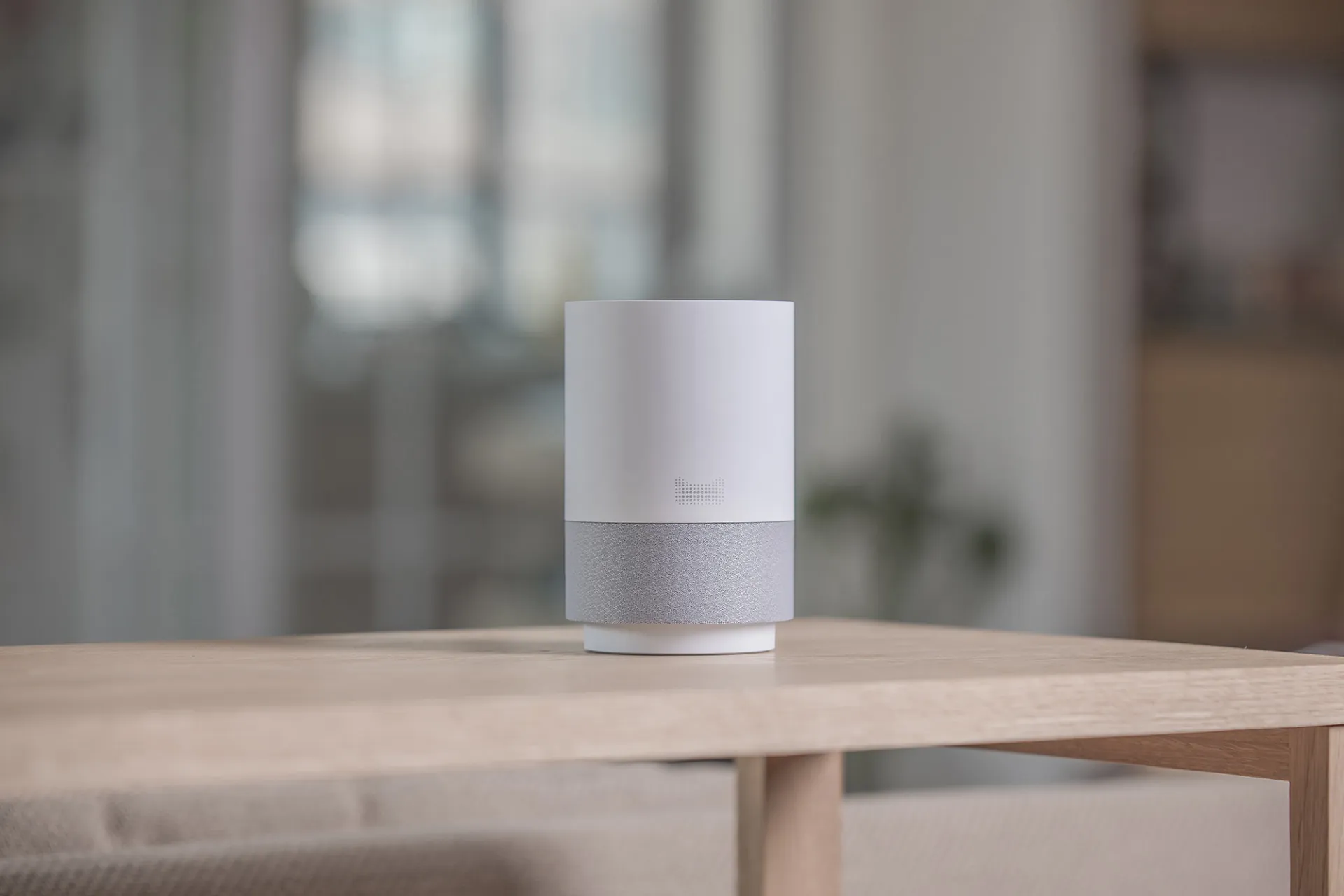
Path A: Tmall Genie/XGenie is a real ecosystem, just not a documented US Matter answer
The Alibaba appliance path should not be dismissed as vaporware. The 2025 Chinese smart-home push described a large installed base: Xinhua reported more than 40 million households, more than 11 billion monthly wake-ups, more than 1,800 brands, and more than 530 million connected devices around the Tmall Genie whole-home 2.0 story [3]. Later 2025 coverage described a whole-home 3.0 push with hardware such as the Kunlun T20S WiFi-7 host and an AI space sensor [4][5].
Those are ecosystem-scale facts, and they make the platform worth watching. They still do not answer the US buyer’s compatibility question. A device platform can be enormous in one region and still be the wrong purchase for a home where the existing control plane is a Matter controller, a Zigbee coordinator, a Z-Wave stick, a Thread border router, or some combination of those.
The older regional and language evidence also points toward caution, not certainty. Tmall Genie’s launch-era profile described it as China-only and Mandarin-only [6]. In a 2020 Alibaba Cloud Community reply under an AliGenie platform post, Alibaba Cloud staff said that outside China it worked with limited features and only recognized Chinese [7]. Those are not 2026 re-tests, so they should not be treated as proof that nothing has changed. They are enough, however, to keep “works in my US home” off the table until the current product page, app region, supported language list, and device-control roles are documented.
The missing item in the reviewed material is a documented Matter controller role for Tmall Genie/XGenie in the US. That is a narrower claim than saying it is incompatible. It means the reviewed sources did not show the role a Matter buyer needs to see: the ability to commission, control, bridge, or expose devices in a standards-based home.
For Matter specifically, the distinction is not pedantic. A smart speaker can contain a good microphone, a capable LLM, a device cloud account, and a polished mobile app, yet still not be the controller your Matter devices join. If you need a refresher on that layer, the Matter Protocol explainer is the place to separate controller, fabric, bridge, and device roles before buying another voice appliance.
China’s own smart-home market context reinforces why documentation matters. In September 2025, China Electronics News reported, citing CNCERT data, that cross-brand compatibility success was below 65% [12]. That figure should not be dragged into a claim about every Alibaba device, and it should not be treated as a direct CNCERT conclusion unless you are reading the underlying dataset. It does explain why “big ecosystem” and “interoperable with my mixed-protocol home” are different claims.
What a documented controller role would have to say
For a standards-based home, the useful product page is usually boring. It says whether the device is a Matter controller. It says whether it is a Thread border router. It says whether Zigbee devices are joined locally or through a proprietary bridge. It says whether Z-Wave is supported at all. It says which region and app account can enable those roles. It says which languages are supported for voice control, not just for marketing copy.
That is the documentation gap around the Tmall Genie/XGenie path as reviewed here. The public material shows an ambitious Alibaba smart-home ecosystem and a Qwen/Tongyi AI integration timeline. It does not show the standards-controller evidence a US Matter or mixed-protocol buyer would need before treating the appliance as a hub.
Path B: local Qwen through Home Assistant changes the job Qwen has to do
The Home Assistant route avoids the wrong question. Qwen does not need to “support Zigbee.” It does not need to be a Matter controller. It does not need to know what a Z-Wave stick is at the radio level. Home Assistant already has the job of talking to devices, bridges, coordinators, and controllers. Qwen’s job is to understand the request well enough for Home Assistant to execute the right service call or conversation intent.
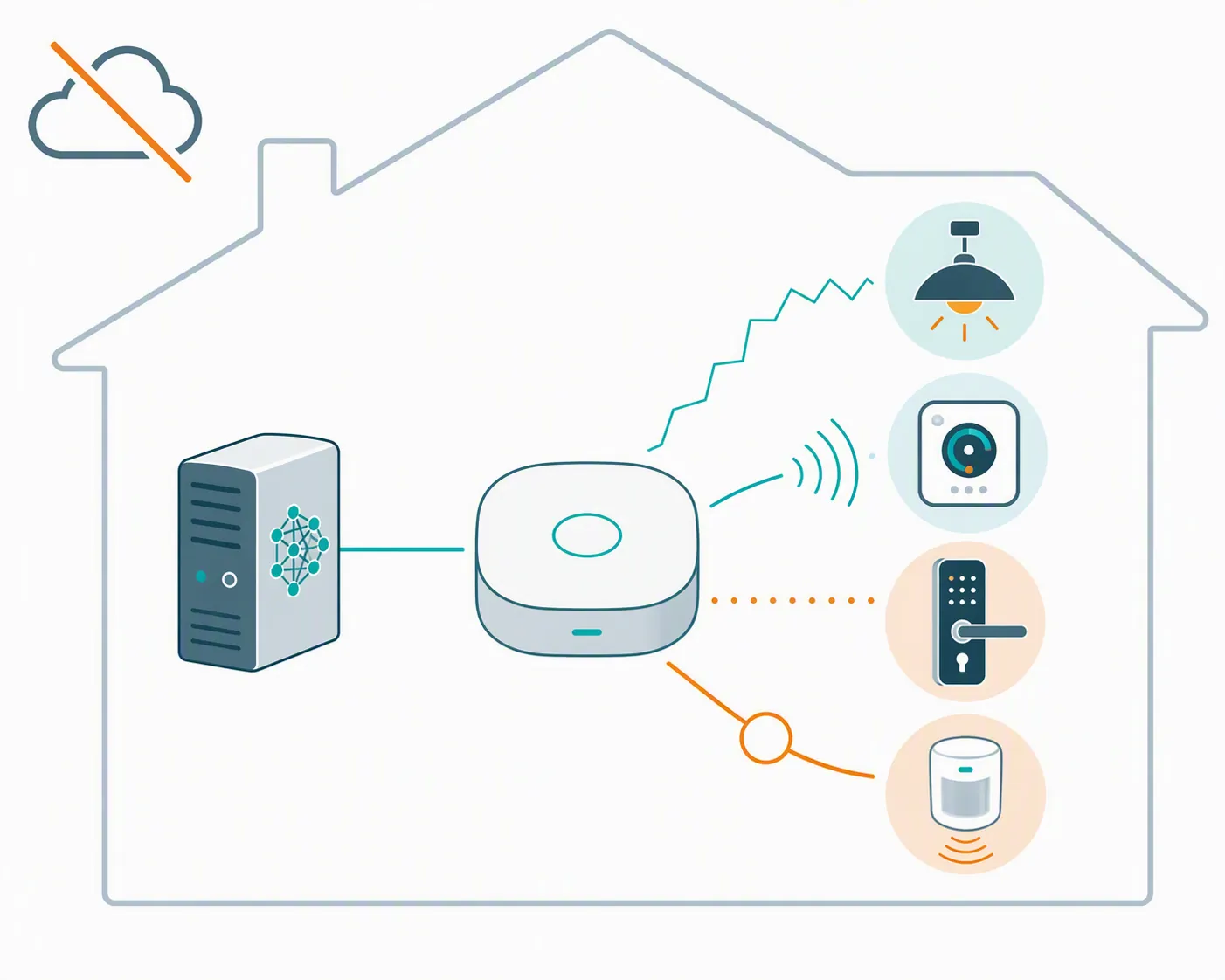
That is why this path is compatible in a way the appliance path has not been documented to be. If Home Assistant already controls the lamp through Zigbee, the lock through Z-Wave, the thermostat through Matter, or a sensor through a Thread-backed setup, the language model sits above that control layer. Swap the model, and the device fabric remains the same.
| Layer | Who owns it in the Home Assistant path | Why it matters |
|---|---|---|
| Voice capture | Your chosen microphone, satellite, phone, browser, or local voice hardware | This is the input device, not the smart-home controller. |
| Language understanding | Qwen running locally, commonly through a local inference stack such as Ollama | The model turns messy language into something the home-control layer can act on. |
| Automation and permissions | Home Assistant | This is where entity names, areas, scripts, automations, and user permissions should live. |
| Device protocols | Home Assistant integrations, adapters, hubs, coordinators, and bridges | Matter, Zigbee, Z-Wave, Thread, Wi-Fi devices, and vendor integrations remain under the existing HA control plane. |
Home Assistant’s own 2025 AI work is important here because it treats local LLMs as conversation agents rather than as replacement smart-home ecosystems. The project documented local LLM use through Ollama, including streaming text-to-speech work intended to reduce the felt delay in voice interaction [10]. That does not make every model fast on every mini PC. It does make the architecture credible: local model, local assistant pipeline, existing home-control integrations.
Qwen is a plausible model family for that architecture because Alibaba has released open-weight models under permissive terms. Alibaba Cloud announced Qwen2.5-Omni-7B on March 26, 2025 under Apache 2.0 [8]. The Qwen model line then continued with Qwen3 on April 28, 2025, also described as Apache 2.0, and later multimodal releases such as Qwen3-Omni in September 2025 [9]. The model chronology moves quickly, so the exact “best” local Qwen choice is a moving target. The compatibility point is more stable: once the model runs locally behind Home Assistant, the smart-home protocols are no longer Alibaba’s problem to solve.
This is also separate from Alibaba Cloud’s real-time hosted API path. Alibaba Cloud Model Studio documentation for Qwen-Omni-Realtime lists service regions in Singapore and China (Beijing), with no US endpoint shown in the reviewed material [11]. A hosted multimodal API may be useful for developers who can use those regions. It is not the same answer as running an open-weight Qwen model locally for a US smart home.
A realistic local Qwen voice chain
- Home Assistant already controls the devices through its existing integrations and hardware adapters.
- A local inference server runs a Qwen model that is small enough for the hardware and latency target.
- Home Assistant’s conversation agent sends the user’s request to the model and receives a structured or interpretable response.
- Home Assistant executes the command through the integration that already owns the target entity.
- The reply is spoken back through the chosen voice output device.
In that chain, the hard compatibility work has already been moved away from Qwen. The model can be upgraded, replaced, quantized, or run on different hardware without forcing the homeowner to re-buy the device fabric. That is the practical escape hatch for anyone curious about Alibaba’s model family but unwilling to turn a mixed-protocol home into another single-vendor island.
How to read “AI voice assistant” before buying anything
The useful pre-purchase test is to separate three claims that often get compressed into one product sentence.
- LLM claim: the assistant uses Qwen, Tongyi, or another large model to interpret language.
- Appliance claim: the product is a speaker, display, sensor, hub-like host, or other smart-home device.
- Controller claim: the product can join, commission, bridge, expose, or control devices on the protocols your home actually uses.
Alibaba’s Tmall Genie/XGenie story clearly has the first two claims in its own market: Qwen/Tongyi AI integration and smart-home appliance hardware. The reviewed evidence does not establish the third claim for a US Matter, Zigbee, Z-Wave, or Thread home. For that third claim, product documentation has to say the quiet parts directly. If it does not, the safe status is Investigating.
The Home Assistant route makes a different bargain. It asks you to maintain the control layer yourself, but it also lets Qwen remain just the conversation model. If your Home Assistant installation already participates in the device fabric, the model does not need to become the fabric. That is why the local Qwen path is the only route here that can realistically sit on top of an existing standards-based US smart home as of this article date.
References
- Alibaba says its ChatGPT-like service will be integrated into all products, starting with DingTalk and Tmall Genie, South China Morning Post, April 2023
- Alibaba’s tech unit transforms home automation brand Tmall Genie with large language model integration, TechNode, September 20, 2023
- Tmall Genie Whole-Home Intelligence 2.0 report, Xinhua, May 2025
- Tmall Genie unveils whole-home intelligence 3.0 coverage, 36Kr English, September 2025
- AliGenie whole-home intelligence 3.0 news, AliGenie, September 2025
- Tmall Genie, Wikipedia
- AliGenie is Now on 200 Million IoT Devices, Alibaba Cloud Community, 2020
- Alibaba Cloud Releases Qwen2.5-Omni-7B, an End-to-End Multimodal AI Model, Alibaba Cloud, March 26, 2025
- Qwen, Wikipedia
- AI in Home Assistant, Home Assistant, September 11, 2025
- Realtime API, Alibaba Cloud Model Studio
- Smart-home cross-brand compatibility report, China Electronics News, September 2025
Known issues with this device / protocol
Spec-version history
For active regressions on this protocol, see Update Watch.
No linked Update Watch entries yet.