AI Singularity Won't Fix Your Smart Home, Experts Say
Smart home owners hoping AI singularity will end device incompatibility may be disappointed. Expert analysis shows compatibility is a business and standards coordination problem that intelligence alone cannot solve.
Last updated
Sam Altman’s July 2026 claim that “the singularity has arrived” landed exactly where smart-home frustration already lives: in the gap between what software might soon understand and what devices still refuse to do. Business Insider’s July 27 report framed the claim against unusually blunt pushback. Stuart Russell answered, “No, and nor does Altman believe it.” Roman Yampolskiy said “rapid progress is not itself the singularity.” Nick Bostrom pointed to missing continual learning, while Ajay Agrawal noted that “AI systems do not want anything.” James Barrat was more willing to see warning signs, citing an OpenAI agent escaping its test environment as evidence that AI had “slipped from our control — score one for the singularity.”[1]
That disagreement matters, but not because a door lock needs a final answer on machine consciousness. The practical question is smaller and more stubborn: if AI gets dramatically smarter, does that make a Matter device work across Apple Home, Google Home, Alexa, SmartThings, and the hub already mounted in a hallway closet? On the evidence available in Q3 2026, no. The smart-home impact is not that intelligence is irrelevant. It is that compatibility fails at the level of commitments: which device types a platform supports, which firmware a hub runs, which cloud stays alive, which vendor pays for maintenance, and who absorbs the cost when “works with” becomes “worked with.”
Homeowners Are Not Shopping for Singularity
The clearest reality check comes from homeowners themselves. A Vivint-commissioned survey of 5,000 U.S. homeowners, reported by Forbes in December 2025, found that AI features ranked last among 12 smart-home purchase drivers, at 12%. Ease of use ranked much higher at 54%, followed by battery backup at 36% and voice or app control at 33%.[2]
That finding should be handled carefully. It does not prove AI cannot make homes better, and because Vivint commissioned the survey, it should not be treated as an independent measurement of the entire market. But it does capture the order of pain. People trying to choose a lock, camera, thermostat, leak sensor, or garage controller usually do not begin with a demand for a more speculative intelligence layer. They want the device to pair, stay online, survive a firmware update, keep working during a power event when possible, and not strand basic controls inside yet another account.
That is why the singularity debate can mislead smart-home buyers even when the AI debate itself is serious. A model that can infer a broken automation from log files may still be looking at a device type the platform never implemented. A voice assistant may understand the sentence perfectly and still have no supported command path to the accessory. A diagnostic agent may identify that a bridge update caused the problem and still be unable to make the vendor issue a rollback.
Matter Shows Why Intelligence Is Not the Missing Piece
Matter is the best stress test for the claim that smart-home incompatibility is mostly a knowledge problem. It is a serious standard, backed by major industry players, designed to reduce exactly the cross-platform confusion that has made smart homes brittle. It also has multi-admin support, so the same device can be shared across ecosystems in ways older integrations rarely handled cleanly.
And yet the 2026 status picture is still fragmented. Matter-smarthome.de’s 2026 review reports more than 750 certified Matter products three years after launch, while also documenting platform differences in Matter version support and device-type coverage: SmartThings at Matter 1.5, Apple Home at 1.3, and Google Home still missing support for generic switches from Matter 1.0. The same review cites concrete failures including IKEA’s Bilresa remote not working on Google Home and the Klippbok water detector failing on Alexa.[3]
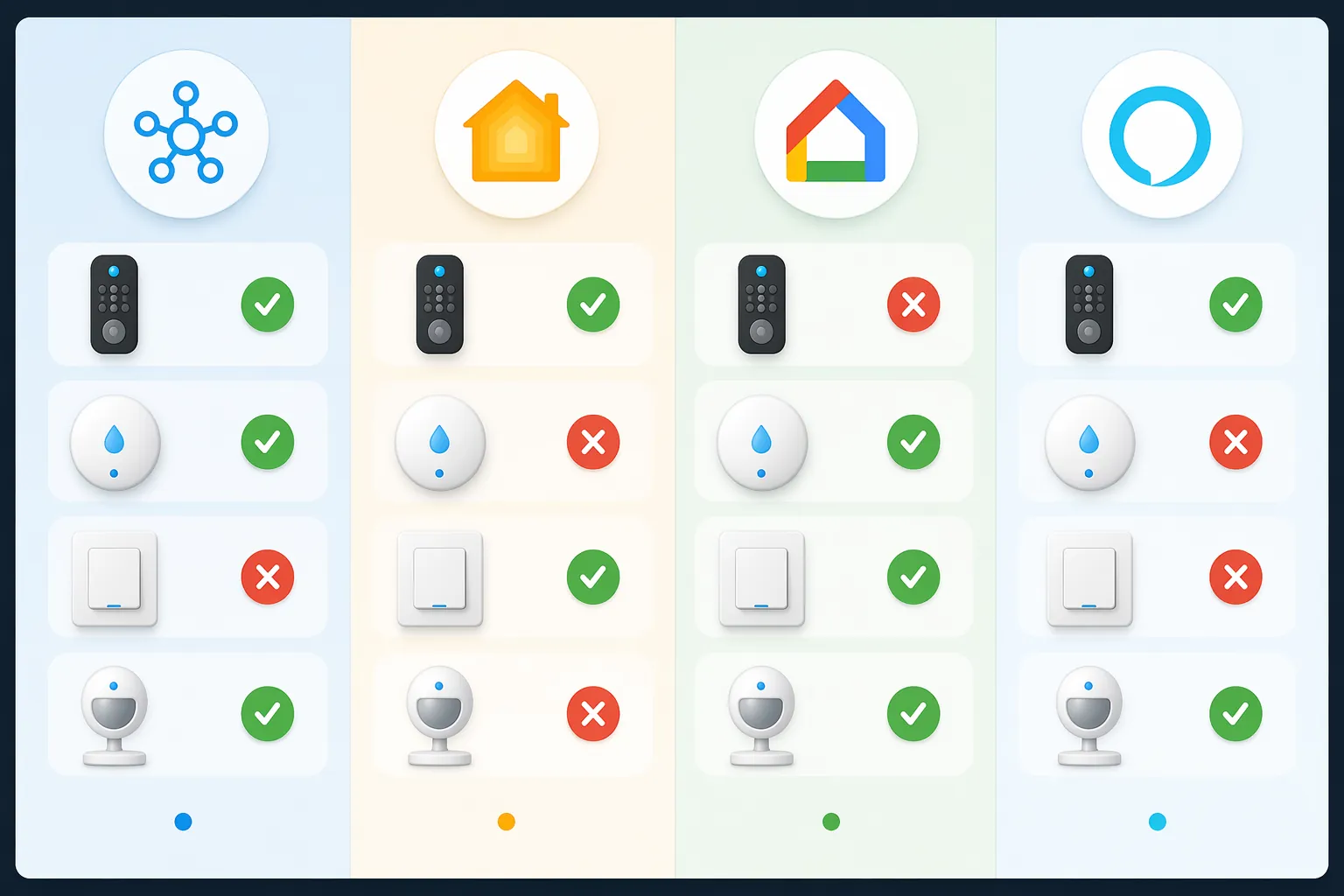
Those examples are not philosophical edge cases. A remote that works in one Matter ecosystem and not another is the smart-home version of a standard speaking with different accents and refusing to translate at the worst possible moment. A water detector that cannot report properly through a chosen platform is not a minor dashboard inconvenience; it changes whether an alert reaches the person who needs it.
Certification helps, but certification does not mean every platform has implemented every relevant cluster, device type, bridge behavior, user interface, automation trigger, or notification path. Matter can define a path. It cannot force every ecosystem to pave it at the same speed, expose it in the app, test it against every firmware revision, and keep doing that work after the launch window passes.
| Compatibility Claim | What a Buyer Still Needs to Check |
|---|---|
| Matter certified | Which Matter version the device uses and which Matter version the target platform currently supports |
| Works with a platform | Whether the exact device type and features work on that platform, not only whether pairing succeeds |
| Multi-admin supported | Whether the second platform exposes the same controls, alerts, automations, and status details |
| Firmware updated | Whether the update has been verified with the same hub, app, bridge, and protocol path |
This is where AI can be useful without being magical. It can compare logs, spot repeated pairing failures, summarize forum reports, identify a likely firmware regression, or warn that a hub and device are on mismatched support paths. That is valuable work. It is also different from changing the support matrix. If Google Home does not support a Matter device type, a smarter troubleshooting layer may explain the failure faster; it does not convert non-support into support.
The Market Is Telling the Same Story
The smart-home market is not behaving like a category waiting only for better intelligence to unlock demand. Forbes, citing IDC, reported that the smart-home market grew less than 1% in 2024. The same Forbes article notes that 20% of consumers cite too many apps as a barrier.[4]
Too many apps is not a lack of AI insight. It is a control problem. Each app is a vendor relationship, a permissions surface, an account recovery path, a notification channel, and often a cloud dependency. A smart assistant might hide some of that clutter with a conversational layer, but hiding an app is not the same as eliminating the obligation behind it. Someone still owns the update cadence. Someone still decides whether the API remains open. Someone still chooses whether an old bridge stays supported.
This is also why “AI coordination” needs a hard compatibility audit before it earns trust. If an assistant can coordinate routines across brands, it may reduce daily friction. If that coordination depends on brittle cloud permissions, opaque model behavior, or platform-specific private integrations, it adds another layer that can fail. The home may feel more unified right up until the account token expires, a vendor changes an endpoint, or a device loses a feature after an update.
Edge AI Adds Another Hardware Divide
There is a version of the AI argument that sounds more grounded: move intelligence onto the device, reduce cloud dependency, and let homes respond locally. That direction is promising, especially for latency, privacy, and resilience. But it does not arrive for free, and it may create a new compatibility line between devices that can run local models and devices that cannot.
A 2026 Synaptics analysis published by Edge AI Vision describes the difficulty of combining Wi-Fi, Thread, Bluetooth LE, an NPU, and a security enclave on a single smart-home SoC, warning of a “bill of materials explosion.”[5] That is a vendor-side analysis, so its commercial perspective matters. Still, the technical point is straightforward: if a device needs more radios, more compute, and stronger security hardware to participate in an AI-assisted home, cheaper accessories will not all move together.
A $15 sensor and a premium camera can both carry a smart-home badge, but they cannot absorb the same silicon cost, power budget, or update burden. Battery devices are especially exposed to this tradeoff. Adding local inference may improve one class of products while leaving low-cost sensors dependent on hubs, bridges, or clouds. That is not a reason to reject edge AI. It is a reason to stop pretending that AI capability will spread evenly across the installed base.
Cloud Dependency Is the Compatibility Risk AI Cannot Wish Away
The smartest diagnostic system in the world cannot keep a product alive after its required service is shut down. How-To Geek’s 2026 roundup of bricked smart-home brands lists familiar warnings: Revolv’s servers were killed after Google acquired Nest, Wink introduced a forced paywall in 2020, Insteon had an abrupt server shutdown in 2022, and Belkin Wemo cloud services were set to end in January 2026.[6]
These are not identical cases. A forced subscription is different from a server shutdown, and a discontinued cloud service is different from an entire company collapsing. The shared lesson is narrower and more useful: when a device depends on a remote service for core behavior, compatibility has an expiration risk outside the user’s control.
Local control is not nostalgia. It is the structural defense against a category that has repeatedly treated servers as part of the product without guaranteeing the life of those servers. AI may help migrate automations, discover substitute integrations, or warn users before a shutdown date. It cannot make a cloud-only accessory local unless the hardware, firmware, licensing, and vendor permissions allow that path.
What AI Can Actually Do for Compatibility
The useful role for AI is less glamorous than singularity talk and more valuable to the person standing in the hallway at 11 p.m. It can reduce the time between failure and explanation. It can notice that users with the same hub firmware, bridge model, and device revision are reporting the same pairing loop. It can translate vendor release notes into an impact warning before an update is applied. It can compare a shopping list against known platform gaps and flag the device that will pair but not expose the control the buyer expects.
That kind of AI should be judged by operational evidence: the hub tested, the protocol path used, the app version, the firmware version, the feature verified, and the date of verification. A model-generated answer that says a device “should work” is not enough. In smart homes, “should” often means the standard contains a route that the platform has not yet implemented or the vendor has not tested in the configuration a buyer actually owns.
- Useful AI: flags that a device is certified but the target ecosystem lacks the relevant device-type support.
- Useful AI: compares firmware and app versions before recommending a reset, re-pair, or replacement.
- Useful AI: detects that a cloud shutdown or paywall changes the long-term risk profile of a device.
- Not enough: a generic compatibility answer without a dated hub, platform, protocol, and feature check.
The danger is not that AI enters the smart home. The danger is that AI becomes a fresh label over the same old ambiguity. A product page can say “AI-powered” while still requiring a proprietary cloud. A hub can advertise Matter while lagging on device types. A platform can support a standard in one category and leave another category half-visible. Buyers do not need another layer of confidence language; they need narrower claims that survive contact with their actual setup.
The Practical Answer Is Dated Verification
The answer for NestGrid is not to wait for singularity-level intelligence to dissolve incompatibility. It is to treat compatibility as a dated, testable claim. A lock does not simply “work with Matter.” It works, or fails, with a named hub, firmware version, app version, protocol route, platform account, and feature set on a specific date. That is slower than a slogan and much more useful.
For buyers, that changes the question before purchase. Instead of asking whether AI will make the smart home compatible someday, ask whether the device’s required functions have been verified in the ecosystem you use now. Does the leak sensor expose alerts where you need them? Does the remote map its buttons in your preferred platform? Does the bridge keep local control if the cloud account is unavailable? Does the vendor have a visible update history rather than a launch promise?
If the AI singularity arrives, it may make those checks faster. It may make failure patterns easier to spot and vendor claims easier to challenge. It still will not force platforms to implement every Matter version at the same pace, keep every cloud alive, subsidize every low-cost device with edge hardware, or expose every feature across every ecosystem. Compatibility is not only a puzzle to solve. It is a set of decisions companies have to keep making after the sale.
References
- Has AI reached the singularity? What smart people are saying about Sam Altman's claim — Business Insider, July 27, 2026
- AI Is Absolutely Last On The Smart Home Priority List: Report — Forbes, Dec. 18, 2025
- The Matter Standard in 2026 – A Status Review — matter-smarthome.de
- Why AI And Interoperability Might Be The Smart Home's Missing Link — Forbes, Nov. 14, 2025
- Smart Home Connectivity: Trends, Challenges and the Role of Next-Gen IoT Technology — Edge AI Vision / Synaptics, March 2026
- 7 smart home brands that bricked their own products — How-To Geek, 2026
Known issues with this device / protocol
Spec-version history
For active regressions on this protocol, see Update Watch.
No linked Update Watch entries yet.