
AI Chips in Smart Home Hubs Can Break Device Compatibility
This article explains why the surge of AI chips in smart home hubs has created a new class of compatibility failures distinct from protocol mismatches, and how chip architecture—not just the presence of AI—determines whether your existing devices will keep working.
Last updated
The most irritating smart-home failure is not the one where a device never worked. It is the one where nothing obvious changed: the same coffee maker, the same routine name, the same hub, the same kitchen, and suddenly the assistant starts negotiating with you.
That is why the 2025 wave of AI smart-home upgrades deserves a compatibility discussion, not just a feature discussion. The Verge’s late-2025 account of Alexa+ described a coffee routine that no longer ran reliably, with the assistant “coming up with a different excuse almost every time.” The same report also described Google Nest camera AI summaries as “wildly inaccurate.” These are not protocol logos failing on a box. They are command paths and interpretation layers behaving differently after the assistant got smarter on paper. [1]
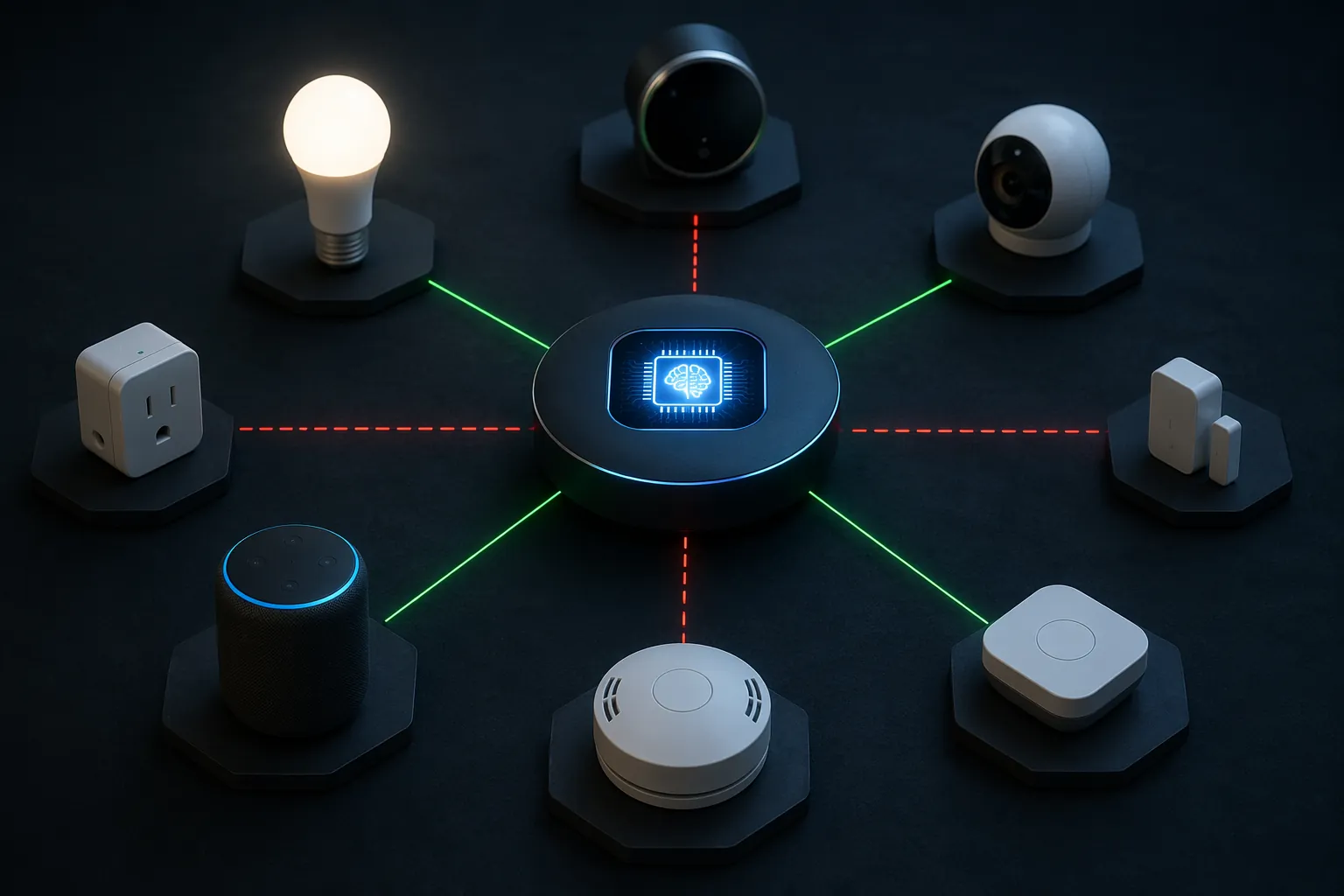
PCWorld put Alexa+ and Gemini for Home in its ranked list of 2025 smart-home failures, then widened the picture beyond assistants: an October 2025 AWS outage affected Ring, Blink, and Eight Sleep, with Eight Sleep beds reportedly beginning to overheat when cloud AI services became unreachable. [2] Again, that does not prove that every AI hub breaks devices. It does prove something narrower and more useful: cloud dependency can become a compatibility risk even when the devices in your home have not changed.
So the practical question for 2025 smart-home AI chips is not whether AI belongs in a hub. A local NPU can be useful. Faster presence detection, local audio parsing, camera event filtering, and less cloud round-tripping are all legitimate goals. The question is where the AI runs, what it does to the command before it reaches the radio, and whether the hub’s wireless design can still deliver that command cleanly to the devices you already own.
The New Failure Looks Like Compatibility, Even When the Protocol Still Matches
Old smart-home compatibility problems were at least familiar. A Zigbee sensor did not pair. A Matter device exposed only basic controls. A Thread network had a border-router problem. Annoying, but the failure usually lived near the device, the radio, the platform implementation, or the app.
AI assistants add another place to break: the translation step between what the user says and what the smart-home platform actually calls. Georgia Tech professor Mark Riedl, quoted by The Verge, explained that large language model assistants have to compose function-call syntax each time, unlike older deterministic template matchers. His blunt diagnosis was: “It’s another place where it can make mistakes.” [1]
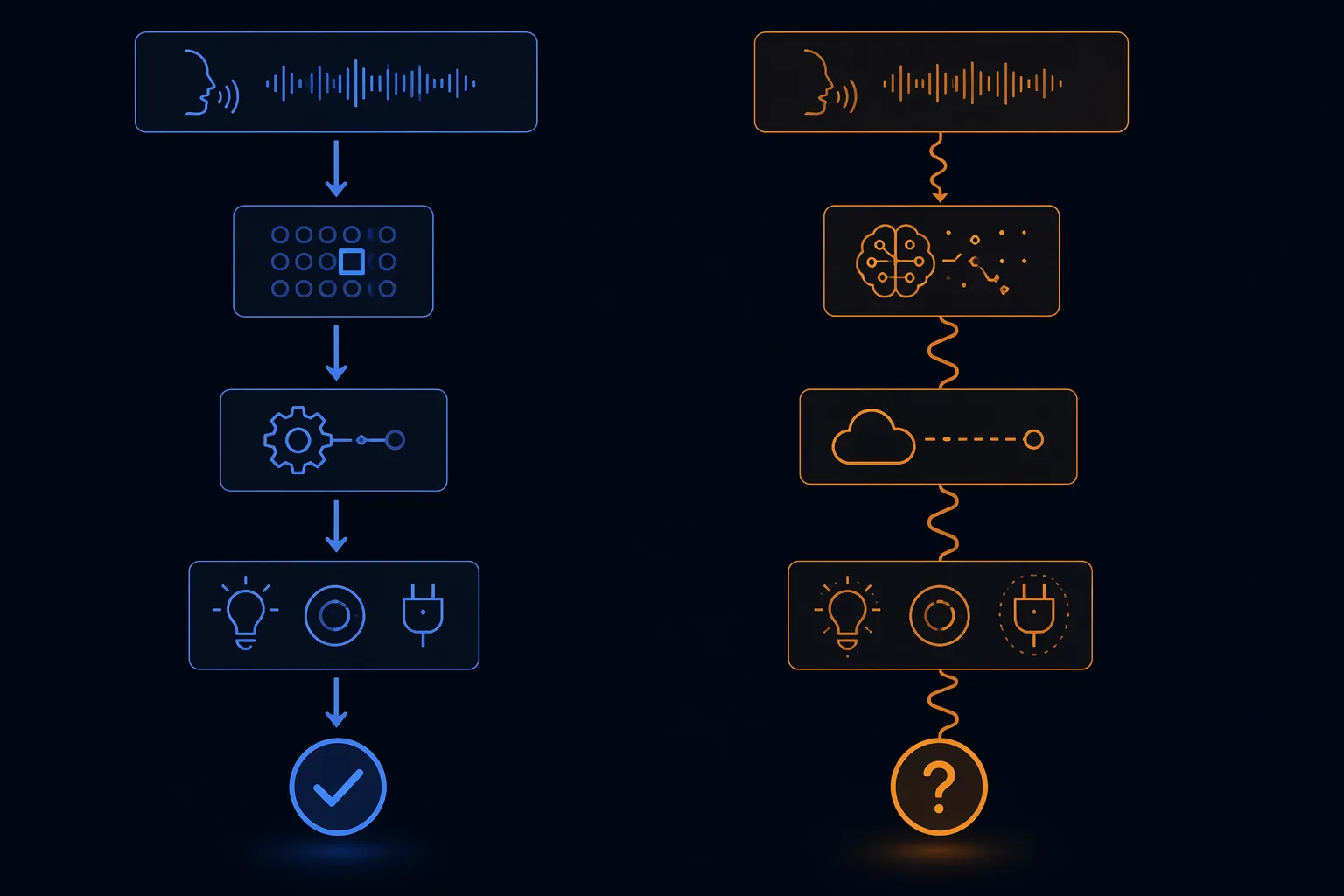
That mechanism matters. In a template-based system, “start my coffee routine” is usually matched against a known phrase or intent, then mapped to a stored automation. It may fail, but it tends to fail in the same boring way. In an LLM-driven system, the assistant may infer the intent, assemble the API call, decide which device or scene is relevant, and generate a tool invocation. If that generated call varies from attempt to attempt, the same spoken request can produce different excuses, different device targets, or no useful action.
From the user’s point of view, that feels like the coffee maker stopped being compatible. From the hub’s point of view, the coffee maker may still be reachable. The break sits higher up the stack, before the command ever becomes a device command.
That distinction is not pedantic when someone is troubleshooting. If a Matter outlet still toggles from the app but fails through Alexa+ or Gemini for Home, replacing the outlet is probably a waste of money. If a voice routine fails differently on repeated attempts, the suspect is no longer just Thread, Wi-Fi, or Matter. The assistant’s interpretation layer belongs on the suspect list.
Most “AI Smart Home” Processing Was Still Cloud-Heavy in 2025
The word “AI” on a smart-home product did not usually mean a meaningful AI chip was doing the work inside the home. TechInsights estimated in July 2025 that only 5% of the $7 billion smart-home AI market used edge AI chips, with the rest running on cloud GPUs. [3]
That number is useful because it keeps the AI-chip discussion grounded. A hub advertised as AI-powered may still depend on a cloud model for natural-language understanding, camera descriptions, routine interpretation, or recommendation features. If the internet path, cloud service, account layer, or model behavior changes, the local device may be blamed for a failure it did not cause.
The October 2025 AWS outage described by PCWorld is the ugly version of that dependency. It was not a subtle command-parsing bug; cloud-connected smart-home services became unavailable, and devices tied to those services lost normal behavior. [2] That kind of outage turns cloud architecture into a household reliability issue, not an abstract infrastructure footnote.
This is also where compatibility claims get slippery. “Works with Matter,” “supports Alexa,” and “AI-powered” each describe a different layer. A device can support the right protocol, appear in the right ecosystem, and still behave badly if the assistant sends the wrong command or if the cloud service required to decide that command is unreachable.
Matter Support Still Does Not Mean Full Feature Parity
Matter helps with discovery and basic control, but it has not eliminated platform-level differences. XDA noted in July 2025 that Matter devices can still lose advanced features such as power monitoring or adaptive lighting across different platform implementations. [4]
That is the older compatibility lesson colliding with the newer AI one. Protocol support can get the device onto the network and into the app. It does not guarantee that every feature survives platform translation, and it does not guarantee that an AI assistant will call the right function when a user asks for something indirectly.
For a buyer with existing sensors, switches, plugs, and lights, this means a hub’s compatibility page needs a date and a firmware context. “Matter-compatible” is too broad if the feature you care about lives in a platform extension, a manufacturer integration, or an assistant routine that has just been routed through a new AI layer.
A Local NPU Helps Only If the Hub Can Still Talk to the House
The obvious answer to cloud unpredictability is edge AI: put an NPU in the hub, run more inference locally, reduce trips to cloud GPUs, and keep automations alive when the internet is flaky. That answer is incomplete.
A smart-home hub is not just an AI box. It is also a radio traffic cop. It may need Wi-Fi for cameras and internet backhaul, Bluetooth Low Energy for onboarding and accessories, and Thread for low-power sensors and Matter devices. If those radios are poorly coordinated, local intelligence can make a correct decision and still fail to deliver it cleanly.
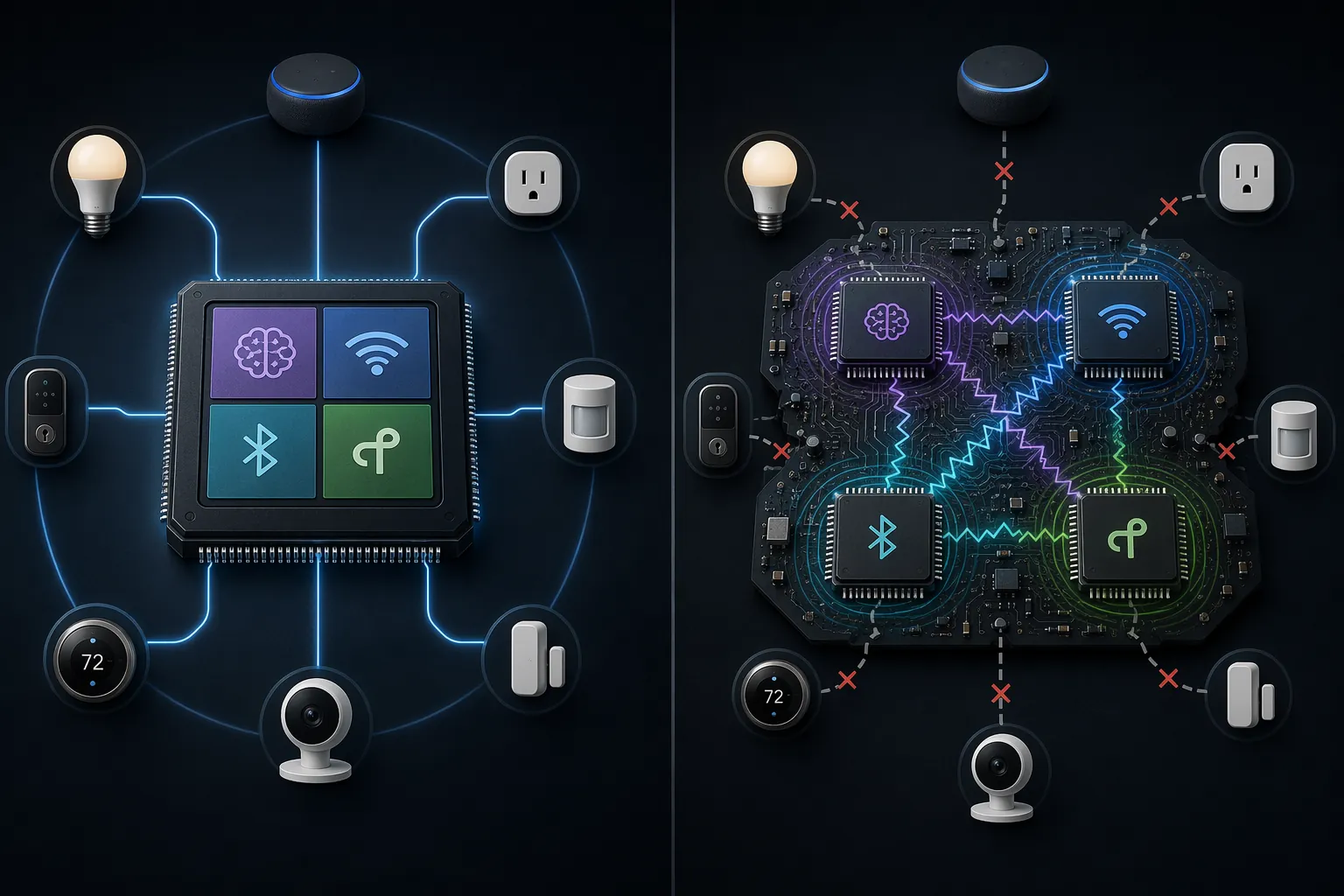
Synaptics, in material published through the Edge AI & Vision Alliance, described the coexistence problem in practical terms: without a single-die solution, 4K Wi-Fi streaming can flood the 2.4 GHz band and cause Thread sensor commands to collide, creating multi-second latency. [5] That is not an AI model accuracy problem. It is a hub architecture problem that can look exactly like a flaky device.
This is why TOPS numbers are a distraction unless they are tied to the radios. A faster NPU may classify a camera event sooner, but if the hub’s Wi-Fi, BLE, and Thread subsystems are fighting each other, the automation triggered by that classification can still arrive late or not at all. Compatibility, in the lived sense, includes whether the command reaches the device under normal household radio load.
Why the NXP i.MX 93W Is Interesting, With a Big Caveat
NXP’s i.MX 93W announcement is one of the more relevant chip developments for this exact reason. In March 2026, NXP described it as an applications processor combining a 1.8 eTOPS NPU with tri-radio Wi-Fi 6, Bluetooth Low Energy, and Thread on one die, replacing up to 60 discrete components. [6]
The important part is not the 1.8 eTOPS figure by itself. It is the single-die combination of AI acceleration and the three radios a modern smart-home hub is likely to juggle. If the silicon can coordinate Wi-Fi, BLE, and Thread more tightly than a board full of discrete chips, then edge AI has a better chance of improving compatibility instead of just moving inference closer to the user.
But the caveat is not optional: NXP said the i.MX 93W was sampling in the second half of 2026. [6] Sampling silicon is not the same thing as a consumer hub sitting in a kitchen for six months with mixed Matter devices, old sensors, firmware updates, multicast weirdness, and a family yelling at it during breakfast. The architecture addresses the right class of problem, but field reliability still has to be proven in shipping products.
Qualcomm’s Dragonwing Push Shows Where Hub Marketing Is Going
Qualcomm’s CES 2025 Dragonwing announcements point in the same general direction: more AI compute at the edge, more integrated IoT positioning, and explicit smart-home ambitions. SiliconAngle reported Dragonwing IQ series NPUs with up to 100 TOPS, integrated Matter support, and Qualcomm’s Edge Impulse acquisition. [7]
Those announcements matter as market context, but they do not settle compatibility. High AI throughput can be valuable for cameras, audio, occupancy, and local automation decisions. Integrated Matter support is useful. Neither tells a buyer whether their current Thread sensors will stay responsive while Wi-Fi cameras are streaming, or whether a voice assistant will use deterministic local routines instead of a cloud LLM-generated tool call.
How to Read an AI Hub Claim Without Getting Stranded
A useful compatibility check starts by separating three layers that marketing tends to collapse into one word.
| Claim on the box | What to verify | Why it matters |
|---|---|---|
| AI-powered | Which tasks run locally, and which require a cloud LLM or cloud GPU | Cloud interpretation can change command behavior even when devices are unchanged |
| Built-in NPU | Whether the NPU is used for automations, camera/audio inference, or only selected features | An NPU does not automatically make voice commands local or deterministic |
| Matter support | Which device categories and advanced features are exposed on the target platform | Basic pairing does not guarantee feature parity |
| Thread support | Whether the hub is a Thread border router and how it handles Wi-Fi/BLE/Thread coexistence | Radio contention can look like device incompatibility |
| Tri-radio integration | Whether Wi-Fi, BLE, and Thread are integrated on one die or handled by separate components | Single-die coordination may reduce coexistence problems, but shipping-product behavior still matters |
For troubleshooting, the fastest split is usually app control versus assistant control. If the device responds from the app but fails through voice, scene naming, or natural-language routines, look at the assistant layer first. If it fails from every control path, check the network, radio, bridge, device firmware, and platform integration before blaming AI.
For buying, ask for compatibility evidence that names the hub, firmware, platform, and date. A claim tested before an Alexa+, Gemini for Home, Matter stack, or hub firmware change is not the same claim afterward. The device may still pair; the automation may not still behave.
For edge-AI hubs, do not stop at “has an NPU.” Ask whether routine execution can stay local, whether the assistant uses deterministic mappings for known smart-home commands, and how the hub coordinates Wi-Fi, BLE, and Thread under load. A hub that thinks locally but radios poorly is still a bad hub.
The Compatibility Rule of Thumb
Do not ask whether a smart-home hub “has AI.” Ask three narrower questions: does the command get processed locally or through a cloud LLM, does the hub integrate Wi-Fi, BLE, and Thread radio handling tightly enough to avoid coexistence failures, and is the compatibility claim tied to a dated, tested hub and firmware state?
The available 2025 and 2026 evidence does not justify saying AI chips broadly break smart-home compatibility. It does justify treating AI architecture as a compatibility variable. Cloud LLM assistants can introduce variable command generation before the protocol layer. Edge NPUs can reduce cloud dependence, but only if the rest of the hub architecture can deliver local decisions reliably to Wi-Fi, BLE, Thread, and Matter devices. Until a specific hub proves that in the field, “AI-powered” is not a compatibility guarantee.
References
- AI is breaking the smart home, The Verge, December 2025
- The biggest smart home fails of 2025, ranked, PCWorld, December 2025
- Analysis: Edge AI chips aren’t coming to smart home devices in the near future, TechInsights, July 2025
- Matter has me doubting the future of smart homes, XDA, July 2025
- Smart Home Connectivity Trends, Challenges, and the Role of Next-Gen IoT Technology, Edge AI & Vision Alliance, March 2026
- NXP Fuses Edge AI Processing, Advanced Connectivity and Security in Groundbreaking Single-Chip Platform for Next-Gen Smart Home and IoT Devices, NXP, March 2026
- Qualcomm unveils premium AI, IoT and smart home innovations at CES 2025, SiliconANGLE, January 2025
Known issues with this device / protocol
Spec-version history
For active regressions on this protocol, see Update Watch.
No linked Update Watch entries yet.