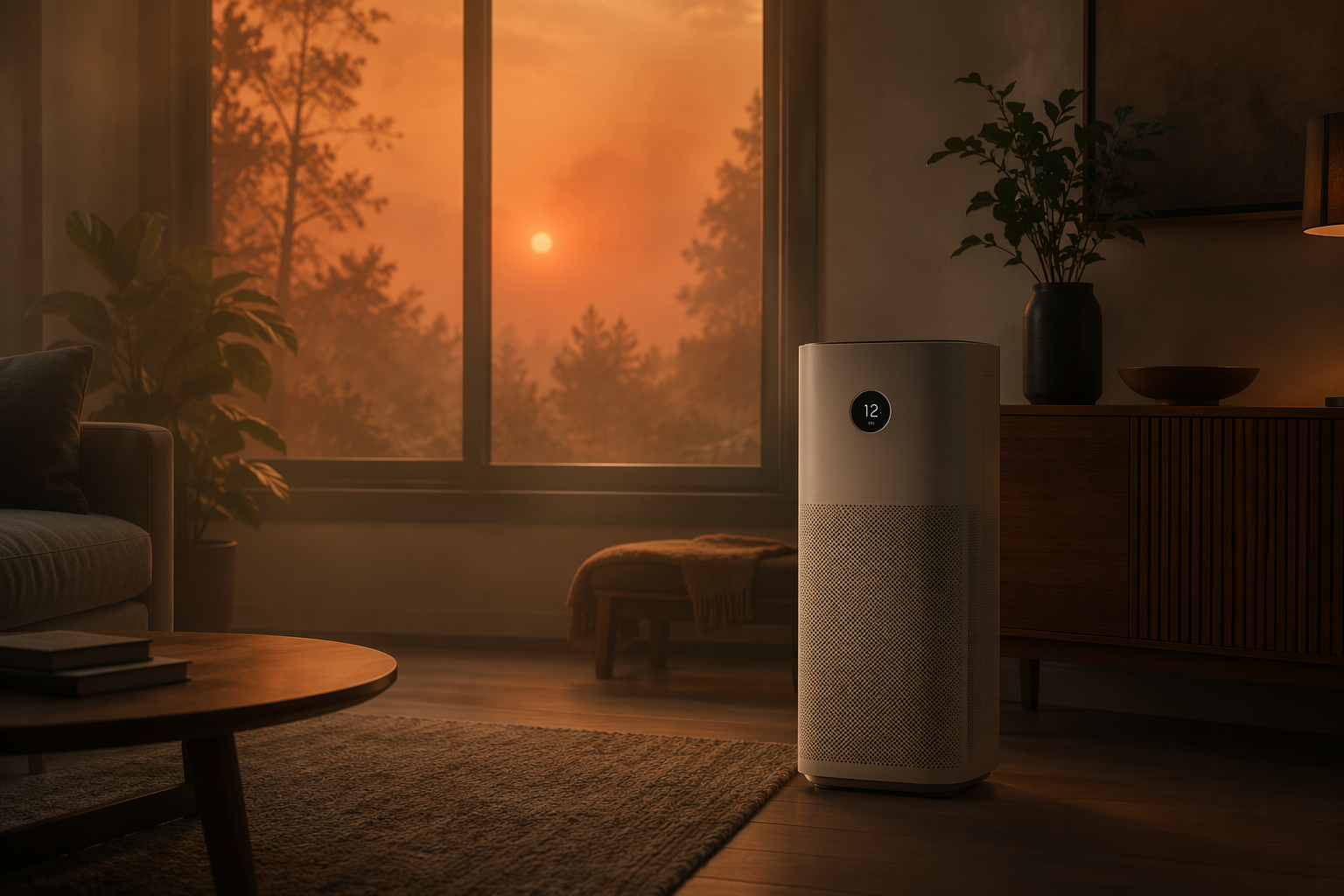
If wildfire smoke is the reason you are buying, start with smoke CADR, not the app. A smart purifier that can schedule itself, send filter alerts, and ramp when PM2.5 jumps is genuinely useful during a multi-day smoke event. But it still has to move enough filtered air for the room. The practical cutoff I would use is the AHAM rule of thumb: choose a purifier whose smoke CADR is at least two-thirds of the room’s square footage, and treat that as a minimum during wildfire season rather than a generous target.[1]
On that basis, the best air purifier for wildfire smoke in a smart home is the Coway Airmega 250S for most recurring smoke-season households. The Levoit Core 400S is the better value if price matters more than the most polished auto response. The Winix 5510 is the high-CADR bargain to watch if you want more raw smoke cleaning per dollar and do not need the most refined app experience.
| Rank | Model | Smoke CADR | Practical room fit by 2/3 rule | Smart ecosystem | Smoke-season behavior | Carbon seriousness | Estimated first-year smoke-season cost |
|---|---|---|---|---|---|---|---|
| 1 | Coway Airmega 250S | Noted as a top smoke performer; exact CADR varies by source | Medium to large room, verify current certified CADR before buying | App control; Alexa/Google-style smart-home fit, not HomeKit/Matter | Best proportional auto-ramp response to PM2.5 spikes | Meaningful filter stack with activated carbon, not just a washable pre-filter | About $260-$310 using $220-$250 street price plus one $40-$60 spare filter |
| 2 | Levoit Core 400S | About 231-260 CFM depending on test source | About 345-390 sq ft by the 2/3 rule | VeSync app; Alexa/Google-style smart-home fit, not HomeKit/Matter | Strong scheduling, remote control, and auto-mode value | Good for the price, though carbon depth still matters if odor and gases are a priority | About $220-$280 using $180-$220 street price plus one $40-$60 spare filter |
| 3 | Winix 5510 | About 253 CFM | About 380 sq ft by the 2/3 rule | App-enabled; not HomeKit/Matter | High CADR in its class; successor to the discontinued 5500-2 | Uses a carbon stage, stronger than token odor claims | About $220-$240 using about $180 street price plus one $40-$60 spare filter |
| 4 | Coway Mighty2 / AP-1512N | Strong mainstream performer; verify current smoke CADR | Smaller than the top cluster unless current CADR supports the room | Smart sensing has moved into this midrange class | Good automatic operation for the price | Useful if you want a lower-cost Coway option | Price cited around $160-$220 before smoke-season filter acceleration |
| 5 | HomeKit/Matter-compatible options such as Smartmi P1, Xiaomi 4 Lite, Govee H7122 | About 130-212 CFM across cited models | About 195-318 sq ft by the 2/3 rule | Better Apple Home or Matter fit, depending on model | Convenient ecosystem control, weaker smoke-CADR ceiling | Varies by model; do not assume app compatibility means smoke readiness | Model-dependent; buy only after checking room size and filter pricing |
The CADR figures above need one caveat before anyone starts splitting hairs over a few cubic feet per minute: exact smoke CADR numbers can differ between AHAM-certified specifications and independent lab measurements. That is why the Levoit Core 400S appears as a range rather than a single magic number, and why any final purchase should be checked against the current spec sheet or certification listing for the exact model being sold.[2][3]
How the ranking was weighted
The order is intentionally unforgiving. Smoke CADR comes first because it decides whether the purifier is large enough for the room. True HEPA filtration and real activated carbon come next because wildfire smoke is not only a dust problem; fine particles dominate the health concern, while gases and odor expose weak carbon claims quickly. Smart behavior comes after that: auto-ramp, scheduling, remote monitoring, and filter-life alerts matter when they reduce babysitting during the hours people are asleep, away, or trying to keep a bedroom protected.
Filter economics get more weight here than they do in a normal smart-home roundup. A nominal 12-month filter can load much faster during active smoke seasons, with reporting indicating that heavy smoke can shorten replacement intervals by roughly 2-3x, often bringing real-world life down to about 3-6 months. A $40-$60 spare filter is not an accessory in that scenario; it is part of the first-year cost.[1][4]
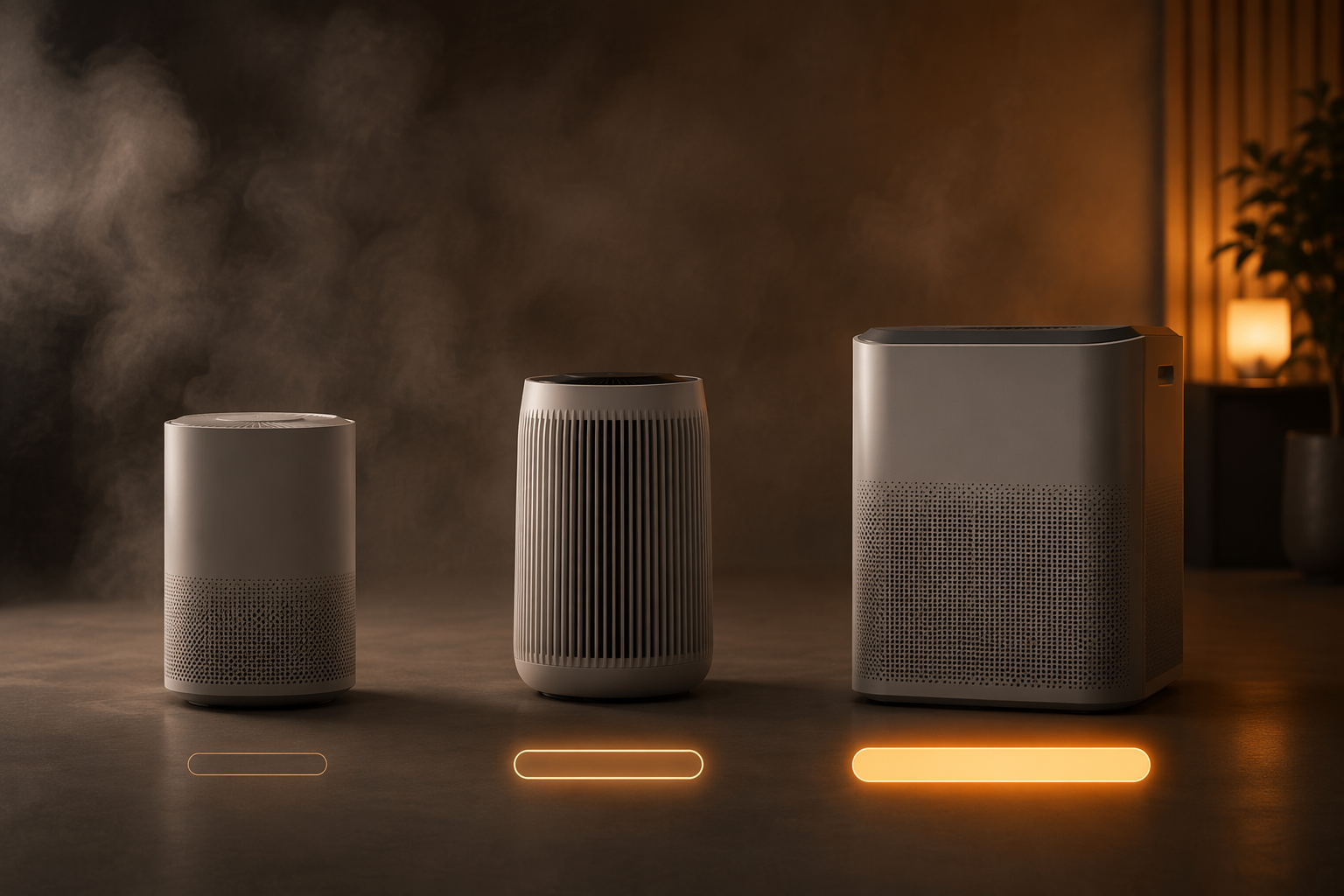
Coway Airmega 250S: best overall for recurring smoke seasons
The Coway Airmega 250S wins because it treats smart control as an operational feature, not decoration. Its strongest point in the cited testing and reviews is a more polished response to PM2.5 spikes: instead of behaving like a simple on/off machine, it ramps more proportionally as particle levels rise.[2][1] That matters when the smoke front moves in after dinner, the windows are already closed, and nobody wants to manually chase fan speeds until bedtime.
This is the purifier I would choose for a main bedroom, nursery, or work-from-home room where wildfire smoke is a recurring seasonal event rather than an occasional bad afternoon. The app and automation side are useful because the purifier has already cleared the first gate: it belongs in the stronger smoke-performance cluster. Remote checks, filter alerts, and automatic ramping become meaningful only after that.
Its cost picture is not the cheapest. With a cited street price around $220-$250, the first smoke-season year looks more like $260-$310 once one extra $40-$60 filter is treated as a realistic reserve.[2][1] That extra filter may not be needed in every home, but it is the honest budget for a household that expects several ugly AQI stretches rather than one smoky weekend.
Levoit Core 400S: the smoke-smart value pick
The Levoit Core 400S is the best value choice in this group because its smoke CADR lands in the useful middle-room range while its smart features are mature enough to help during a real event. The cited smoke CADR range is about 231-260 CFM, depending on the test source, which translates to roughly 345-390 square feet under the two-thirds rule.[2][3] That is a practical size for a protected bedroom, office, or modest living room, not a whole-house solution.
VeSync scheduling is the feature I would actually use. A purifier that can start before bedtime, stay on a known routine, and remain remotely visible while the outdoor AQI is changing takes one more task away from the person already checking whether it is safe to crack a window. Its auto-mode also belongs in the current midrange shift where PM2.5-based ramping is no longer reserved for premium models.[2][3]
The price is where the Core 400S makes its case. At about $180-$220 street price, its first-year smoke-season cost is roughly $220-$280 if you budget for one additional $40-$60 filter.[2][1] That keeps it close to Winix on total cost while giving buyers a particularly approachable app and scheduling setup.
Winix 5510: high CADR per dollar, with the 5500-2 era closed
The Winix 5510 is the model to look at if the priority is raw smoke CADR for the money. It is described as the successor to the discontinued Winix 5500-2, adds app control, and carries a cited smoke CADR of about 253 CFM.[3][5] By the AHAM room-sizing rule, that puts it around a 380-square-foot fit before accounting for the messier reality of leaky rooms, open doorways, and heavy smoke days.
At about $180, the 5510 is unusually aggressive if local pricing holds.[3] Add a $40-$60 spare filter and the first-year smoke-season estimate lands around $220-$240. That makes it a strong pick for renters trying to protect one bedroom or buyers who would rather put the savings toward a second purifier in another room.
The trade-off is polish. The Winix case is less about having the most elegant smart-home layer and more about getting serious airflow, an app-enabled successor to a popular older platform, and a cost structure that does not punish you immediately for preparing before the smoke arrives.
The HomeKit and Matter gap is still real
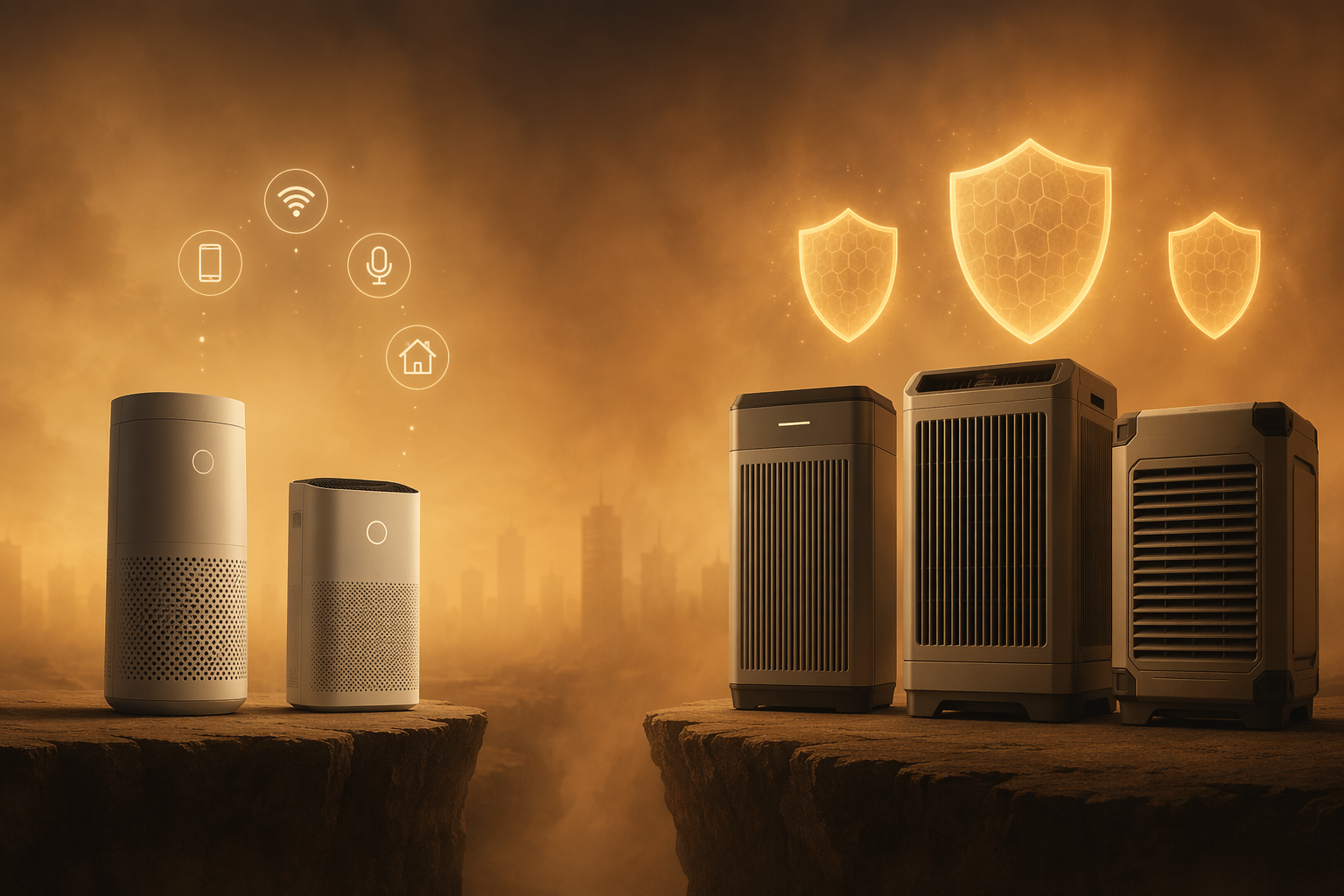
Apple Home households have the most annoying trade-off in this category. As of mid-2026, the strongest smoke-performing smart purifiers in this comparison group — Coway, Winix, Levoit, Blueair, and Dyson among the cited brands — do not support Apple HomeKit or Matter. The HomeKit or Matter-compatible models cited in the brief sit meaningfully lower on smoke CADR: Smartmi P1 around 150 CFM, Xiaomi 4 Lite around 212 CFM, and Govee H7122 around 130 CFM.[6][7]
That does not make those models useless. It makes them room-limited. A purifier around 130 CFM is a small-room smoke tool by the two-thirds rule, not a confident answer for a larger living room during a bad regional event. The Xiaomi 4 Lite’s cited 212 CFM is more capable, but it still does not erase the gap with the stronger smoke-focused picks.[6][7]
Matter may improve this later, but the current catalog is thin. The research brief notes fewer than 10 Matter-certified purifier models as of mid-2026, with none matching the smoke CADR of the top smoke-focused competitors.[7] If your Apple Home setup is already central to the house, it may be worth accepting a standalone purifier app for the smoke room rather than choosing a weaker cleaner just to keep the tile inside one dashboard.
What to ignore, or at least downgrade
Start with vague odor language. Wildfire smoke includes particles, gases, and smell; a thin washable pre-filter with a deodorizing label is not the same thing as a meaningful activated-carbon stage. Available smoke-focused testing and reviews support treating carbon seriousness as a deciding factor, especially when smoke odor lingers after particle readings begin to fall.[1][4]
Also downgrade app complexity that does not change behavior. A dashboard is helpful if it shows PM2.5, confirms the purifier ramped, lets you schedule a bedroom before sleep, warns about filter life, or lets you check operation while away. It is much less important if the purifier is still undersized for the room.
Be skeptical of nominal filter life, too. A 12-month filter claim may be reasonable under ordinary conditions, but smoke loading changes the math. If wildfire season is a known annual problem where you live, buy as if the first year includes at least one spare filter, then adjust after seeing how quickly your own home loads it.
Use-case winners
- Best overall for recurring wildfire seasons: Coway Airmega 250S, because its smoke-performance tier and proportional auto response make the smart features feel protective rather than decorative.
- Best value for a smart smoke room: Levoit Core 400S, because it combines useful smoke CADR, VeSync scheduling, auto-mode, and a lower first-year cost.
- Best high-CADR bargain: Winix 5510, because it brings about 253 CFM smoke CADR and app control at a cited price around $180.
- Best for Apple Home purists: a HomeKit or Matter-compatible model only if its CADR fits the specific room; otherwise, use a stronger standalone purifier app for the smoke-protection zone.
- Best next step if you want a shorter shortlist: read the Best Smart Air Purifiers for Wildfire Smoke in 2026 buyer guide.
- Best next step if you want a whole-home setup: pair the purifier decision with the broader smart home devices to protect against wildfire smoke strategy.
For wildfire smoke, buy enough purifier first, then choose the smartest machine inside that performance band. Smart-home integration is valuable when it helps the purifier react, schedule, alert, and maintain itself. It is not worth trading away the CADR and carbon needed to clean the room.
References
- Top performing air purifiers for wildfire smoke (+DIY units), HouseFresh
- Best Smart Air Purifiers for Wildfire Smoke 2026, SmartHomeExplorer
- Best Smart Air Purifiers – Tested, Reviewed and Ranked, Air Purifier First
- Wildfire Smoke Air Purifier Guide: Summer 2026, AirPureLab
- Best Air Purifiers For Wildfire Smoke – Top Picks!, Air Purifier First
- Best HomeKit air purifiers for the Home app in 2026, iMore
- Best Matter Smart Air Purifiers 2026, Matter Catalog
Discussion
Share your experience with the compared products, flag outdated pricing or specs, or ask clarifying questions about the comparison verdict.
Comments
Join the discussion with an anonymous comment.