
The best home security system for home invasion protection is the one that still helps when the break-in is happening while someone is inside. That changes the buying question. A loud siren may scare off some intruders, but it does not verify what is happening, talk to the person at the door, keep working through a Wi-Fi outage, or tell a monitoring center whether police should be dispatched.
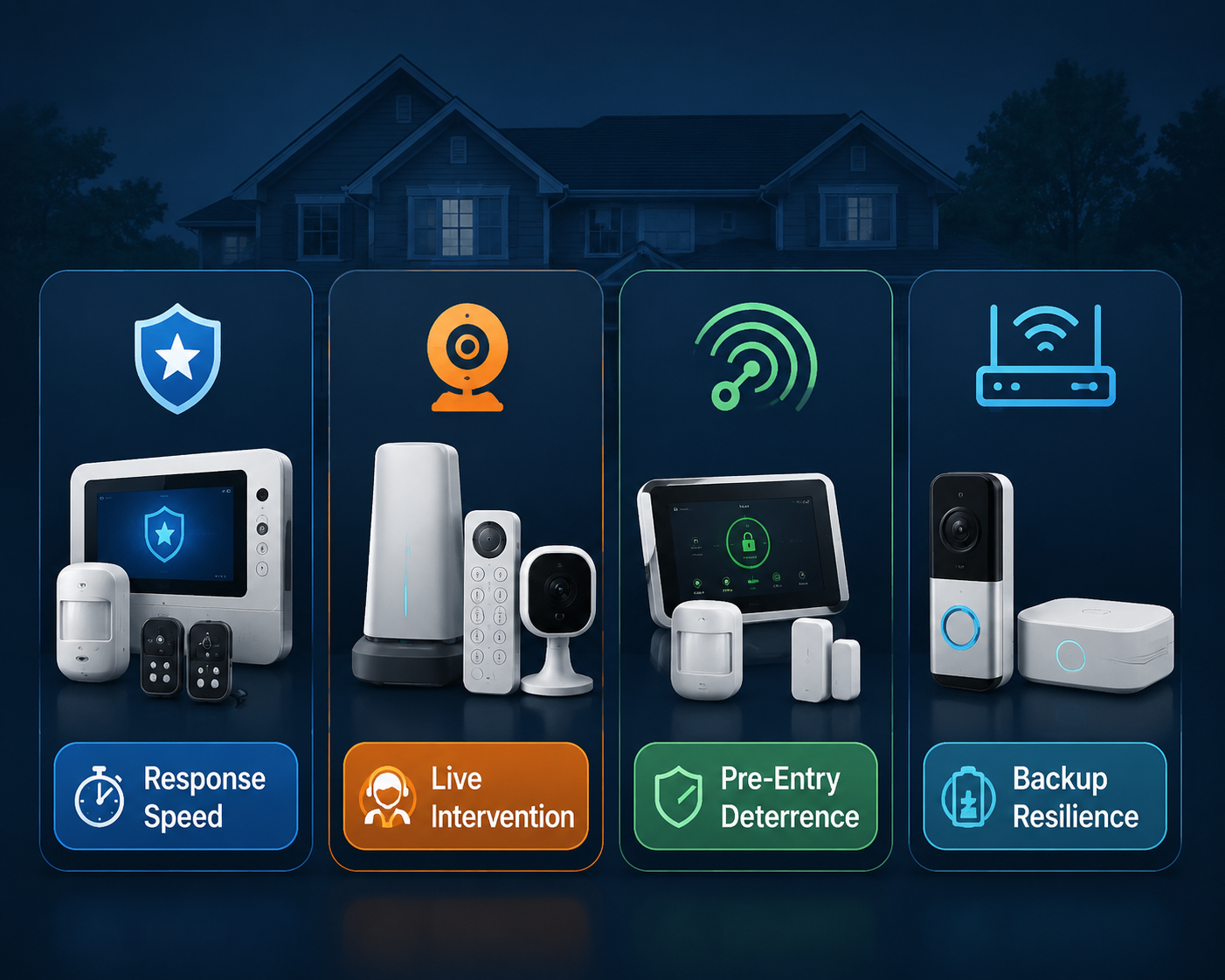
For an occupant-present scenario, the strongest chain has four parts: professional monitoring that answers in under 30 seconds, live-agent video intervention, cellular backup, and glass-break sensors covering likely entry points. On that narrower standard, ADT is the best pick for response speed, SimpliSafe is strongest for live-agent deterrence, Vivint is the most interesting pre-entry deterrence system, and Ring Alarm Pro is the better fit when backup connectivity and flexible response matter most.
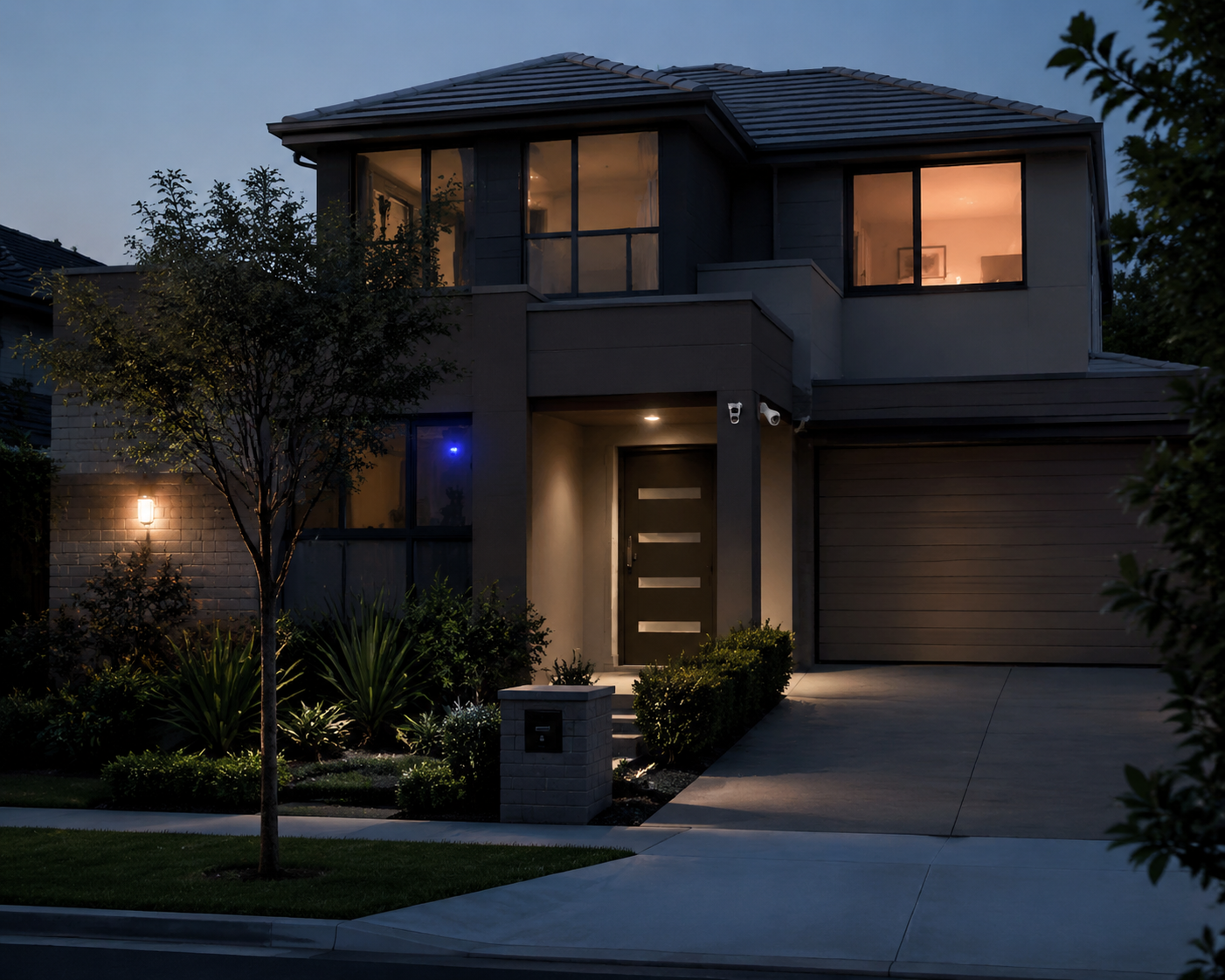
Home invasion protection is not the same as ordinary burglary protection
Away-mode burglary protection can tolerate a slower chain. A sensor trips, a siren sounds, a phone notification arrives, and the homeowner checks a clip from across town. That is still useful. It is just not the same problem as hearing glass break downstairs at night.
When people are home, the system has less time to be impressive and more need to be clear. The first minute matters: which sensor triggered, whether a camera can verify activity, whether a live agent can speak through the device, whether the monitoring center can reach the homeowner, and whether cellular backup keeps the system online if the internet fails.
The deterrence evidence is useful, but it should not be treated as fresh surveillance of today’s crime patterns. A UNC Charlotte study of convicted burglars, widely cited since the early 2010s, found that 83% said they checked for an alarm before attempting a burglary, 60% said they would seek another target if they saw an alarm, and only 13% said they would continue after discovering an alarm during the attempt.[1] That supports visible security as a deterrent. It does not prove that a yard sign, by itself, is enough when someone is already at the threshold.
A Rutgers study from the same era found that houses with monitored alarms were associated with 50% less property crime in their neighborhoods.[2] That is helpful context, not a complete answer for the person who needs the system to make a fast decision while they are inside the house.
The practical verdict
| System | Best for home invasion protection | Why it matters when someone is home | Main caution |
|---|---|---|---|
| ADT | Fast professional monitoring response | Security.org measured a 28-second average monitoring response in 2026 simulated break-in testing. | Response speed is only one part of the chain; camera verification and sensor placement still matter. |
| SimpliSafe | Live-agent intervention | Intruder Intervention lets an agent confront an intruder through an indoor camera within 12 seconds of an alarm trigger in Security.org testing. | Outdoor live intervention depends on plan and camera setup. |
| Vivint | Pre-entry deterrence | Smart Deter uses computer vision and radar to trigger lights and sirens when it identifies a lurker before entry. | AI detection can reduce delay, but it should not be treated as certainty. |
| Ring Alarm Pro | Backup resilience and customizable response | Its built-in Eero 6 router supports 24-hour battery backup and cellular internet backup. | It is stronger as an infrastructure-resilience choice than as the most forceful direct deterrent. |
ADT: the response-speed pick
ADT’s strongest home-invasion argument is simple: in Security.org’s 2026 testing, ADT averaged a 28-second monitoring response across simulated break-ins, the fastest measured result in that testing set.[3] In an ordinary burglary, 20 or 30 seconds can sound like a spreadsheet difference. In an occupant-present event, it is the difference between someone still deciding where to go and someone already trying to get children behind a locked bedroom door.
That speed helps most when the rest of the installation is built around the likely first triggers: contact sensors on doors, glass-break sensors near vulnerable windows, and cameras positioned where they can verify motion without turning the whole home into a surveillance project. Fast monitoring is not a substitute for good detection. It is what makes good detection useful under pressure.
ADT is the easiest recommendation when the buyer’s main fear is delay: an alarm event waiting in a queue, a notification missed on a nightstand, or a homeowner being unreachable because they are managing the situation inside. The system’s value is not that it makes the break-in impossible. It is that it shortens the time before a trained monitoring agent enters the sequence.
SimpliSafe: the live-intervention pick
SimpliSafe becomes more compelling when the question shifts from “Did the alarm sound?” to “Did anyone confront the intruder?” Security.org’s testing found that SimpliSafe’s Intruder Intervention allowed live agents to speak through an indoor camera within 12 seconds of an alarm trigger.[3] That is a different event from a siren echoing in an empty hallway.
The useful part is the interruption. A camera-verified agent can say that police are being contacted, that the person is being recorded, and that the home is monitored. For the occupant, that also means the system is not asking them to become the dispatcher, investigator, and negotiator all at once.
SimpliSafe’s outdoor Active Guard Protection extends this idea to outdoor cameras on the Pro plan, which Security.org listed at $49.99 per month in its 2026 coverage.[3] That plan detail matters because the best version of SimpliSafe’s home-invasion case depends on live agents seeing enough, early enough, to intervene. A cheaper plan may still be useful, but it may not deliver the same active-deterrence chain.
Vivint: the pre-entry deterrence pick
Vivint is strongest before the door or window gives way. Its Smart Deter feature uses AI computer vision and radar to detect a lurker and trigger visible deterrents such as lights and sirens before entry, according to Security.org’s 2026 system coverage.[3] In a home-invasion scenario, that timing matters. The cleanest win is the one that keeps the person outside.
This is where “AI” should be treated as a tool, not a promise. Computer vision and radar can help identify behavior that a simple motion alert might miss or over-report, but they do not eliminate ambiguity. A contractor, a neighbor, a delivery driver, and a genuine threat can all occupy the same patch of driveway for a few seconds. The value is that Vivint can create friction earlier in the event, not that it knows intent with certainty.
Vivint makes the most sense for homes where the vulnerable zone is outside the actual entry point: a side yard, a recessed front door, a dark driveway, or a ground-floor window that is partly shielded from the street. In those layouts, pre-entry deterrence can reduce how often the alarm chain has to begin with broken glass.
Ring Alarm Pro: the backup-resilience pick
Ring Alarm Pro is not the most aggressive direct-intervention system in this group. Its home-invasion case is resilience. The system combines a Ring alarm base station with a built-in Eero 6 router, and Security.org and SafeHome.org both highlight its backup design: 24-hour battery backup and cellular internet backup.[3][4]
That matters because home security increasingly depends on the same fragile home infrastructure everything else uses. If Wi-Fi drops, power fails, or the broadband line goes down, a system that can keep the alarm and internet connection alive has a real advantage. In the middle of a break-in, “offline” is not a minor inconvenience.
Ring’s customizable police response is also worth noting because it can reduce unnecessary dispatches and false-alarm fines, according to SafeHome.org’s 2026 system coverage.[4] That is not as dramatic as a live agent confronting someone through a camera, but it speaks to a real operational problem: the best dispatch is the one attached to a verified, actionable event.
Why glass-break sensors, video verification, and cellular backup belong together
Many buyers overbuild the camera layer and underbuild the entry layer. Cameras help explain what happened. Sensors tell the system that something has happened. For home invasion protection, especially at night, that distinction is not academic.
Door contact sensors are the starting point, but glass-break sensors close an important gap. A first-floor window, patio slider, basement window, or back door with glass can become the first alarm trigger without the door ever opening. If that trigger feeds into a monitored system with camera verification, the monitoring agent is working from a stronger signal than a generic motion alert.
The false-alarm problem is the reason this chain has to be more than “trip sensor, send police.” The Monitoring Association has stated that false alarms account for up to 99% of alarm dispatches.[5] That figure explains why many municipalities scrutinize alarm calls and why verified response rules vary locally. A system that can pair a glass-break event with video verification or live-agent review has a better chance of turning noise into a credible emergency.
Cellular backup is the quiet part of the system until it is needed. It keeps monitoring available when broadband fails, when a router locks up, or when a power event takes part of the home offline. A camera-heavy system without backup connectivity can look strong in the app and become much less useful during the exact event it was bought to handle.
How the first minute should unfold
A strong home-invasion setup compresses the first minute into a few clear handoffs. The sensor should trigger quickly. The system should identify whether the signal came from a door, window, glass-break sensor, camera, or outdoor detector. If video is available, a monitoring agent should be able to verify activity without waiting for the homeowner to wake up, unlock a phone, and interpret a clip.
- Before entry: Vivint-style pre-entry deterrence can use lights, sirens, and outdoor detection to interrupt suspicious activity before a door or window is breached.
- At entry: glass-break and contact sensors should trigger without depending on someone walking past an indoor motion detector.
- During verification: live video review or agent intervention can separate a real emergency from a pet, guest, or user error.
- During escalation: professional monitoring should move quickly enough that the homeowner is not the only person responsible for deciding what happens next.
- During an outage: cellular and battery backup should keep the alarm chain alive even if the home network does not cooperate.
This is also where privacy choices belong. Indoor cameras are useful for verification, but they should be placed deliberately: entry corridors, common areas, or locations that confirm an intrusion without recording bedrooms or private family spaces. More cameras do not automatically mean better protection.
What the crime statistics can and cannot tell you
Broad crime statistics can explain why people care about residential security, but they should not be used to turn a buying guide into a panic essay. SafeHome.org cites FBI data showing that 48% of violent crimes occur at a residence.[4] That does not mean a home invasion is likely for every household. It means residential settings are not outside the scope of violent-crime planning.
Security.org’s home security statistics also cite DOJ data showing that homes without dogs were 27% more likely to be burglarized.[3] That is interesting, but it should be kept in its lane. A dog may deter some offenders or create noise, but it does not replace monitoring, verification, cellular backup, or entry-point coverage.
The older offender-behavior studies still point in a consistent direction: visible security can change target selection. The more specific home-invasion question is what happens after visible deterrence is not enough.
Pricing should not be the first filter
Equipment discounts and monitoring fees change too often to make price the lead criterion for this kind of decision. Security.org and SafeHome.org pricing data from April through July 2026 is useful for comparing current plans, but promotional bundles, camera features, and monitoring tiers can shift quickly.[3][4] The plan detail matters most where it changes the security chain: live-agent intervention, outdoor video protection, professional monitoring, cloud recording, cellular backup, or verified response options.
A cheaper self-monitoring setup may look adequate on paper if the goal is to receive phone alerts. It is weaker when the homeowner might be half-awake, hiding, unable to speak, or already dealing with children or an elderly family member. In that moment, the useful upgrade is not another app notification. It is a monitored, verified, redundant path to action.
Which system should you choose?
Choose ADT if professional monitoring response speed is the deciding factor. The 28-second average in Security.org’s 2026 simulated break-in testing gives ADT the clearest measured advantage for buyers who want the monitoring center involved as quickly as possible.[3]
Choose SimpliSafe if live-agent intervention is the priority. Its 12-second Intruder Intervention result makes it the strongest option here for turning an alarm into an active confrontation through a camera, especially when the installation supports useful video verification.[3]
Choose Vivint if pre-entry deterrence matters most. Smart Deter’s computer vision and radar approach is best suited to homes where suspicious activity can be detected outside before the entry point is breached.[3]
Choose Ring Alarm Pro if backup connectivity and flexible response are the main concern. Its 24-hour battery backup and cellular internet backup make it the standout resilience choice, particularly for households that want the alarm system and home network to keep functioning through an outage.[3][4]
No single system wins every criterion. For home invasion protection, the right choice is the system whose strongest feature covers your weakest moment: speed, live intervention, pre-entry interruption, or backup connectivity.
References
- Understanding Decisions to Burglarize from the Offender's Perspective — UNC Charlotte
- Rutgers study finds alarm systems are valuable crime-fighting tool — Rutgers University
- The Best Home Security Systems of 2026 — Security.org
- Home Security Statistics 2026 — SafeHome.org
- False Alarm Reduction — The Monitoring Association